
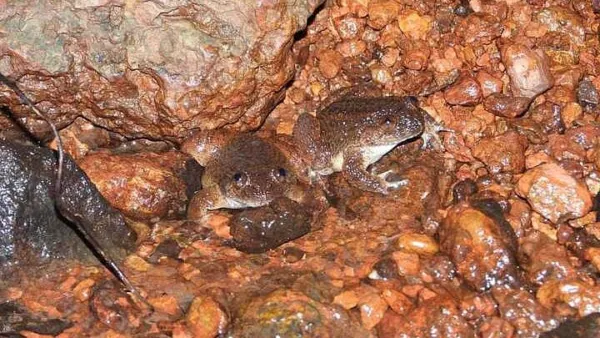

Hubballi: Researchers along with frontline staff of the forest department have discovered 35th night frog that is endemic to the Western Ghats.
The frog-- Nyctibatrachus kali (Kali Night Frog) -- has been named after river Kali and the Kali Tiger Reserve.
Kali Night Frog appears similar to Kumbara Night Frog, but DNA and call analysis revealed it to be a new species. The new frog has been described as a cryptic species as it appears similar to an existing species, but varies in DNA and acoustics.
Preeti, Assistant Professor at Manipal Institute of Technology (MIT) Bengaluru and lead author, said cryptic species are those that are morphologically similar but differ genetically. "During our amphibian survey in Castlerock region, we encountered a species that appeared similar to the Kumbara night frog, calls appeared to be similar too. However, Kumbara frog distribution was known from Sharavathi and Aghanashini regions of Karnataka which is at least 100 kms away. Research suggests night frog species have restricted distribution range."
Karnataka: Residents deprived of PNG connection in NanjangudShe said when genetics and acoustics were more deeply investigated, results showed that it was different species from Kumbara night frog.
Gururaja K V, Professor from Srishti Manipal Institute of Art, Design and Technology, MAHE, Bengaluru, gives the credit of discovering the 35th night frog species to the frontline staff of the forest department. "It is interesting to note that citizen scientists are part of this discovery, and we have a long way to go in this direction as conservation needs collaboration with people, practice and policy."
He says there of 9027 species of amphibians known across the globe of which, 474 species are reported from India. "However, nearly two out of every five species of amphibians are facing the threat of extinction, both globally as well as in India. Habitat loss is one of the major threats for the global amphibian decline. In addition, climate-change and diseases are also contributing to the current loss of species," he says.
Preeti says : "It is evident that Karnataka's forests and its streams support the diversity of night frogs and more research should be supported and funded to understand on the ecological factors that influence its distribution, how forest streams support the breeding of Kali frog and map the threats to its distribution."
The team consisting of Aravind C K PhD scholar at MIT and forest staff C R Naik and Ramesh Badiger.
Their discovery was published in PeerJ, an international journal recently.