




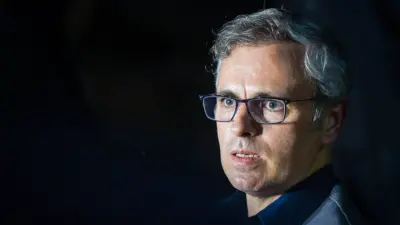

Srinagar: Two years into Omar Abdullah's second stint as Jammu and Kashmir chief minister, the political question is changing.
It is no longer simply whether his government has fulfilled its promises.
The more consequential question is whether an elected government under Union Territory (UT) can turn the limited space available to it into visible governance - while holding together its political base and negotiating effectively with New Delhi.
That makes the next three years more important than the first two.
The recent Assembly confrontation over statehood brought the central contradiction into sharp focus. Omar pushed through a resolution seeking immediate restoration of statehood, while a subsequent dispute over the role of senior officials in questioning aspects of the resolution exposed the continuing ambiguity over where political authority ends and administrative authority begins.
Former J&K finance minister Haseeb Drabu argues that the post-2019 system has created an unusual democratic arrangement in which an elected legislature operates alongside an administrative structure in which the Lieutenant Governor remains central to executive authority. Former J&K interlocutor Radha Kumar has described the elected government's effective powers as "precious few".
Centre not serious about J&K's statehood restoration: Farooq AbdullahThat is a legitimate structural constraint. But it cannot become an explanation for every shortcoming.
The clearest pressure point is employment. JKPSC and JKSSB received 21.12 lakh applications for 15,964 posts between 2023 and 2026, collecting about Rs 114 crore in application fees. JKPSC advertisements fell from 2,586 posts in 2023-24 to 357 in 2025-26, while JKSSB advertisements fell from 5,044 to 1,731.
For educated young Kashmiris, this is a more immediate measure of performance than the constitutional debate. That is why Mission YUVA could become Omar's most important economic experiment. The programme aims to create 1.37 lakh enterprises and 4.25 lakh employment opportunities over five years. By August 31, the government said more than one lakh applications had been received, with Rs 1,996 crore sanctioned and Rs 1,769 crore disbursed.
But the real test begins after the loan is disbursed. Can a young entrepreneur keep a business alive for three years? Can it employ people beyond its founder? Can enterprises in food processing, horticulture, tourism, technology and services find markets outside J&K? Those questions will determine whether Mission YUVA becomes an economic transition or simply another government scheme.
J&K cannot indefinitely rely on government employment and tourism as its two principal escape routes from unemployment. The April 2025 Pahalgam attack demonstrated how vulnerable the tourism economy is to security shocks. The next phase, therefore, requires a broader private economy, with investment in value-added horticulture, food processing, manufacturing, technology, logistics and services. That also requires the government to move beyond credit schemes towards easier regulation, reliable infrastructure, market access and predictable policy.
The other major test is political cohesion. Firebrand MP Aga Ruhullah's increasingly sharp criticism matters not merely because one National Conference parliamentarian is unhappy. His challenge exposes competing expectations within the constituency that brought Omar to power. Ruhullah has criticised the government over reservation and described his departure from the NC as a 'foregone conclusion'.
The reservation issue is particularly combustible because it concerns access to education and government employment. A recent Assembly debate over EWS certificates has added a regional dimension, with People's Conference chief and MLA Sajad Lone questioning the distribution of certificates between Jammu and Kashmir.
Omar faces a difficult choice. Reforming the reservation architecture could alienate groups that benefit from it; leaving it untouched could deepen resentment among open-merit aspirants.
The Cabinet offers another opportunity. A much-discussed reshuffle has yet to materially change that structure. Its significance is not the number of ministers. It is whether Omar uses the second half of his term to build a government around performance and accountability. The vacant Deputy Speaker's post and the continuing debate over five nominated Assembly seats show that J&K's post-2019 political architecture is still evolving.
The relationship with New Delhi remains the backdrop to all this. Omar has chosen negotiation alongside disagreement. That will be tested by how much political and administrative space New Delhi is prepared to give his government and by whether Srinagar can convert that space into results.
There is a potential bargain here. New Delhi needs an elected government that can demonstrate political normalisation; Omar needs enough room to show that such a government can deliver.
Security should remain outside Omar's political credit column. The improvement in the security environment is principally the product of the Centre's security architecture and the work of the armed forces, police, and intelligence agencies.
By the next election, voters are unlikely to judge Omar only on constitutional questions. They will ask whether recruitment became more credible, whether businesses survived, whether reservation became fairer, whether ministers delivered and whether the government became more responsive.
The first two years were about restoring elected politics to Jammu and Kashmir. The next three will be about proving that an elected government, even without the full powers of a state, can turn political representation into better jobs, stronger institutions and more responsive governance.
By 2029, that will be the measure of Omar Abdullah's second term.