
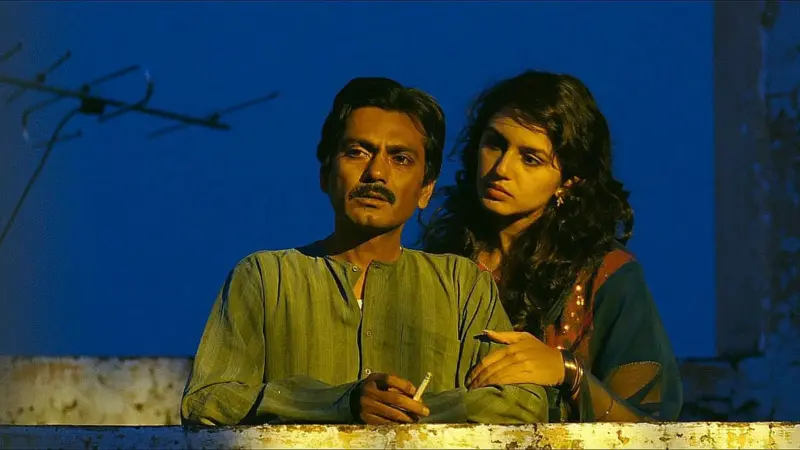

Aditya Dhar did not sit down to make 'a two-part film'. He sat down to make 'a film'. Then he shot seven hours of footage and someone had to make the call.
That call, made on the edit table in October 2025, turned 'Dhurandhar' into a duology. The original plan was one long film. The footage, the scale, and the narrative complexity made that impossible without the story feeling rushed. So 'Part 1' released in December 2025, 'Part 2' followed in March 2026, and the rest, as they say, is box office history.
The result has sparked a conversation about whether big-budget Indian cinema has found its next big trick. Or just remembered something from the history books that once worked.
In 2012, Anurag Kashyap screened a five-hour film at the Directors' Fortnight section of the Cannes Film Festival. The audience sat through the whole thing. Then came the question of releasing it commercially in India, where no multiplex was going to give one film a five-hour slot. Both parts of 'Gangs of Wasseypur' released the same year, each roughly 150 minutes, made for under 2 million dollars combined. The split was pragmatic, not strategic. It was never about milking a franchise. The material was strong enough that the container didn't matter.
Even 'Ponniyin Selvan', Mani Ratnam's adaptation of Kalki Krishnamurthy's five-volume novel, was shot as two parts from the start because the source material simply demanded the space. Both parts released in 2022 and 2023 to critical and commercial success. Then came the more surprising case: Hemanth M Rao's 'Sapta Saagaradaache Ello' (2023), a quiet Kannada love story split into 'Side A' and 'Side B'. No epic battles, no star-studded ensemble. Just a story that needed two sittings to land. It did.
Fast forward to 2024. 'Indian 2', directed by Shankar and starring Kamal Haasan, had been in production since 2019. Five years, an on-set accident that killed three members of the crew, a legal dispute between the director and producers, and a budget that started at Rs 235 crore and ballooned past Rs 500 crore. The film was split in two out of necessity rather than vision. Released in July 2024, the film was a critical and commercial disaster, barely crossing Rs 150 crore worldwide. 'Indian 3', with 80% of its footage already shot before 'Part 2' even hit theatres, remains in limbo.
Even Kashyap wasn't immune to the temptation. His recent crime comedy 'Nishaanchi' was originally conceived as a streaming release for Prime Video. Riding on 'Wasseypur''s long shadow, the decision was made to split it and release the first part theatrically. It collected less than
Rs 2 crore at the domestic box office. Those who appreciated the film preferred watching it in one sitting, either at trial screenings or when both parts released together on OTT. The lesson Kashyap drew from
'Wasseypur' - that a split can work - turned out to be the wrong one. The split worked because the film worked. Not the other way around. Two Indian films, both split in two. One is a classic. One is a cautionary tale. The difference was never the strategy. It was the material.
Hollywood has been having this conversation far longer. In 1973, 'The Three Musketeers' was shot as one film and split into two without telling the cast. The director got sued because the actors had only been paid for one film but found out they had effectively made two. 'Kill Bill' was one film until Harvey Weinstein walked into the edit room and found a four-hour cut. Tarantino's options were cuts or a split. He chose the split. With a combined budget of 60 million dollars, both volumes went on to earn over 330 million dollars. Tarantino still calls it one film. The rest of the world paid for two tickets.
'Harry Potter: Deathly Hallows' validated the model, grossing a combined 2.31 billion dollars. 'Twilight: Breaking Dawn' followed with 1.54 billion dollars. Then 'Divergent: Allegiant' grossed 179 million dollars and never got its Part 2 made. The formula needed the audience to care enough to come back.
The gold standard is 'Dune' and 'Wicked', where the split was a creative decision made before a single frame was shot. Director Jon M Chu announced the 'Wicked' split in April 2022, during pre-production, saying it had become impossible to wrestle the story into a single film without doing damage to it. 'Part 1' grossed over 680 million dollars with a 92% critics score. It worked because the story was built for it from the start.
'Dhurandhar' worked for the same reason. One story, not two half-stories stitched together. When 'Part 1' ends, one doesn't feel cheated. One feels interrupted. That distinction is what most two-part films get wrong. Reports suggest both Shah Rukh Khan's 'King' and Sanjay Leela Bhansali's 'Love and War' are weighing a similar split. A final call on both, reportedly, will be taken on the edit table. The edit table. That is where 'Indian 2' made its call too.
Every split that worked - 'Wasseypur', 'Kill Bill', 'Dune', 'Wicked', and 'Dhurandhar' - earned its length through the story. Every split that failed was running from its own excess. 'Dhurandhar' was a happy accident. The danger is in assuming the accident was the plan. Someone always finds out. Usually on the edit table.