





Since the pandemic, ordering online has slipped effortlessly into the rhythms of everyday life. Not just food or groceries, but house cleaning, body massages, airport drops and office commutes are now summoned with a few taps on a smartphone.
Convenience has become habitual, almost invisible.
Yet, as consumers - the self-styled "prevailing gods of the e-commerce ecosystem"- we rarely pause to consider what lies beneath the surface of this frictionless world: the labour, risk and uncertainty that power the swift delivery of goods and services.
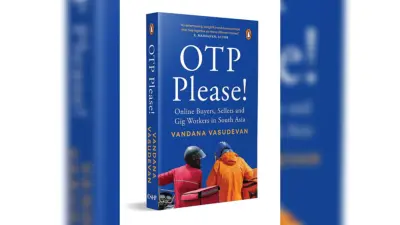
In her exhaustively researched book OTP Please, Vandana Vasudevan turns the spotlight on the people who inhabit the gig economy - sellers, workers and consumers - across India and South Asia. Drawing on a year-long investigation and hundreds of interviews, she captures a society in the midst of a quiet but profound transformation. Technology, she observes, is reshaping how we buy, eat, travel, work and sell, altering not just markets but the emotional fabric of everyday life.
What distinguishes OTP Please is its unwavering focus on the human element. At its heart are gig workers who labour for long hours under precarious conditions so that the wheels of digital commerce keep turning. Vasudevan structures her narrative around emotions that cut across borders and job descriptions - Pleasure, Guilt, Gratitude, Anger, Freedom, Oppression, Anxiety, Isolation and Courage. This inventive framework allows her to explore the gig economy not as an abstract system, but as a lived experience shaped by hope, frustration and resilience.
One might wonder why the book avoids a country-by-country structure. Vasudevan explains that the similarities were too striking to ignore. Whether in India, Bangladesh or Sri Lanka, the stories echoed one another so closely that they demanded to be woven together, revealing a shared regional reality rather than isolated national ones.
Her canvas is expansive and often unsettling. We see global e-commerce giants deploying clever strategies that quietly erode local businesses; small sellers squeezed by shrinking margins on digital platforms; cab drivers and delivery riders clocking punishing hours, navigating opaque algorithms while risking life and limb. There are women in beauty services dealing with rude and demanding customers, and warehouse workers trudging up and down multiple floors without fans, hauling trolleys to fulfil online orders. These are lives largely invisible to the end user, yet central to the promise of instant gratification.
One of the book's most revealing insights concerns income decline as the principal source of anger among gig workers in India - the largest market examined. High platform commissions, rising fuel costs, oversupply of labour and mounting debt have pushed many into distress. For those who entered the sector with high hopes, the eventual disillusionment cuts deep, leaving a lingering sense of betrayal.
In the chapter on 'Anger', Vasudevan also turns her attention to the app itself - the backbone of the gig economy. She documents how systems fail at critical moments, a frustration familiar to most users. Drawing an unexpected parallel with NASA's Mars Climate Orbiter disaster, she reminds readers that even the most advanced technologies are fallible, their consequences magnified when human livelihoods depend on them.
Yet OTP Please is careful not to paint the gig economy in monochrome. Vasudevan records stories of empowerment and possibility. Across South Asia, new forms of work have given many women financial independence and agency. For people with physical disabilities, ride-hailing apps have opened up mobility and autonomy. The elderly and those with limited movement now travel with greater ease, avoiding chaotic traffic and unsafe footpaths.
Still, the book does not shy away from the hidden costs of this "easy living". One of the most corrosive effects, Vasudevan pinpoints, is social isolation - the quiet disappearance of everyday interactions with neighbours and local kirana stores. Add to this unhealthy routines, disrupted sleep cycles and an erosion of traditional food cultures, and the conveniences of the gig economy begin to look far less benign.
Informative yet intimate, anecdotal yet balanced, Vasudevan's reportage illuminates the digital age we inhabit: the logic of algorithms, the 'atomisation' of workers, Gen Z's YOLO-driven consumption patterns, and phenomena like nocturnal snacking enabled by late-night delivery apps.
In a particularly poignant passage, she reflects on how work once meant belonging - to an office or factory alive with human exchange. Gig work dismantles this idea, replacing it with solitude and placelessness. Workers belong everywhere and nowhere at once. This, Vasudevan suggests, is the brave new world millions are being asked to adapt to - one OTP at a time.