




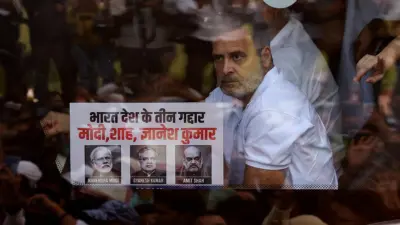

Congress leader Rahul Gandhi's protests have shifted from large rallies of party supporters planned weeks ahead to surprise actions designed to catch eyeballs.
The new tactics first appeared in July, during the Gen-Z protests, when Congress MPs gathered to celebrate party president Mallikarjun Kharge's birthday and unexpectedly marched to 7, Lok Kalyan Marg, the prime minister's residence.
In August, Rahul Gandhi and his sister Priyanka Gandhi Vadra staged a sit-in at Parliament Street police station to ensure the police registered an FIR by a student whose eye was injured by a police pellet gun. More recently, eyeballs caught him climbing a police barricade and waving the tricolour. This was followed by an impromptu decision by the siblings to enter Akashvani Bhavan and convert it into a protest site after police blocked the route to the office of the Election Commission of India (ECI).
A day later, a lunch gathering of over 100 Opposition MPs in Connaught Place turned into a surprise march to Jantar Mantar against Chief Election Commissioner (CEC) Gyanesh Kumar. When police stopped the MPs, Priyanka Gandhi lay down on the road, producing viral posts and reels. The lunch turned into a six-hour protest, and a police bus ferrying the protesting MPs to a police station took two-and-a-half hours to cover a distance of barely 10 minutes. Thousands of reels would have been made in that time.
Reportedly, at a closed-door meeting of party functionaries on October 5, Rahul Gandhi urged them to devise out-of-the-box protest techniques with an element of surprise and shock value. He reportedly cited the instance of Youth Congress workers staging a 'shirtless protest' at the global AI Summit organised by the Narendra Modi government in February that took media attention away from the event.
Improvisation and street-level politics may in fact be a useful strategy for an embattled Opposition stymied by the ruling party's overwhelming strength in Parliament, to raise political issues.
Rahul Gandhi's own body plays a part in conveying the message of civil disobedience: sitting outside the prime minister's residence or lying on the road as police grapple to remove him by force, climbing on police barricades with the national flag, or resisting with his body as he is pushed into a police vehicle. While a young protester may be pushed, dragged or detained with little institutional consequence, doing this to the Leader of the Opposition, surrounded by MPs and TV cameras, can carry severe political costs. Both he and the police are well-aware of this. It forces the government into a policing dilemma. Blocked from the protest site, detained or dragged by the police, Rahul Gandhi becomes the story and an abiding political image.
The availability and reach of mobile cameras have changed the economy of policing since the July student and youth protests. After visual recordings of brutal treatment of youngsters with tasers, spiked batons and pellet guns were publicly circulated, the Delhi Police seem to have realised that power is harder to use when they are themselves under surveillance by thousands of protestors recording their actions on mobile cameras.
As recordings of visible coercion can lead to accountability and scrutiny, the police have been pushed to adopt less visually damaging forms of control. The formulaic strategy of batons and tear gas to disperse protestors has given way to barricades, containment, detention, and FIRs. Some personnel have been issued bodycams, and frontline police no longer carry batons or weapons, although occasionally name tags are still missing when in action.
Rahul takes centre stage of street politics in protest against CEC Gyanesh KumarMoreover, the State no longer has a monopoly over the record of coercive force, particularly before the law. The police can no longer assume that the only visual record of violence is their own. Perhaps Rahul Gandhi is moving into a political space and practice created by the Gen-Z protests.
How do these guerrilla-style protests differ from earlier party rallies? For one, they draw far greater attention. A large conventional rally speaks to people who are already supporters or have been bussed-in or paid to attend. Any confrontations with the police en route draw little or no attention. By contrast, Rahul Gandhi's video waving the tricolour from a police barricade on October 6 crossed 2.7 million Instagram views in just three hours, on one platform and from one post.
Such protests also turn abstract claims ('The CEC is manipulating electoral rolls', 'ECI is not independent', 'SIR is vote-theft') into a visual image. As a visual vocabulary is built gradually through social media reels, people can grasp the meaning behind 'vote-chori' and 'Gyanesh, you are done bro'.
Because these posts stay in circulation, the narrative outlives the event. Public participation no longer requires physical presence; watching videos does the job, and reels draw more attention than a one-time rally can. The message is economical as it reaches people who would never attend a party rally. As it speaks to the language of Gen Z, it is likely to attract younger citizens as well.
In effect, a political protest is no longer about a mass gathering at one site but a confrontation that creates dramatic optics, captured on camera, and spread online. These images of confrontation with the State machinery become more powerful than a speech in Parliament or at a rally. Once they become viral, government control over the 'Godi media' or mainstream media weakens as they too must follow them.
Performative protests, however, have a serious downside. Memorable, camera-friendly confrontations alone are not sufficient to convert public attention into popular belief. 'Vote-chori' must become more than a highly recognisable slogan for the Congress. It will have to become a deep-rooted conviction among the masses. The protests must be accompanied by party cadre helping citizens whose voting rights have been denied by documenting their problems and getting them re-registered as voters. Only when that is done on as large a scale as possible and in a non-partisan manner - by helping even those who are outside the Congress ecosystem - will the narrative acquire political durability and pay electoral dividends.
The Congress' 'Vote Bachao, Desh Bachao' campaign attempts to do this: party workers have apparently been asked to identify people whose names are missing from the rolls and help restore them. Providing this service should be the sequel to the visible protests.
For the message of theft of democracy to endure, the party organisation at the ground level will have to put its shoulder to the wheel. It will also have to work harder with allies who have deep and strong political organisations but may feel left out of the limelight with Rahul Gandhi's new improvisational style.
Bharat Bhushan is a New Delhi-based journalist. (Disclaimer: The views expressed above are the author's own. They do not necessarily reflect the views of DH.)