




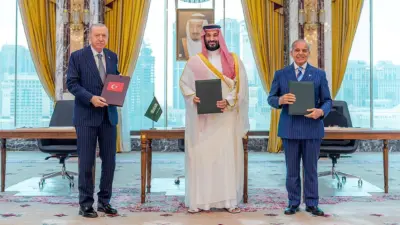

The Türkiye-Saudi Arabia-Pakistan defence alliance, signed in Mecca, Saudi Arabia, earlier this month, is quintessentially a defensive pact insofar as it has no target in its crosshairs - certainly, not Iran - and its thrust is unmistakably on strategic self-reliance.
If one of the constituent states is a NATO power and another a nuclear power, let's say, that is happenstance.
The 'losers' here are two protagonists, namely, the United States, and Israel, which has deeply troubled relations with Türkiye and which Tel Aviv belligerently declared to be its next existential enemy after Iran. The Mecca pact buries the Abraham Accords, and will ostracise Israel unless and until it becomes a normal country.
On the other hand, the alliance opens new possibilities for reconciliation, even amity, with Iran once the war clouds disperse. It signifies a dawn marking the waning of the US' global hegemony. We are entering a transitional phase where the US remains the dominant military power and may remain so for a while - that is, assuming its economy does not pack up.
Therefore, right at the outset, it needs to be underscored that, from an Indian perspective, there is no reason for the political leadership to panic. Certainly, such a belligerent posturing ("We will go after them") by National Security Adviser Ajit Doval on the Discovery TV channel was best avoided as it grates against the zeitgeist - and creates misconceptions coming so soon after US Vice-President J D Vance's tantalising invitation to Prime Minister Narendra Modi, possibly in knee-jerk reaction to the Mecca pact, to deepen the US-India 'Global Partnership' and jointly meet 'security challenges' in the emergent regional and international environment.
At all times, it is a bad diplomatic move to indulge in muscle-flexing, and in the case, it borders on the burlesque, reminiscent of the famous scene in Miguel de Cervantes' novel Don Quixote, widely considered the first modern novel, where the deluded hero obsessed with chivalric romances, mistakes a field of 30 to 40 windmills for ferocious giants and ignoring his pragmatic squire, Sancho Panza, Don Quixote charges on his horse and gets violently knocked downby the rotating sails, later claiming an enchanter turned the giants into mill.
On a serious note, the Mecca pact is unlikely to yield any meaningful military action in the foreseeable future. Please note that a similar agreement signed between Saudi Arabia and Pakistan before the US-Israel war on Iran began in February did not prevent Tehran from attacking Saudi Arabia, nor did Pakistan intervene militarily on its ally's behalf.
In the cacophony of drum-beating, what is lost is that the agreement's main significance may be economic and diplomatic initiative dovetailing into a pointing broader push in recent years to establish trade routes linking the Far East and Middle East with Europe (eg., India-Middle East-Europe Economic Corridor or IMEC, an Israeli initiative duly unveiled at the September 2023 G20 Summit in New Delhi by then US President Joe Biden and Modi). Türkiye and Pakistan were uncomfortable with the India-Saudi Arabia-Israel-Greece transportation corridor with American blessing, which was at the conceptual core of the IMEC.
Türkiye's Transport Minister Abdulkadir Uraloglu recently said that Türkiye plans to build a railway with Saudi Arabia connecting the two countries via Jordan and Syria and that other Persian Gulf states could eventually join the route, creating a corridor leading to Türkiye that would bypass Israel.
For sure, with the collapse of the 'rules-based order' imposed by the West, we are entering a new era which gives countries, especially the middle powers, an unprecedented level of freedom to form alliances to safeguard or advance their specific interests. The withering away of the US-sponsored Abraham Accords bears testimony to this new geopolitical reality.
As for Türkiye, the pact represents a show of strength and the culmination of a years-long effort to deepen its ties with the Arab and Muslim world. Türkiye is eager to demonstrate that despite its NATO membership and alliance with the US, it remains committed to a multipolar world order, rather than being dictated by a single superpower, allowing regional countries greater freedom to manoeuvre in international diplomacy. Beijing's assessment is almost the same.
In an important editorial comment, the Chinese communist party tabloid Global Times pooh-poohed the notion of the Mecca pact being a 'NATO-style' platform of collective security. Calling the pact "essentially a turbocharged evolution of last year's mutual defence pact between Riyadh and Islamabad", the commentary goes on to predict that "this blueprint is bound to redraw the regional map. It pushes Gulf capitals away from rigid, single-pole dependence and toward a multi-source balancing act, while giving Turkey a fast-track path from peripheral NATO member to core security architect in the Islamic world."
The commentary ponders: "Step back, and a much bigger picture comes into focus: As Middle East conflicts spiral, regional countries are waking up to the fact that they can no longer rely solely on US security guarantees, even if an alliance with the US is unlikely to crumble in the near future… Rather than keeping its faith in a US umbrella that leaks whenever it storms, Riyadh has decided to hedge its bets ... a blunt, public verdict on just how much the US security umbrella is truly worth today."
The commentary concludes with an interesting thought with an eye on the Thucydides Trap: "Washington (is) backed into a classic geopolitical dilemma: Double down with ironclad security guarantees, and the US completely torpedoes its own strategy of military retrenchment. Look the other way and shrug, and its remaining grip on the region slips through its fingers, leaving the US to watch a multi-polar Middle East spin permanently out of reach." Was it a mere coincidence that Vance's call to Modi came soon after the Global Times commentary appeared?
Jettisoning tunnel vision and eruptions into paroxysmal outbursts of frustration over India's growing regional isolation and the colossal breakdown of diplomacy, policymakers in New Delhi ought to weigh in on the big picture: the tectonic plates of West Asian geopolitics are shifting inexorably toward self-reliance and multi-polarity. And that is something India not only ought to welcome but also tap into for its potential as a factor of peace and regional security.
M K Bhadrakumar is a former diplomat.
(Disclaimer: The views expressed above are the author's own. They do not necessarily reflect the views of DH.)