
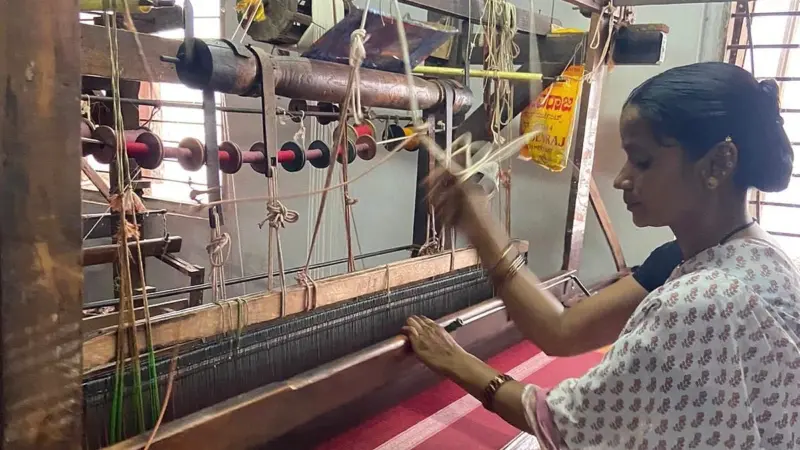

Fieldwork rarely follows a straight line. It meanders, guided as much by instinct as by intent. During an ethnographic study on natural dyes in Karnataka, one such instinct led me to the town of Moodbidri, an unexpected site that revealed the fading traces of a little-known textile tradition.
As I moved through the town in Dakshina Kannada and engaged in conversations with local people, my curiosity led me to a few Jain households. In one such home, almost hidden in a corner, I noticed a small pile of old saree rags - faded, frayed and repurposed for cleaning. They seemed ordinary, nearly invisible. But something about them made me pause.
A closer observation revealed faint structural details: parallel threads and intersecting checks, patterns that had survived wear and time. The fragments, though reduced to utility, carried the remnants of a once-distinct weave. These were Sudha Kadi sarees, a traditional weave of Dakshina Kannada.
Craft beyond nostalgiaThere was something deeply moving about that moment. A saree that once held meaning and identity had slipped into anonymity, its story surviving only in memory and fragments. Yet, even in that condition, it had not completely disappeared.
The Sudha Kadi saree is defined by its simple yet profound design: two parallel lines run along the border, while the body is composed of weft threads intersecting these lines forming a chequered pattern that creates the illusion of connection. The parallel lines are said to represent the paths of sunrise and sunset, moving alongside each other, never meeting. It is perhaps this that gives the saree its name. "Sudha" evokes a fleeting, almost sacred moment of transition, while "Kadi" refers to the lines that structure the weave. Together, they form a textile that is as philosophical as it is functional.
Further inquiry in Moodbidri led me to a more intact Sudha Kadi saree preserved in a Digamber Jain household. Unlike the earlier fragments, this piece retained its full form. Its lines were defined and its checks intact.
An everyday wear
Research through archives and conversations revealed that such sarees were common in Dakshina Kannada region during the 15th century. It was an everyday wear and was mostly worn by local farmers and labourers. It was specifically worn by married women.
It was mostly woven by the Devanga community weavers in Moodbidri, Bantwal, Puttur, Bajpe and Vitla areas. Over time, however, industrialisation and the rise of powerloom textiles led to their decline.
Cheaper, more durable alternatives replaced handwoven cottons, and with changing aspirations, these quiet weaves were gradually set aside. Today, the weaving of these sarees is almost nil in these two regions.
Woven into life: The quiet legacy of Haigala MeliWhat remains today are scattered traces: an old saree preserved in a home, a few fragments tucked away, and a
memory carried in stories. The craft itself is no longer practised. The looms that once created these patterns have fallen silent.
For me, this journey became something more than research. I had never visited Moodbidri before, yet it existed vividly in the stories of my maternal grandmother Ratana Aaji. She had once spoken of leaving her maternal home after her wedding as a loss. Yet here I was, finding my way back through her words, through memory, through a saree that refused to be forgotten.
Today, as I continue to document, catalogue and revive the sarees through my Punarjeevana Trust, Sudha Kadi becomes part of that archive. Not just as a textile, but as a story of movement, separation and quiet continuity.
(The author is a textile revivalist)
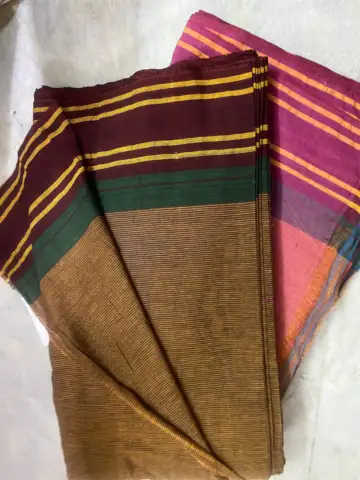
Sudha Kadi sarees.
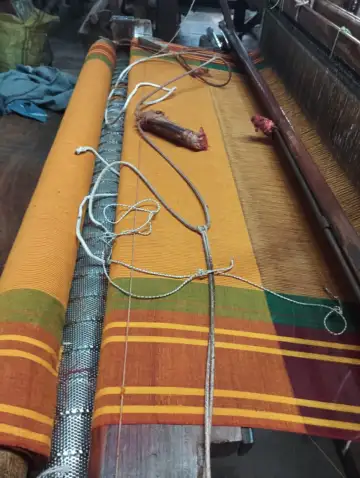
A Sudha Kadi saree getting ready on the loom.