
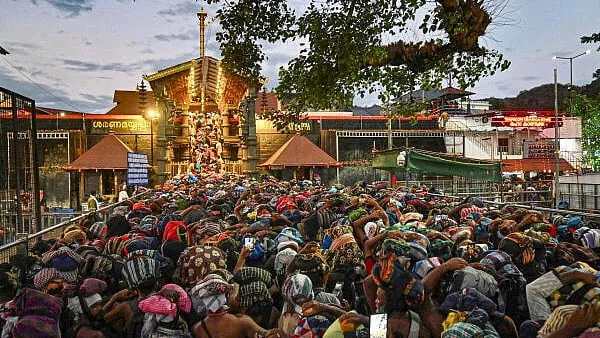

New Delhi: The Union government on Thursday submitted before the Supreme Court that the top court's 2018 judgement in Sabarimala case proceeded on the assumption that men are superior and women are on a lower pedestal.
A nine-judge bench led by Chief Justice of India Surya Kant, however, cautioned against practices that restrict access to places of worship on denominational grounds and orally observed that it would be "dividing the society".
Continuing the submission on restriction on the entry of women of menstruating age into the famous Kerala's temple, the Centre through Solicitor General Tushar Mehta said that there were instances of temples even where men are not allowed, as there were certain faiths and beliefs attached.
Woman can't be treated as 'untouchable' for 3 days: Justice B V Nagarathna in Sabarimala case"There are temples, where male priests are under a religious mandate to wash the feet of female devotees. There are temples like the Pushkar temple, the only Brahma temple in the country, where married men are not allowed," he said.
Narrating the way and manner in which the practice was done, Mehta said that there was also a temple in Kerala where the practice is that men enter dressed as women. "They go to beauty parlours, and their female family members help them dress in sarees and other attire. Only males go there. So it is not a question of male-centric or female-centric religious beliefs. In the present case, it happens to be woman-centric," he contended.
During the hearing, the bench orally observed that Hinduism's inclusive spirit must not be undermined by exclusionary traditions, saying, "it will affect Hinduism negatively, and everybody must have access to every temple and mutt".
'Religious faith beyond judicial review': Centre backs restriction on women's Sabarimala entry in SCThe bench was hearing petitions related to discrimination against women at religious places, including the Sabarimala Temple in Kerala, and on the ambit and scope of religious freedom practised by multiple faiths.
The bench also comprised Justices B V Nagarathna, M M Sundresh, Ahsanuddin Amanullah, Aravind Kumar, Augustine George Masih, Prasanna B Varale, R Mahadevan, and Joymalya Bagchi.
Senior advocate C S Vaidyanathan, appearing for the Nair Service Society, Ayyappa Seva Samajam, Kerala Kshetra Samrakshana Samiti, and others, submitted that even the court cannot go into whether it is an essential part of religion or not because the state is prohibited.
"Secular authority of the state is prohibited from going into whether it is an essential part of religion, if this is the belief of the community, the judge is bound to accept that belief, it is not for him to sit in judgement on that belief. He has no right to interfere with the conscience of a donor, who makes a gift, etc," he said, citing a previous judgment.
"These observations afford an indication of the measure of protection that is given by Article 26 (b)," he added.
On this, Justice Nagarathna, however, said, "There is one apprehension, keep aside the controversy in Sabarimala. If you say this right of entry in the context of Venkataramana Devaru, where they said anybody other than Gowda Saraswath Brahmin is excluded. It will affect Hinduism negatively. Everybody must have access, regardless of the controversy in Sabarimala. Everybody must have access to every temple and mutt."
"But, if you say it is a practice, it is a matter of religion. Only my denomination must attend my temple, and no one else. That is not good for Hinduism. Keep that in mind," she said.
Justice Kumar said, "You will be dividing the society". Justice Nagarathna agreed with Justice Kumar's observation, saying "let the religion not be adversely affected".
It was argued before the bench that there are private temples, and if they want to have it only for a denomination, they can't seek funds either from the state or from private donors, or from the public, because they are not dependent on footfall from others.
Justice Nagarathna said that would be counterproductive for that denomination.
Vaidyanathan replied that it is a matter for them to decide, and the apex court would have to look at whether it is contrary to public order, morality, and health.
Justice Nagarathna said, "Generally, if you say only persons of Gowda Saraswath must come to this, followers of Kanchi mutt must go to Kanchi, followers of Kanchi mutt should not go to Sringeri. Followers of Sringeri… see, the greater the people go here and there, the strength…access to temples."
Vaidyanathan said ordinarily that is the reality and that is why it cannot happen, and he is conscious of it, and this is a matter which should be taken note of by every denomination and then take a decision.
Justice Nagarathna observed that the state can step in under Article 25(2)(b) to ensure access to the temple for all sections. Justice Kumar, referring to senior counsel's argument that Article 26(b) supersedes Article 25(2)(b), added, "That is why we said, don't pitch it too high."
Mehta, representing the Centre, contended that he filed a written submission and gave instances where men are not allowed in temples.
The hearing in the matter will continue on April 15.