




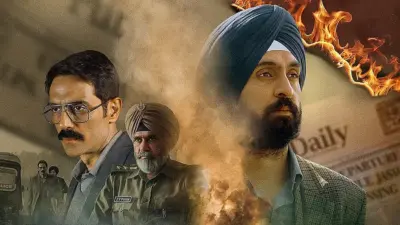

The allure of banned films often achieves the opposite of its intent. That is precisely what is happening with Satluj, pulled down by the government 48 hours after it released on ZEE5. It is now freely available online, and screened in gurudwaras across villages in Punjab.
Although not legally 'banned', 127 cuts were demanded by the censor board for the film's certification. After a four-year battle with the board, the filmmakers changed its name and released the uncut version on ZEE5. Reports suggest the government invoked IT Rules 2021 read along with Section 69A of the IT Act, referring the film to a three-member committee to decide its streaming future.
Originally titled Ghallughara and then, Punjab 95, the film portrays the life of human rights activist Jaswant Singh Khalra, superbly essayed by Diljit Dosanjh. Khalra exposed the abduction, extrajudicial killing, and secret cremation of Sikh youth by the Punjab Police between 1984 and 1994. For this, officers were rewarded with promotions. Angered by his revelations, he was tortured and killed by the police.
Sikh body announces public screenings of 'Satluj' after ZEE5 removalThere is speculation that since the film touched on the themes of Sikh militancy and extrajudicial killings, it might fan separatist flames in the state yet again, as Punjab approaches elections in February 2027. Free-speech advocates, however, see this as an attempt to suppress inconvenient truths about Punjab's history, especially State-sponsored atrocities against Sikhs.
But it is unclear why the Narendra Modi-led Bharatiya Janata Party (BJP) government at the Centre would want to stop the screening of the film. The party has repeatedly raked up the collective wounds of the Sikh community over the killing of Sikhs in the aftermath of Indira Gandhi's assassination by her Sikh guards, in 1984.
The government has also had no problems with OTT streaming of controversial films like The Kashmir Files, The Kerala Story, The Bengal Files, and The Kerala Story 2. These films addressed issues of communal violence, religious conflict, and/or State security themes, that are as politically sensitive as those raised in Satluj. Yet, because they were aligned with the BJP ideologically, they were allowed undisturbed runs in theatres and on OTT platforms. Some even received national awards.
In the case of Satluj, the Centre may have had apprehensions that the film could revive Khalistani sentiments in Punjab. Such sentiments are alive in the Sikh diaspora, and periodically flare up. But to do so would be to disregard the intention of the filmmaker, and underestimate the intelligence of film audiences.
Punjab needs to come to terms with the history of the 1980s and '90s. Such an understanding of the past is not inherently destabilising. Without admitting State accountability for the horrific events of those decades, there can be no lasting peace and reconciliation in the Sikh community. A healthy society and State must, therefore, acknowledge their mistakes and move on, hopefully chastened and more accountable.
It is not as if all arms of the State failed in the Punjab. Khalra's investigations were substantiated by the CBI and validated by the National Human Rights Commission - both State organisations. Six policemen were punished for Khalra's abduction and killing by the courts, and compensation was awarded to 1,245 people. The State's corrective mechanisms, even if imperfect, worked, and some progress was made in the right direction.
The film, moreover, shows only well-established facts and not unverified political or ideological claims. In fact, it does no damage to the BJP or its reputation. The killings happened under Congress Chief Minister Beant Singh (his grandson Ravneet Singh Bittu is a minister in the Modi government). Yet, even the Congress is not burying the story of that violent period but citing justice done by the courts punishing the guilty. In fact, all other parties in Punjab - from the Congress, SAD, and the Aam Aadmi Party (AAP) - have come out against the withdrawal of the film from public viewing.
Not that electoral calculations are absent. SAD stands to gain the most from the controversy as it positions itself as the loudest voice of Sikh grievances. SAD leader Harsimrat Kaur Badal has alleged that it was the AAP government of Punjab which approached the Centre to get the film pulled down. She has also claimed an analogy between the killings under the Congress in the 1980s-90s and the alleged current-day 'encounter killings' under the AAP government. In a news report, she quoted an unnamed Punjab Police Chief's 'admission' of 350 encounter deaths in the state, including 34 in the last three months.
The BJP gains little electorally from pulling the film - the party has limited appeal in the state. On the other hand, justifying its actions on grounds of security and preventing the resurgence of separatist Khalistani ideology has little meaning as separatist sentiment has no traction within Punjab today and is more of an international phenomenon. Perhaps the Centre could yet make a correction, and it will have that opportunity with the recommendations of the three-member review committee.
The film, however, carries a serious message for the Indian security forces as the extra-judicial killings, investigated by Khalra for Punjab, also take place elsewhere in India - especially in Jammu & Kashmir. The message is that a 'cash-for-kill' or promotions system, does not eliminate militancy, while it does end up killing innocents and spreading militancy. Worse, it makes criminals out of security force personnel. The AFSPA shield to the security forces in disturbed areas offers the kind of protection that the Punjab Police never had. Despite that the Punjab Police were responsible for '25,000 +1' (plus one, being Khalra) extra-judicial killings, as a police officer boasts in Satluj.
The State needs to dismantle this loathsome incentive structure so that accountability is neither rare nor absent. That is why Satluj needs to be viewed by all - especially by those in the security structure of the State.
Meanwhile, the struggles of many other legal activists in Punjab's militancy era deserve discussion through popular films. One is of the story of late Ram Narayan Kumar, an intellectual and activist par excellence and a South Indian to boot who was educated in Austria. He supported Khalra's work and authored Reduced to Ashes (along with Amreek Singh, Ashok Agrwaal, and Jaskaran Kaur) documenting police atrocities and human rights violations. He funded this research by selling his inherited family land.
The other story that needs retelling is of the systematic torture of hundreds of Sikh youngsters in Sangrur's Ladha Kothi Jail, where despite Justice Tiwana's findings and Supreme Court orders, no officer has yet faced prosecution.
Bharat Bhushan is a New Delhi-based journalist.
Disclaimer: The views expressed above are the author's own. They do not necessarily reflect the views of DH.