
In the vast Pacific, thousands of kilometres from the South American mainland, Easter Island rises like a solitary thought in the azure waters.
Though it belongs to Chile, the island feels culturally Polynesian and spiritually self-contained - a place where distance moulds everything, including belief.
I am told that the island's etymology is courtesy the Dutch navigator Jacob Roggeveen, who sighted the island exactly 304 years ago, on Easter Sunday in 1722 on April 5. Long before that moment of European arrival, Polynesian voyagers had already crossed the Pacific guided by stars and currents, settling this remote outpost they called Rapa Nui - the navel of the world.By the time I arrived, after travelling nearly two days west from India, the journey had begun to feel less like movement and more like a quieting of the world. Flight paths dissolved into ocean and what remained was wind, sky and the strange awareness of reaching somewhere far beyond ordinary routes.
Sunrise with ancestors
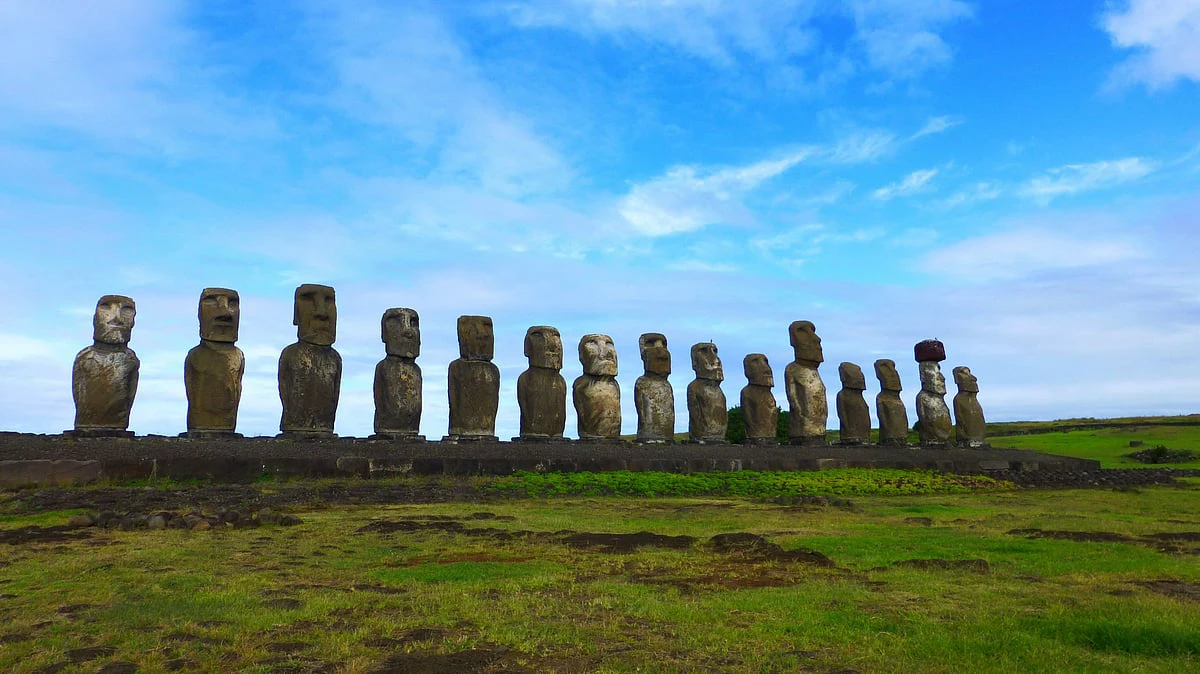
Easter morning began before dawn at Ahu Tongariki, where 15 towering moai stand in a long line. In the half-light they appeared almost spectral, their silhouettes rising against the horizon.
Contrary to popular belief, the statues do not face the sea. They look toward the island, guardians watching over the land and the people who once raised them. Standing there, with waves striking black volcanic rock and nothing but open ocean beyond, I felt the distance from India in a way no map could convey. The moment belonged entirely to the present - a quiet Easter sunrise among the ancestors of another civilisation.
Mass at the world's edge
Later that morning, church bells rang across Hanga Roa, the island's only town. The small church stood bright against the sky, its façade decorated with carvings that blend Catholic iconography with Polynesian design.
Slow lanes, rich rewards for the growing travellerInside, the service unfolded in Spanish and Rapa Nui. Christ appeared in woodcarving with island features rather than European ones. Women wore flowers and children shuffled quietly beside their families.
The Mass felt intimate rather than ceremonial. Catholicism arrived here with missionaries in the 19th century, yet it settled into the rhythms of island culture rather than replacing them. Outside the church, Easter Sunday carried the warmth of a community gathering. Tuna grilled over open fires. Sweet potatoes emerged from earth ovens. Conversations drifted between locals and visitors beneath the midday sun.
Much of the island lies within Rapa Nui National Park, and access to many archaeological sites now requires accredited guides. Preservation here is not merely policy but necessity; the heritage of Rapa Nui remains both fragile and precious.
By afternoon, I made my way to Rano Kau, the vast volcanic crater that forms one of the island's most dramatic landscapes. From the rim, the view revealed a lake thick with reeds at the crater's base, while beyond the cliffs the Pacific stretched without interruption.
Nearby lies Orongo, the ceremonial village once associated with the Birdman competition - a ritual that required swimmers to brave treacherous waters to retrieve the first egg of the season.
As evening approached, I returned to the coast where moai stand at Tahai. The sky softened to violet and the statues darkened into silhouettes. The night sky soon filled with stars. The Southern Cross hung above the ocean, a reminder of the celestial routes that once guided Polynesian navigators across the Pacific.
Rapa Nui offers something rare: the feeling of reaching the far edge of the inhabited world. On Easter Sunday, that edge felt less like an ending than a beginning - a place where stone, sea and faith meet.