
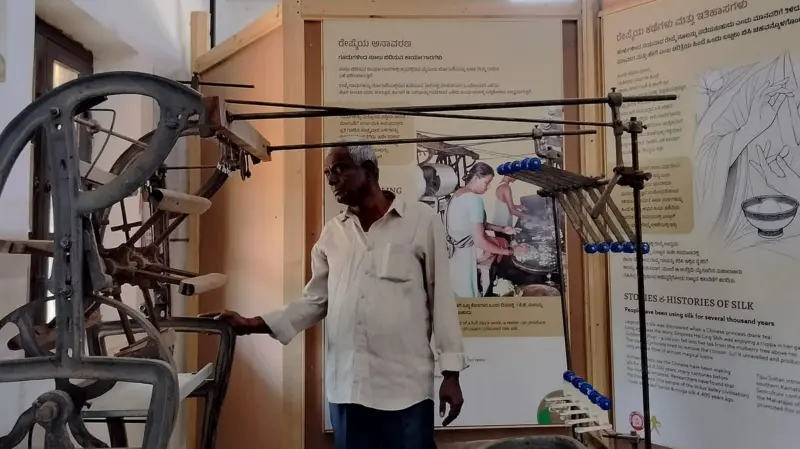

Surrounded by farms and retaining its traditional architectural style, Avatihalli Railway Station now invites travellers heading towards Nandi Hills or nearby towns to pause and learn about the journey of silk.
At the station, a new silk museum stands as part of INTACH's effort to restore old railway stations around Bengaluru.
Women queue from dawn for GI-tagged Mysuru silk saris in BengaluruThe museum offers a simple, clear look at how silk is made, tracing the process from breeding silk moths to weaving sarees. Specimens and replicas of every stage of the silk moth, along with mulberry leaves and several other tools, are on display. Visitors can also see equipment such as a reeler for extracting yarn from cocoons and a silk handloom. The station's ticketing agent, also a former silk farmer, is present to guide visitors through the process. Information about nearby silk-producing areas, such as Shidlaghatta and Vijayapura, adds context, helping visitors understand the region's broader silk network. Karnataka produces nearly half of India's silk, making the museum especially relevant.
According to INTACH co-convenor Aravind C, the station, built in the 1920s, has long been linked to silk farming, a livelihood here since the time of Tipu Sultan. Turning it into a silk museum, he says, helps preserve both heritage and local knowledge.
The museum was inaugurated on Sunday, World Heritage Day, with actor Vinay Rajkumar and Sathish Mokshagundam, president of Visvesvaraya National Trust, as guests of honour. Around 50 people attended, including residents of nearby villages, silk farmers and school children. A nature walk around the station, led by Chandrashekar Koira from Naturalist School, with a brief description of the trees in the area, added to the experience. Several trains from Bangalore to Chikkaballapura and Kolar stop here, making the station accessible to travellers.