
We have a penchant for exploring lesser-known destinations, which are generally off the popular tourist map. So, when we decided to spend a few days in Malaysia, Kuching felt like an ideal choice.
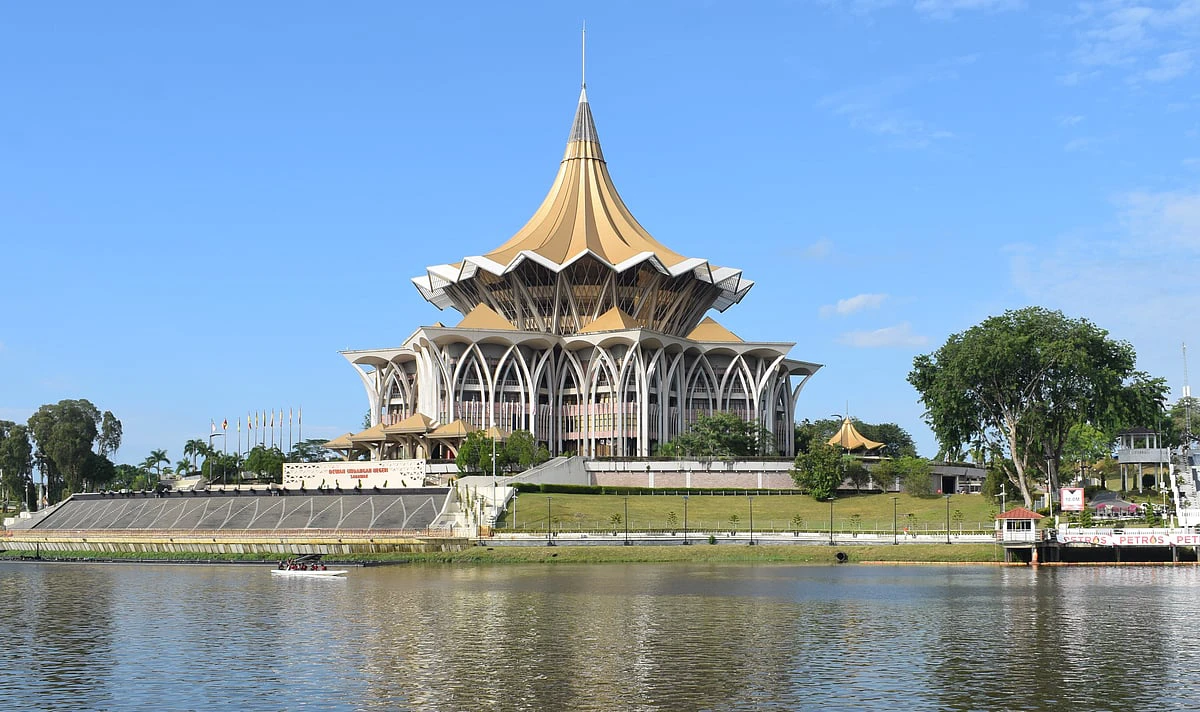
The snaking rivers, and the extensive mangrove forests, which become visible as the plane descends into Kuching, provided a pleasing introduction to Sarawak, which boasts of a forest cover of about 80 per cent. The beautiful waterfront, on the shores of River Sarawak, is the hub of activity in Kuching. A uniquely-designed walkway across the river connects both shores. The Sarawak Legislative Assembly building, shaped like a giant flower, catches the eye from afar.
Exploring Sarawak
Sarawak was originally part of the Brunei Sultanate. British adventurer James Brooke assumed control of Sarawak as the 'White Rajah' in 1841. He and his descendants ruled Sarawak till 1946. Astana, the beautiful palace built by the second Rajah, on the northern shore of the Sarawak River, is visible from the waterfront. The history and the cultural heritage of the Sarawak peoples are tastefully showcased in the grand Borneo Cultures Museum, reputed to be the largest in Malaysia.
The Bako National Park, which is the oldest conservation area in Sarawak, provides a cursory glimpse into the extensive natural wealth of the place. The Park can be accessed by a 20-minute boat ride through a wide estuary, which opens out to the South China Sea. The Park has extensive walking trails, with a wooden boardwalk laid up for some part. Our guide was able to get us to spot a pair of proboscis monkeys, endemic to Borneo, a family of silver-leaf monkeys, and a lemur. A highlight was getting to see the colourful, but highly venomous, Borneo keeled pit viper, at close quarters. The trek through the thick foliage was nice, though a bit strenuous in parts. Cabins are available for those who want to stay and explore the Park in detail.
Slow lanes, rich rewards for the growing travellerBorneo is one of the original habitats of the orangutan. The best place to see this majestic animal near Kuching is the Semenggoh WildLife Centre, which houses 28 semi-wild orangutans, in a natural habitat spanning 653 hectares. Visitors congregate at the feeding platforms in the Centre, hoping to glimpse any of the animals, who may (or may not!) turn up, to savour the offered fruits. We were lucky to witness two magnificent animals - 17-year old Anaku, and 12-year old Ruby, who entertained visitors for quite a while.
Carnivorous bloom
A big draw for Kuching is the world's biggest flower, Rafflesia arnoldi (Stinking Corpse Lily), which occasionally blooms in Gunung Gading National Park, about 100 km from Kuching. This carnivorous flower could grow up to one metre in diameter, but lasts only for three to four days. You need very good fortune to see it in bloom (which was not for us!)
The River Cruise is a popular activity for tourists. The 90-minute twilight cruise is complete with short cultural performances by various tribes, hailing from different parts of Sarawak.
Kuching is eminently walkable. It has many well-preserved colonial-era buildings, and beautiful parks. The absence of crowds, and any serious traffic makes strolling a pure bliss. Our walks among the well-manicured lawns of Heroes Memorial, Padang Merdeka, and Reservoir Park are cherished. The Waterfront is dotted with quaint colonial-era cafes, which serve excellent coffee, with local delicacies like the traditional multi-layer cake of Sarawak - Kek Lapis.
What Antony, the elderly cab driver who took us from the airport to our hotel, told us, summarises Kuching: "You will definitely slow down when you come to Kuching". Yes, an unhurried, and pocket-friendly vacation is what Kuching can offer.