




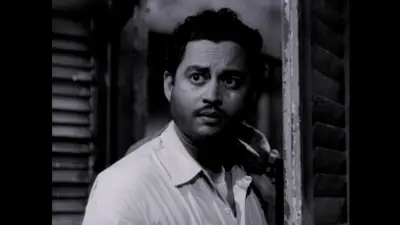

Clad in a white kurta-dhoti with a shawl draped over his shoulders, a morally anguished Guru Dutt stands with both hands braced against an auditorium entrance.
As the audience turns to face him, this stark silhouette forms one of the most striking scenes in Indian cinema.
Guru Dutt's Vijay in the song (written by Sahir Ludhianvi) which plays at the climax of 'Pyaasa', sings 'yeh mahalo yeh takhto yeh taajo ki duniya….' - 'This world of palaces, thrones, and crowns, this world of societies that are enemies of humanity, this world of wealth-obsessed social norms: Even if one were to gain this whole world, what is it worth?' He dismisses a world obsessed with materialism over human emotion, questioning its worth when love is treated merely as a commodity.
Guru Dutt wrote 'Pyaasa', originally titled 'Kashmakash', in 1947 amid the turmoil of India's Partition. The story mirrored his personal frustrations as a Bombay artiste struggling to survive the film industry's cut-throat commercialism.
Nearly 78 years later, artistic truth remains hostage to market value, and integrity to box-office metrics. Just as Vijay experienced, modern filmmakers are only celebrated if their films bring in the moolah, driving today's cinema into artistic decay.
'Yeh duniya agar mil bhi jaaye toh kya hai' ends with the poet saying 'jalado yeh duniya, ise phook daalo yeh duniya….' Unfortunately, we continue to live in a world Guru Dutt mourned and rejected.
Song Stories is a monthly column that takes up an iconic number and explores why it still lives rent-free in our heads.