
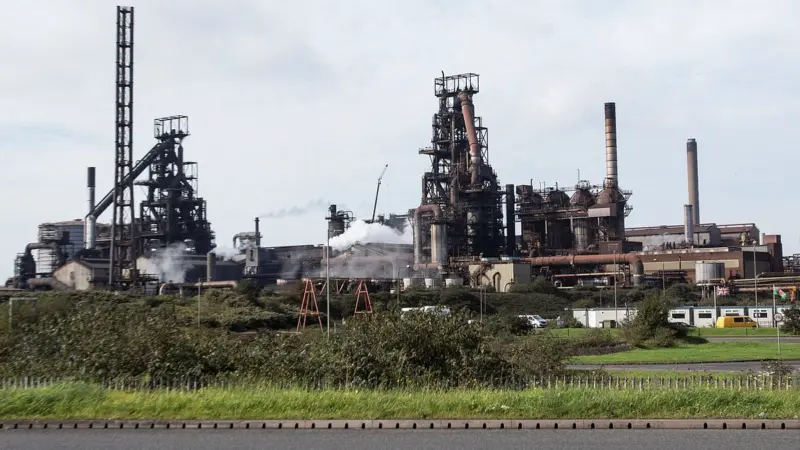

The steel that holds up buildings, carries electricity across continents, and moves people in cars and trains is being made the same way it has been for over a century, by burning coal.
A new assessment of 18 of the world's largest steelmakers, operating across 29 countries, found that no nation is genuinely prepared to change that.
The Steel Corporate Scorecard evaluated companies across Asia, Europe, and the Americas, including Baosteel, Nippon Steel, POSCO, Tata Steel, ArcelorMittal, Thyssenkrupp, Cleveland Cliffs, and SSAB, and found coal dependence firmly entrenched across the sector despite long-term climate pledges these companies have publicly made.
The distance between their promises and their production floors, the report finds, is not closing. It is widening. "One of the reasons for steel industries not being transition-ready is that there hasn't been enough pressure on the industry to change when compared to other industries," said Caroline Ashley, Steel Executive Director.
Climate goals only on paper
Steel is one of the world's most carbon-intensive industries, responsible for roughly a tenth of all global CO2 emissions and the technology driving most of that damage is well understood. Blast furnaces powered by coal, a nineteenth-century technology that accounts for up to 90% of the sector's total emissions, remain the dominant production method across every company the report assessed.
India-Australia research pioneers partial coal replacement with farm waste for green steelTo arrive at its conclusions, Steel evaluated firms across 21 indicators organised into five areas: how seriously they are moving away from coal, whether they are investing in cleaner alternatives, how their actual climate performance measures up, the credibility of their targets, and how transparently they report on both environmental impact and social responsibility.
The picture was the same across all five categories - an industry that has made public commitments to a cleaner future while continuing to pour money into the infrastructure of a dirtier one. "This first scorecard shows that leading steelmakers are failing to lay the foundations for near-zero-emissions production fast enough. Consistently low scores illustrate the gap between company actions and what our climate requires," said Caroline.
According to Saumya Nautiyal, Energy Finance Analyst at Institute of Energy Economics and Financial Analysis, of all barriers to producing green steel, financial constraints remain the largest. As of now, producing green steel is 20-30 per cent more expensive than conventional coal-based steel production. It is difficult for steel companies to reach consumers willing to pay extra for the product.
Prior to producing a single tonne of green steel, the whole process involves altering existing manufacturing facilities, such as electric arc furnaces, hydrogen storage, electrolysers, and renewable energy sources, requiring initial large investments.
"The issue becomes even more complicated because of limitations on resources used. Green steel production requires only a small share of high-quality iron ore available globally, forcing countries like India to import," said Saumya. The scrap steel path through an electric arc furnace faces a bottleneck due to a lack of local scrap, forcing companies to import it.
A double whammy?
Beginning 2026, Indian steel exported to the European Union will be charged for its carbon footprint based on the emissions produced in its manufacture, under the Carbon Border Adjustment Mechanism (CBAM) regulation. Since India exports about 1.5 million tonnes of steel to the European Union, the risk is huge, one that will increase further when the CBAM comes into full force in 2034.
Decarbonising steel is not a single problem to solve. The issues surrounding the decarbonisation of primary production, in which producers use coal-fired blast furnaces and raw iron ore, need to be addressed separately from secondary production, in which scrap metal is fed into electric arc furnaces. Experts say policies should account for these differences.
There is no commercially viable, Paris-aligned alternative that producers could switch to, which makes steel difficult to decarbonise. The financing mechanism faces a tricky situation, as green bonds require a steady flow of funds to support green projects that have already been tested and deemed environmentally friendly and efficient. However, the producers lack the ability to show such technology.
The locking-in of coal-related assets is one of the barriers to the transition process. The majority of India's steel production capacity, both existing and under construction, is dependent on the coal-intensive blast furnace method. "The average life span of the blast furnace plant is 50 years; therefore, the investments made by the coal-intensive industries in the 2020s would be operational even after 2070, making it impossible for India to reach its net-zero objectives," said Saumya.
India's renewable energy sources are insufficient to meet the energy needs of energy-intensive industries. It lacks low-cost green hydrogen and high-quality iron ore, which enable the manufacturing of such products with minimal emissions, and it lacks a carbon pricing mechanism to compel companies to move in the direction Europeans want. What Indian companies do to move toward green steel largely depends on local governments.
Tata Steel and JSW find mention in the scorecard. JSW, ranked 5th, highlights in its Business Responsibility and Sustainability Report (BRSR) its transition toward "green steel" through the commissioning of India's largest green hydrogen project for steelmaking (3,800 tonnes annual capacity) and the rollout of 'JSW GreenEdge', a certified low-carbon steel solution.
Tata Steel, ranked 10th in the scorecard, discusses various green steel initiatives at its UK and Netherlands branches in its Business Responsibility and Sustainability Report (BRSR). When it comes to India, it tries to leverage the Taxonomy of Green Steel, introduced by the Ministry of Steel, which classifies steel by carbon emissions and assigns star ratings.
"Unless you have a mandate by the government or law that every steel manufacturer has to go green, I don't see a shift happening towards green steel," said Saurabh Kumar, an independent expert in the energy field.
Experts say that to fast-track the development of green steel technologies, India should concentrate on brownfield development, deploying green steel technologies and leveraging existing steel production capacity. They feel that innovation should focus on reducing electrolyser costs and making iron production flexible enough to manage renewable energy intermittency.