




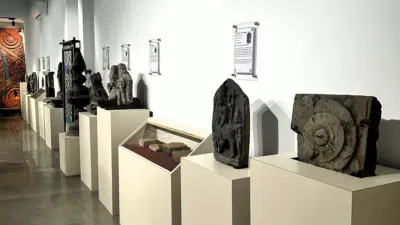

When you land at Goa's Manohar International Airport in Mopa and take a slight detour towards Sant Sohirobanath Ambiye Government College and Research Centre in Pernem, you encounter an unexpected window into Goa's past.
Tucked inside the college campus is a modest archaeology museum where history quietly survives in stone and wood.
The Museum of the Centre for Archaeological Studies houses around 40 artefacts dating from the 6th to the 17th century. What makes the museum remarkable is not just the antiquity of its objects, but the story of how they were gathered - through years of patient effort by historian Dr Rohit Phalgaonkar and his students.
The museum, which opened recently, reflects nearly 15 years of work by Phalgaonkar, assistant professor in the Department of History, and a group of students who have collected, revived and restored these objects.
For Phalgaonkar, the Centre for Archaeological Studies - of which the museum is a part - was born out of necessity. With the introduction of a new archaeology course under the Skill Enhancement Course (SEC) of Goa University, teaching the subject without access to field material became a challenge.
"Archaeology is one of the primary sources of history," says Phalgaonkar. "Teaching this course could be a challenge, as practically no excavation work is happening in Goa. That's why this Centre came about - to create awareness about it."
The idea soon found institutional support. "The present Education Secretary, Prasad Lolayekar, who was then the director of higher education, realised the need for the same. We then identified the sorting room of the library for this museum," he explains.
Juao D Costa, principal of the college, believes the museum offers more than a display of artefacts. "The museum provides an opportunity for researchers and students of all ages to experience our past and preserve it for future generations. Researchers from within and outside Goa visit our campus to explore and learn about our legacy," he says.
Phalgaonkar, who has long researched Goa's temple artefacts and their history, often found himself being contacted by locals whenever ancient objects surfaced. One of the earliest discoveries came from the village of Usgao, where residents handed over four sculptures of mother goddesses that had been found on the steps of a water tank.
"Out of the four sculptures, two are of Saanteri, which are important for Goa's cultural history. They show the development of the icon of Saanteri, who is otherwise worshipped in the form of an anthill along the Konkan belt," he explains.
Among the most striking objects in the collection is a sculpture of Vishnu dating back to the 5th or 6th century, from the Chalukyan period. "It was found in three pieces in the Bhagavati temple at Tuem in Pernem. It was handed over to us, and we carried out the restoration of the sculpture," says Phalgaonkar.
Another rare find is a 12th-century idol of the Vedic god Indra. "It's a unique one as it was fished from the water tank of Chamundeshwari temple in Pilgao in 2010. Actually, we received many artefacts from this temple, like the wooden dvaarpaals and also a deity of Kaalbhairav," he says.
The Kaalbhairav sculpture, dating to the 16th century, holds particular linguistic significance. "It has an inscription on its back, which is probably the first mention of Konkani script, deciphered by me. It's the first inscription in Konkani which mentions Goa as 'Goem' and 'Goyant'," he adds.
The museum's collection also includes several remarkable wooden artefacts. One of them is a heavily decorated 17th-century wooden ceiling panel measuring about three metres by three metres, with intricately carved lotuses. It once belonged to the Betall temple in Poinguinim, Canacona.
When the temple underwent renovation, the ceiling was removed and eventually handed over to the Centre. But it arrived in fragments. Restoring it became a hands-on lesson for students. "Our students were trained to conserve and restore the ceiling. It took three days," says Phalgaonkar, recalling a workshop on wood conservation techniques organised by the college.
Another wooden masterpiece is a 16th-17th century temple chariot from Sanguem. Crafted from local jackfruit wood, it features carved crocodile faces jutting out from its base, each holding a movable wooden ball in its mouth. The structure weighs nearly two tonnes.
"This artefact is the best example of local carpentry and could become a reference to study this skill of Goa," Phalgaonkar notes.