




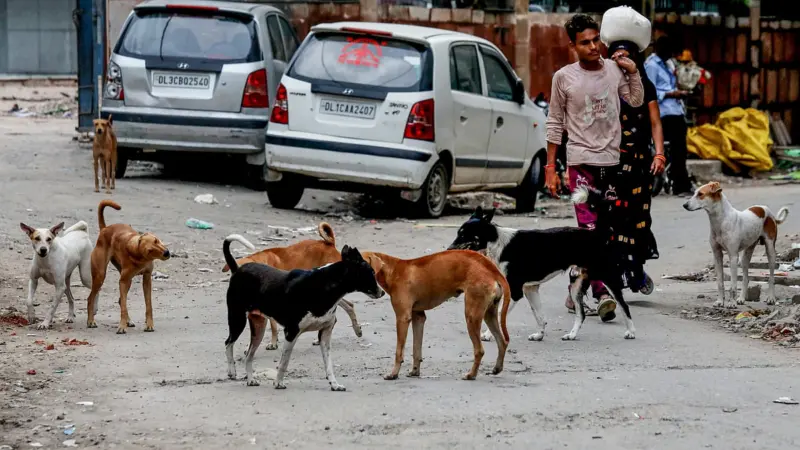

This week, the Supreme Court of India delivered a sweeping 131-page judgment on stray dogs and public safety - a judgment that will likely shape India's stray animal policy for years to come.
The decision arrives in the backdrop of mounting public anxiety over dog attacks, rabies deaths, and the visible collapse of urban animal management systems. Courts were perhaps always going to be drawn into this vacuum left by decades of municipal inaction. Yet the significance of this judgment lies not merely in the directions it issues, but in the constitutional language through which it frames the problem. At the outset, the Court correctly recognises that the issue lies "at the intersection of public safety and animal welfare" and requires a "careful and principled balance" between Article 21's rights of citizens and the humane treatment of animals. That matters.
Only months ago, during hearings before another bench, stray dogs were discussed in rhetoric more evocative of vigilante extermination than constitutional adjudication. The now-infamous observation that "this is the time to shoot and not to talk," lifted from a film dialogue, reflected the anger many citizens feel. However, it also revealed how quickly public discourse around stray dogs can slip into calls for elimination rather than governance. This judgment, at least in tone, is more restrained and institutionally careful.
The Court upholds its earlier direction that stray dogs cannot be re-released into institutional spaces such as schools, hospitals, sports complexes, airports, railway stations, and bus depots after sterilisation and vaccination. The bench reasons that such premises are fundamentally different from ordinary public streets because they involve vulnerable populations, hygiene concerns, and uninterrupted institutional functioning.
Prima facie, this position is difficult to dispute. Hospitals cannot function like open community spaces. Schools cannot be expected to expose children to roaming packs of dogs in the name of animal welfare. The Court is also right to reject the argument that the Animal Birth Control (ABC) Rules create an absolute right for dogs to inhabit every space. The problem, however, lies in what the judgment leaves unsaid.
Throughout the proceedings, animal welfare groups warned the Court that India lacks anything close to the shelter infrastructure necessary to support a large-scale relocation of dogs. The numbers placed before the Court were staggering: over 15 lakh educational institutions, potentially implicating crores of dogs, requiring tens of thousands of shelters and enormous recurring expenditure. The applicants also warned that where authorities lack shelter capacity, relocation policies often degenerate into illegal culling, poisoning, disappearance or mistreatment of animals. This concern is not theoretical. It reflects administrative reality.

Rahul Bajaj is a practising lawyer with expertise in disability rights and IP law, and is co-founder of Mission Accessibility. He wears more hats than he can himself sometimes count.
India's municipal authorities have historically struggled to comply even with sterilisation and vaccination obligations under the ABC framework. Faced with pressure to "solve" stray dog complaints quickly, many local bodies are likely to kill a stray dog rather than relocate it.
The Court does clarify that euthanasia is permissible only in legally recognised circumstances, such as where dogs are rabid, mortally wounded, or demonstrably dangerous. But the judgment offers little guidance on what qualifies as "demonstrably dangerous" or "aggressive". In a climate of public outrage, that ambiguity matters enormously. Without clear procedural safeguards, vague standards can become gateways for abuse.
Equally striking is the near-total absence of a disability rights lens in the judgment. Ironically, the Court itself acknowledges that stray dog attacks disproportionately affect vulnerable groups, including Persons with Disabilities (PWDs). Yet the judgment does not meaningfully engage with what a disability-sensitive response to the stray dog crisis might look like.
There is no direction requiring coordination between municipal authorities and State Commissioners for PwDs. No framework for prioritised grievance redressal where blind persons, wheelchair users, autistic persons, or persons with psychosocial disabilities face recurring attacks or mobility barriers. Nor does the Court engage with a possibility that could have transformed the discourse: the training and rehabilitation of suitable community dogs as service or assistance animals for PwDs. The truth is that India's stray dog crisis was never created by dogs alone. It is a product of failed waste management, unregulated feeding practices, collapsing municipal capacity, underfunded sterilisation programmes, and decades of administrative indifference. Courts can compel urgency. They cannot substitute governance. And that is where this judgment will be tested - not in the rhetoric of balancing, but in how that balance operates on the ground. Because in India, the distance between principle and implementation is often where both constitutional rights and humane values disappear.
The writer is a practising lawyer with expertise in disability rights and IP law, and is co-founder of Mission Accessibility. He wears more hats than he can himself sometimes count.