





Blackstone, a private investment management company, manages $1.3 trillion in assets. It has owned hospitals, logistics networks, real estate portfolios and energy companies across six continents.
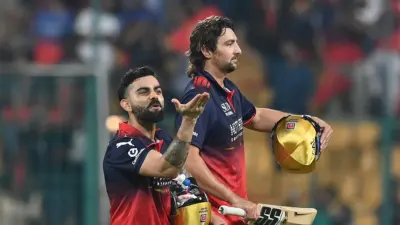
Until last month, it had never owned a cricket team. That changed when it joined the consortium, alongside the Aditya Birla Group, The Times Group and David Blitzer's Bolt Ventures, to buy the Royal Challengers Bengaluru (RCB) for $1.78 billion (approximately Rs 16,600 crore).
The timing is rather pointed. RCB won their first Indian Premier League (IPL) title in June 2025, after seventeen years of trying. They are currently in the top four of the ongoing season. Diageo, which has owned the franchise since its takeover of United Spirits Limited, decided that a cricket team sat outside its core alcobev business and put it up for sale. When the RCB process opened, some of the world's largest investment firms were in the room.
The same day, the Rajasthan Royals were sold for $1.63 billion. EQT, KKR, Premji Invest and TPG had all been linked to one or both processes. Two franchises, a waiting room full of capital that usually goes elsewhere. Something has changed.
The case for entry
The financial logic behind an IPL franchise starts with a guarantee.
IPL 2026| From Vijay Mallya to Birla: How ownership of RCB has changed over the yearsThe BCCI diverts all broadcast and league-level sponsorship revenue into a central pool from where it distributes a guaranteed equal share to all franchises, regardless of where they finish. In sports business terms, it is what they call a "closed league", minus relegation. In most other sports, ownership is a bet on performance. In the IPL, the floor is fixed.
The track record has reinforced that appeal. CVC Capital Partners, a European private equity firm, bought the Gujarat Titans in 2021 for $670 million. Four years later, it sold a majority stake to the Gujarat-headquartered Torrent Group at a reported return exceeding 350%, retaining a 33% holding. RedBird Capital Partners, an American investment firm, paid $37.5 million for a 15% stake in the Rajasthan Royals (RR) that same year, valuing the franchise at $250 million. That stake, at the time of RR's March 2026 sale, multiplied at least 6.5 times to roughly $244.5 million. These are the numbers that drew Blackstone and the rest into the process.
Underpinning all of it is the 2022 broadcast deal, in which the IPL sold media rights for the 2023-2027 cycle for $6.2 billion (Rs 48,390 crore), more than double the previous deal. That single transaction repriced every franchise in the league. The eight original franchises are all profitable. The two newer entrants are working towards that position.
The rooms that matter
The returns explain the interest. However, they do not fully explain the appetite.
There is a second motivation, less visible in any financial presentation, that matters to certain buyers. In India, there are very few rooms that matter. Rooms where business decisions of consequence get made, where relationships between capital and government are built, and where the people who run the country's largest institutions sit together. Access to those rooms is not bought directly. It comes through a demonstrated presence in places that India's governing and business classes take seriously.
The IPL is one of those places. Ownership puts an investor at a table that money alone can't buy. For foreign capital with broader India ambitions, whether in technology, financial services or consumer businesses, a franchise is a way into conversations that would otherwise take years to cultivate. The derivative of that access, felt in deals that have nothing to do with cricket, does not show up in a financial model. It is, nonetheless, real.
David Blitzer's portfolio spans the NFL, NBA, the English Premier League and Major League Baseball. A sudden passion for T20 cricket does not explain his presence in the RCB consortium. For investors like this, an IPL stake is also a key to securing rooms in Mumbai, New Delhi (and indeed Bengaluru) that global capital has historically found difficult to enter.
This is not a cynical point. Every serious market has institutions that carry social capital alongside commercial weight. The IPL has earned that status in nearly two decades, which is the more remarkable fact.
What the money will demand
While the case for buying is legible, what comes after is less certain.
The 2022 broadcast rights deal, which underpins current franchise valuations, was, in a specific sense, unrepeatable. It was driven by a direct bidding war between Disney Star and Viacom18.
The two companies have since merged into JioStar, unifying all IPL rights under a single entity. The competitive dynamic that tripled the rights value in one auction no longer exists. Media Partners Asia, a Singapore-based consultancy, projects the 2028-2032 cycle will stay flat at $5.4 billion, with the per match value falling 13% as the league expands its match count. Franchise owners buying at $1.6-1.8 billion today, are pricing that the media rights table, on current projections, cannot deliver alone.
The real-money gaming ban has compounded the problem. Fantasy platforms like Dream11 and My11Circle were the single largest advertising category in IPL broadcasts. No replacement category has emerged at the same scale.
The gap is most visible in merchandise. When RCB jerseys sell out at a Puma outlet in Bengaluru, that is not a merchandise business doing well. It is a supply problem. The NFL earns billions of dollars annually from licensed products. The IPL, with 1.4 billion people in its domestic market and a large diaspora concentrated in wealthy cities abroad, generates a fraction of what those numbers imply.
The ceiling is not entirely a market problem. Indian franchise owners have simply not committed the investment, in teams, in logistics, and licensing to raise it.
Foreign capital from markets where franchise businesses are run as proper consumer operations has closed gaps like this before. RedBird brought that experience to RR. Blackstone has portfolio depth across consumer and real estate that few investors can match. Whether any of it translates to the particular conditions of the Indian market will take seasons, not quarters, to establish.
The harder question involves the BCCI itself. The board has run the IPL with authority and limited external accountability, and the league has grown well under these conditions. Institutional investors operate on different terms. They manage money on behalf of pension friends and university endowments that require transparent reporting. They will want to know how revenue is divided as new streams emerge, and what recourse exists when league-level decisions affect franchise value. That is a different kind of pressure on the BCCI that it has faced from franchise owners before.
Blackstone's entry and the wave of institutional capital that preceded it, is good for Indian cricket. A league that attracts serious global investors regarded as a viable long-term asset is a more durable league. The networks and operational experience these investors bring are things Indian franchise ownership has not consistently provided.
The question is not whether this capital belongs here. It does. The question is whether the IPL, as an institution, is ready for owners who will eventually want their money back, and will keep asking until they understand exactly how that happens.
(Venkat Ananth is the founder and writer of The State of Play, a subscription-led publication on the business of Indian sport.)