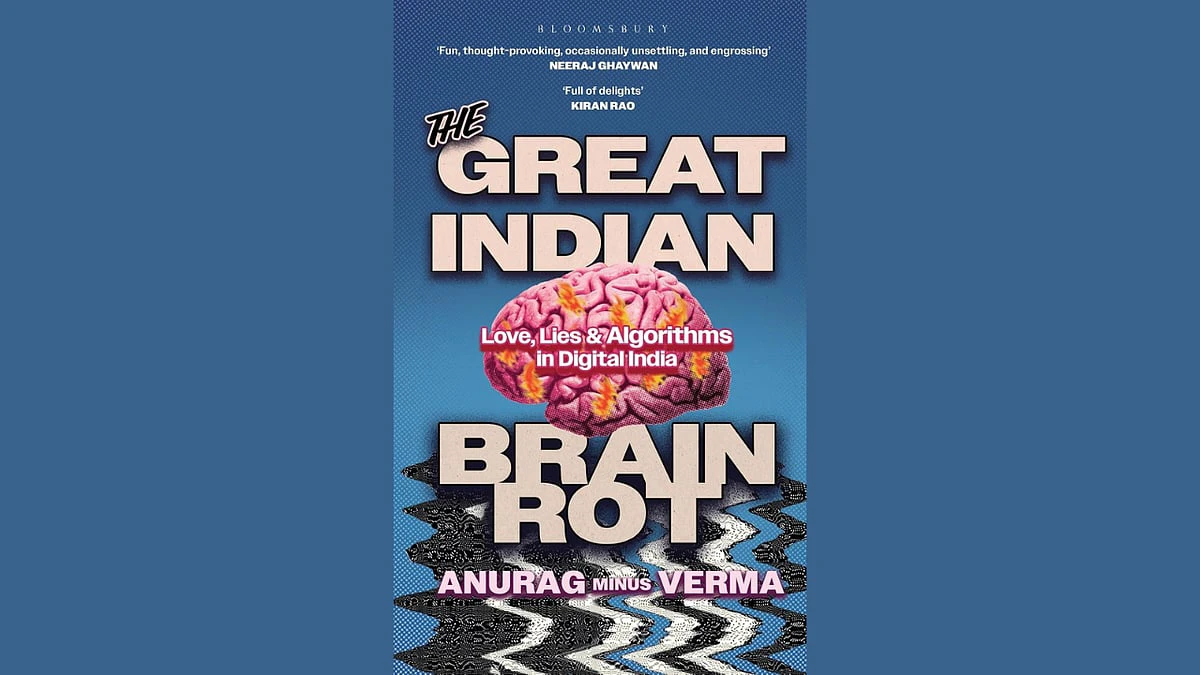

The blurb of the book is clear. Anurag Minus Verma welcomes you to the Indian internet- the messy sweep of voices that is now largely unavoidable.
What follows is a carefully stitched portrait of several moments of a history still in the making, experienced by people differently; dictated, of course, by the big A - the algorithm.
Written across nine essays, the book picks up instances and repackages them as phenomena to be studied, historically, sociologically, and psychologically. The perspective born out of this coming together is a map the reader receives, in Anurag's voice, a part of the very same brain rot he's reading.
The Great Indian Brain Rot places its writer within the growing legion of writers and thinkers who've taken it upon themselves to unpack the world of the internet. Often compared with Jia Tolentino, an American journalist who wrote a book of essays on the internet called Trick Mirror, Anurag's book resists this lumping together in both form and content. Unlike Tolentino, his exchange with the reader remains absent from his own experience. He opens up worlds from a distance. In the care taken to narrate and critique the Indian psyche, he refuses the position of netizen himself, his voice emanating from somewhere around us. A comparison with Tolentino is ineffective, doing a disservice to both writers, speaking to their own contexts. Perhaps the question to be asked is: how can one talk about the Indian internet in its entirety?
Anurag shows us one way of doing it. Each essay, helpfully titled to point to its subject, takes you through the harrows of living through the painful ordeal of being online - be it the confusing personality of Ranveer Allahbadia, the nightmare of Sushant Singh Rajput's untimely death or the unlikely emergence of a personality like Dhinchak Pooja.
The essays are tasked with the arduous job of unravelling each moment, so the reader understands each one clearly. Anurag's voice, full of critique and the wisdom of someone who has 'been there, done that', appears as the muscular hand offering to pull you out of pitch black darkness - a scene from your favourite horror film. It is only somewhat unfortunate that this rescue from darkness lands the reader back into the brain rot, mimicking the experience of being on the internet. The essays are divided by sentence-long subheads, each one describing a particular influencer or an oddity. "The Challenge Economy: Push-Ups, Pints and the Content Creator's Daily Routine" is one such example. The reader is given no break to recover from the different surfaces of the brain rot, yanked from one bizarre reality to the next.
Inches apart, worlds awayHis reading of the Internet appears in the form of mic drop moments, thrown in to give you pause. In an essay titled, "I'm Cringe, I'm Free", he concludes, "As Gandhi never said about the digital cycle of birth and death - first they mock you, then they appropriate you, then they call it a trend." When read along with Anurag's podcasts or the video essays from early in his career, such statements land more firmly - laughs are just around the corner.
The essays on cringe culture and India's influencers provide a shrewd anti-caste critique of Indian social media, but the argument he makes is that the brain rot of the Indian internet has very little to do with the internet at all, but has existed time immemorial. The book then offers itself up as a text on the shoulders of which we must re-examine how our fractured world has adapted to social media. It is charged, topical, and opens up a world barely acknowledged by people like you and me.
Brain Rot is an act of kindness to anyone on social media; a blueprint masquerading as a book on internet use in India. The next time a well-meaning relative shows up to your house, whose fake-news-riddled reading life has led them to believe that a UFO has landed in the US, don't feel shamed for being uninformed. Open The Great Indian Brain Rot and feel comforted by the volume of us who navigate the internet blindly, exhausted by the unsolvable riddle of what's real and what's not.