




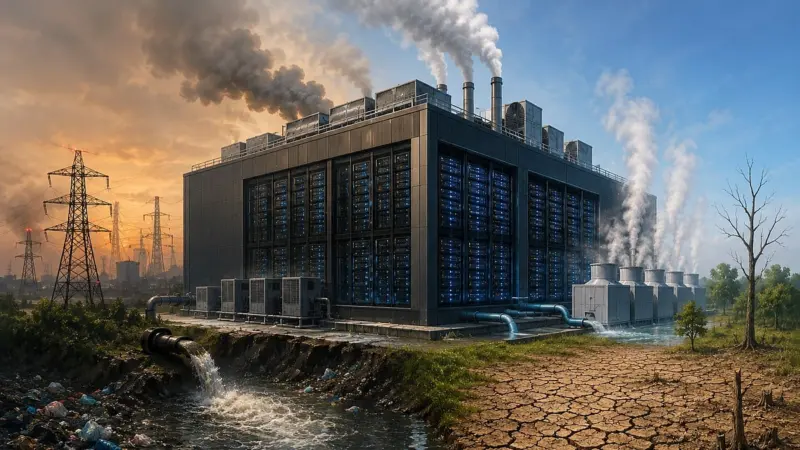

If the architects of the Artificial Intelligence (AI) boom are right, we are going to face shortages of energy and water. Developers are increasingly worried that data centres will eventually require more energy and land than are available on Earth; the giant computing facilities that power AI may have to be located beyond the planet itself.
Last November, Google announced that it is working on a project called Suncatcher, with prototype satellite launches planned for early 2027 to test whether AI hardware can survive and function in orbit. Google's Chief Executive Officer, Sundar Pichai, has said he expects space-based data centres to become a relatively normal way of building infrastructure.
Modern AI is built on vast neural networks trained on trillions of numbers, words, and images, enabling models to recognise patterns or even predict the next word or number. This is based on repeatedly processing colossal datasets using graphics processing units (GPUs). AI accelerators pack billions of microscopic transistors that generate heat when electricity passes through them. The chips, originally designed for video game graphics, are now AI workhorses capable of performing thousands of mathematical operations simultaneously - at the expense of enormous power consumption. From basic physics, we know that the heat produced must be continuously removed to prevent GPU failure.
Toll on water and power
Traditional data centres manage around 12 kW per rack, while AI data centres are seeing dramatic increases, with current ultra-high-density racks consuming 85 kW per rack and projected to rise to 200-250 kW as AI workloads grow more demanding. Water consumption can be gauged by a simple benchmark: according to OpenAI's CEO Sam Altman, a single, simple ChatGPT query by anyone consumes approximately 0.32 ml of water, though independent researchers place the figure higher, at around 1.2 ml when off-site water use is included. When video and images are considered, this requires more water and power. Multiplied across billions of queries per day, the aggregate is substantial.
Data centres also typically operate between 21 and 24 degrees Celsius; if located in warmer or cooler places, additional energy is needed to maintain this range. These facilities are equipped with intricate cooling systems. Removing heat from a system requires energy. In most data centres, heat is siphoned off using water-based cooling technology. Air is blown through water-soaked pads or towers - a technology known as evaporative cooling - and in the process, substantial water evaporates into the surrounding atmosphere. This water returns to Earth only through natural precipitation. Evaporative cooling cannot be deployed in water-scarce areas, nor in the orbital data centres now being explored.
Environmental cost
The environmental cost of AI is already substantial. A 2019 study by researchers at the University of Massachusetts Amherst found that training a single large AI model can emit more than 626,000 pounds of carbon dioxide equivalent - roughly the lifetime emissions of five average cars. This figure, though now several years old, illustrates the scale of the problem.
The use of energy from fossil fuels only aggravates global warming. Data centres currently consume approximately 1-1.5% of global electricity; according to the International Energy Agency's base-case projections, this share is expected to rise to around 2.3% by 2030 and 2.6% by 2035, with a high-growth scenario pushing the 2035 figure to around 4.4%.
In addition, mining operations for batteries, semiconductors, and rare earths cause significant ecological damage and displace communities. It is essential that data centres use renewables and non-polluting energy sources such as nuclear, wind, and solar.
India too is set to accelerate data centre investments over the next two years to match rising global demand for AI, cloud computing, and digital services. Though it presents opportunities, it underscores mounting challenges for power availability and cooling. Electricity consumption across all data centres in India is projected to reach 600 terawatt hours in 2026 - approximately 14% above 2025 levels. Google has announced a $15 billion investment over the next five years to establish its first AI hub in the country, located in Visakhapatnam in Andhra Pradesh.
The way forward
Technologies are emerging to use liquid and immersion cooling instead. Waste heat is also recoverable as a by-product, usable across a variety of industrial and agricultural applications. Shifting to these emerging technologies is essential for reducing the water footprint of AI. Gallium-based liquid metals and carbon nano-fluids have been found to be durable and efficient in heat transfer. Direct-to-chip liquid cooling removes heat at the chip level by placing a cold plate on the chip and circulating liquid through it, transferring heat via thermal conduction in single-phase and via liquid vaporisation in two-phase systems.
Immersion cooling is another method in which an entire server is submerged in a container filled with dielectric coolant. Liquid cooling - especially direct-to-chip - is well-suited to high-density computing environments, offering superior thermal conductivity and cost-effectiveness.
Finally, though not the right solution, big technology companies have pledged to transition to net-zero. Google has ramped up the use of green energy and is making its AI data centres more efficient, pushing for net-zero by 2030. Microsoft is targeting net-zero carbon and plans to use liquid cooling to reduce evaporative water consumption by 2030. Meta has also pledged to achieve net-zero by 2030 through cleaner power and tighter controls on cooling and water use. Amazon's net-zero pledge is comparatively delayed, with a target of 2040; to cover its expanding AI and cloud loads, it is contracting large-scale nuclear, solar, and wind power.
(The author is a former Head of Forest Force, Karnataka and a science communicator)