




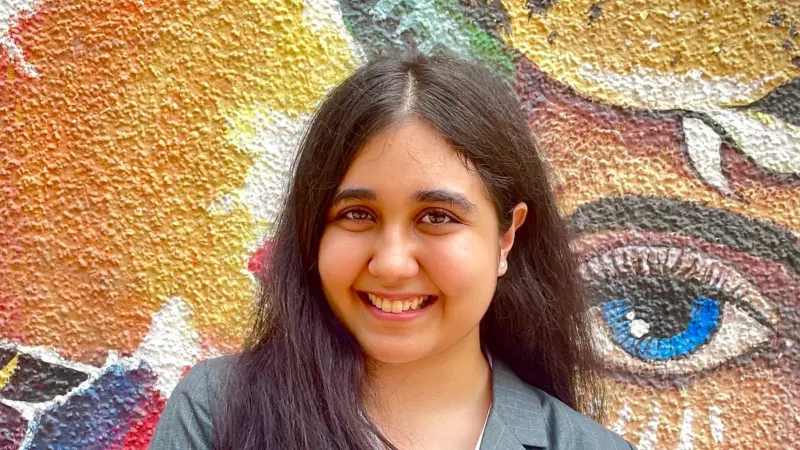

"Patriarchy didn't come into my life with a warning sign or buzzed into my ears with an alarm, loud and clear. It creepily seeped into my life quietly, only for me to unwrap its discomforting manifestations on my own, first through my observations of my mother as a child, soon after through my experiences firsthand."
Delhi-based poet and behavioural science communicator Abhisha Gulati has witnessed enough of patriarchy to take action against it. As a child, she would often question why her mother didn't receive the credit she deserved as the breadwinner in the family.
She questioned why it was a crime to say 'periods' in front of relatives or to buy a pack of sanitary pads openly. Wearing skirts and dresses became an act of rebellion in a city where safety means women being invisible. "I questioned why conversations around gender were always so hush-hush among my family and even friends when I was a child," she reveals.
Perhaps it was the questioning. Perhaps it was the rebellion. However, with a degree in psychology and a Master's in conflict transformation and peacebuilding, much of Abhisha's work involves applying a gendered lens. "Two core values that I hold very tightly to my cerebral cortex and heart as a researcher and an evidence-informed poet are: curiosity and empathy." Those core values form the foundation of her work as an evidence-informed poet, researcher, and behavioural science communicator.
"When it comes to gender, one needs to understand that whatever we think about gender and how our gender makes us think, feel, and behave is all socio-cultural and psychological in nature," Abhisha explains. A feminist lens, she continues, isn't one that defines, but rather one that understands. "It is this lens that helps me hear the unheard, see what's often unnoticed or ignored or kept seated at the corner of our world's patriarchal eye. It is this lens that helps me in my favourite poet and activist's words, to "name the nameless so it can be thought" (Audre Lord).
'Evidence-informed poetry'
Abhisha coined the term 'evidence-informed poet' to describe someone who translates academic research into more accessible, emotionally resonant poetry. "Being an evidence-informed poet is also a loaded term. It comes with responsibility. The responsibility to make sure you're delivering findings with ease, emotion, and authenticity while also taking care of the ethical considerations undertaken in all forms of science communication." An example, she says, would be collaborating with a team of researchers to write poems for women farmers in Rajasthan.
Poetry as a tool for change
In doing so, Abhisha isn't just another gender activist. She uses the power of language, poetry, science, and metaphor to drive meaningful change and conversations, even at the rural grassroots level. This is what makes her work pathbreaking: the fusion of science and poetry as tools for transformation.
Abhisha uses behavioural science to extract data-driven insights into human behaviour, stereotypes, and decision-making. She then uses poetry to deliver those insights through emotion, metaphor, and empathy. Together, they allow her to address gender bias, shame around female expression, and the silent weight of societal expectations. Abhisha is doing something radical in this work: she is making feminist knowledge felt.
Her poetry has been performed on over 75 Indian and international stages, including the Harvard Project for Asian and International Relations. "Something that I've particularly explored in the past is why mothers experience feelings of maternal guilt, compelling them to quit their jobs after childbirth, and how poetry and behavioural science insights could be merged to bring positive change in their situations," she explains. Her poems explore reproductive justice and domestic violence, with 'Why I Want A Refund On Womanhood From God," being inspired by various studies on rapes, shaming, and domestic violence, as well as her own experience.
She's deeply aware that this work is emotionally heavy, loaded, complex, and often severely misunderstood. Abhisha draws hope from changing norms in Indian society, where she sees more women recognising the patriarchy they have internalised. She sees change - a slow ripple - but change that keeps her hopeful. There aren't grand visions, she admits. It's not about fixing the world, but about something more personal.