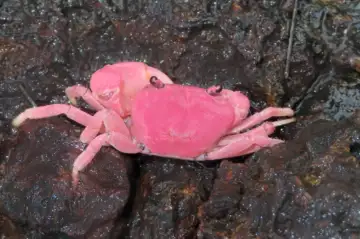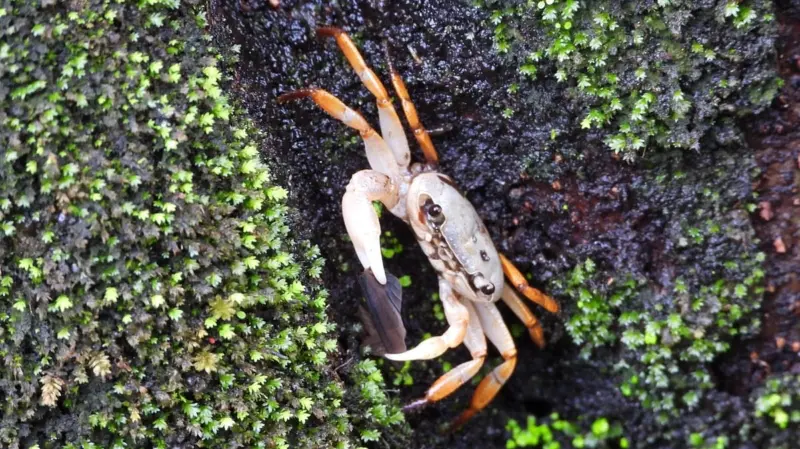

Of the 84 freshwater crab species currently known from the Western Ghats, 63 have been identified in the last two decades. In Uttara Kannada alone, 10 species have been documented over the past ten years, with five discovered in the last five years by frontline forest personnel - Gopal Naik, Sunil Gouda and Parashuram Bajantri, and citizen scientist Gopal Hegde.
"Sunil and I were patrolling the Shirave hills in the Karwar forest division, looking for orchids. Our eyes fell on a deep reddish-brown and milky-white crab that peeked out of a cavity and then disappeared. We had never seen such a crab before," recalls Gopal. His curiosity eventually led to the identification of the 84th freshwater crab species in the Western Ghats, Ghatiana dhritiarum.
Parashuram Bajantri and Gopal Hegde, who described four other species - Ghatiana dvivarna, Ghatiana dvirupa, Vela bandhavya and Aradhya placida - in the Yellapur region of Uttara Kannada district, also encountered them during routine patrols.
Where crocodiles and communities coexistSameer Kumar Pati, Assistant Zoologist at the Zoological Survey of India's Western Regional Centre in Pune, who guided Gopal and Parashuram, says the high diversity of endemic crabs in Uttara Kannada is linked to its geological antiquity, good rainfall and varied habitats.
"The last five discoveries in the district were largely possible because of the active field involvement of forest personnel. Their knowledge of terrain and microhabitats, continuous presence, and the department's support facilitated early detection," he explains.
Describing the forest staff as vital bridges between systematic research and field-based conservation, he adds that their contribution shows how collaboration between taxonomists and forest personnel can accelerate biodiversity documentation in complex regions like Uttara Kannada.
According to experts and studies, the Western Ghats' ancient mountain chain has provided freshwater crabs ample evolutionary time to diversify. Uttara Kannada, with its evergreen forests and heavy rainfall, offers the moist conditions essential for their survival.
The identification of new species in such environments is also changing the understanding of crab ecology. "Earlier, researchers focused on streams and rivers, but several recently documented species - especially in the genus Ghatiana - inhabit specialised microhabitats such as lateritic plateaus, rock cavities, forest floors and water-filled tree holes. These habitats are often seasonal, spatially restricted, and isolated," says Sameer.
Crabs are considered indicator species, as their presence or absence reflects habitat health.
Gopal adds that their research highlighted the ecological role of crabs, which serve not only as prey but also as micro-predators. "They function as nutrient recyclers, feeding on decaying plant matter and forest litter. They also consume insects such as termites and mosquito larvae and at the same time, they are food for birds and other predators, playing a crucial role in the forest food web," he says.
Mounting threats
Despite the region's status as a biodiversity hotspot, the crabs here are facing mounting threats. Their habitats are harmed due to deforestation, agricultural expansion, mining, infrastructure development, hydrological alterations and climate change.
Many crab species have very localised distributions, sometimes limited to a single hill or forest patch. This makes them vulnerable to even small disturbances. "Most species are poorly studied and not assessed for conservation status. Without baseline data, effective management is challenging," says Sameer, noting the area still has high potential for discovery of new species of crabs.
Senior forest officials say they are committed to conserving the region's biodiversity. Vasanth Reddy, Chief Conservator of Forests (CCF), Dharwad, who oversaw the Canara Circle during these discoveries, notes that curiosity drove the staff to find the new species. "All three personnel went beyond routine duties. The department provided guidance and permissions for the study," he says, adding that field-based staff collaborating with scientists can greatly enhance biodiversity exploration and conservation efforts.
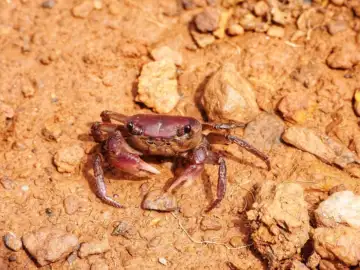 Ghatiana rouxi found under small boulders adjacent to waterfalls along stream banks and forest trails. Photo by Gopal Naik
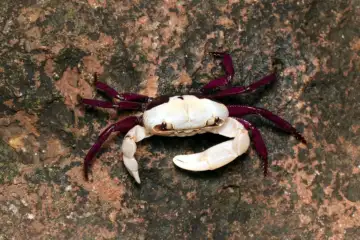 The Ghatiana dvivarna a freshwater crab species in the Western Ghats. Photo by Parshuram Bajantri