




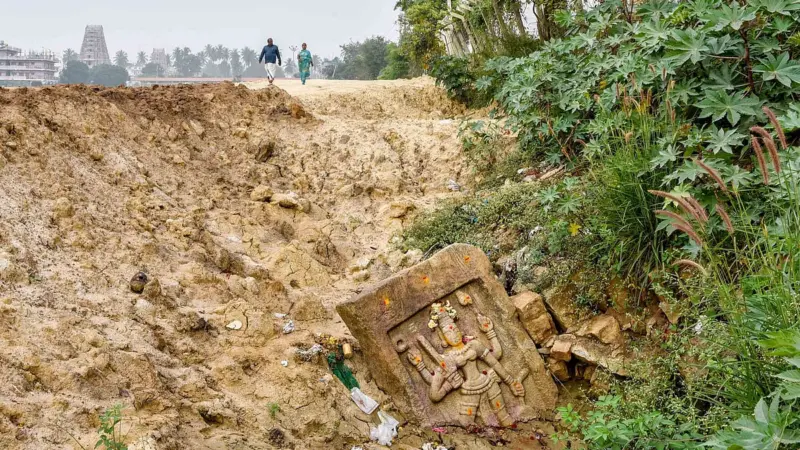

Tucked away in the village of Marasur Madivala, off Hosur Road between Chandapura and Attibele, far from Bengaluru's glass towers, stands one of the most extraordinary sculptures the city has ever produced.
An eight-armed Chamundi, carved over a thousand years ago, holds her pose with such geometric precision that recent 3D scanning by The Mythic Society confirmed that her sculptors followed the strict proportional canon of Talamana, an ancient Indian system where every part of a figure is sized in multiples of the face.
She holds the damaru, the trishula and the kapala - drum, trident, skull bowl - and yet her face is composed, almost meditative. A serpent crosses her chest while a rundamala of severed heads hangs at her waist. Unlike the gaunt Chamundas of northern India, this 10th-century goddess is fierce without being grotesque, anticipating the refinement Hoysala sculptors would bring to stone two centuries later.
A nearly identical sister figure stands at the Chowdeshwari Temple in Dasarahalli, almost certainly the work of the same workshop of master artisans. And she is no isolated marvel.
She is one of at least eight ancient Durga and Chamundi idols recorded across Bengaluru - at Bhoopsandra, Hesaraghatta, Dodda Gubbi, Kalkere, Begur, Marasur Madivala, Dasarahalli and Bellandur. Their placement was not random. Almost every one of them stands beside a kere - installed, the records suggest, as a divine guardian of the water.
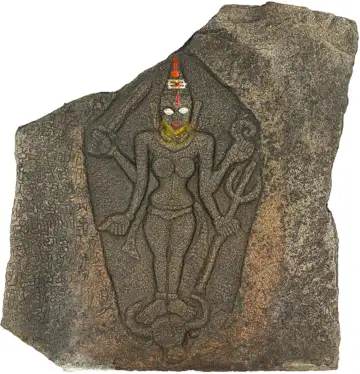 The Bhoopsandra Durga idol with its grant inscription is likely the oldest worshipped deity in Bengaluru. 3D Scan by The Mythic Society
The oldest of them survives at Bhoopsandra, near Hebbal Lake. Dated by its palaeography to around 750 CE, it is likely the earliest worshipped deity in Bengaluru that survives today. The sculpture is a four-armed goddess standing atop a buffalo's head, holding a sword, a trident, a conch and a bowl - the iconography of an 8th-century Mahishasuramardini.
The inscription beneath her records a grant to the goddess, witnessed by four named villagers - Padiltumbu, Manchageya, Karuveeda and Nallolamoleya. It closes with a striking curse: anyone who violates the grant will bear the sin of killing a Kapile, a sacred orange-brown cow, in Varanasi.
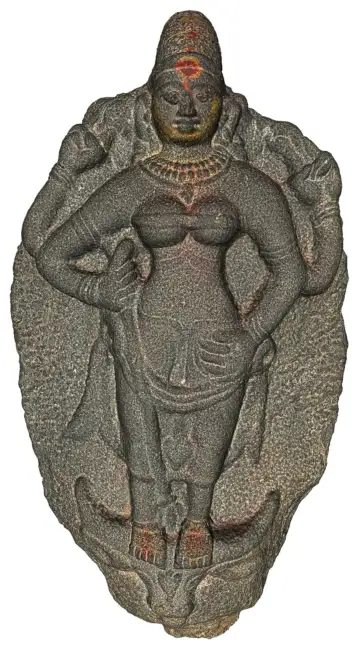 The 10th-century Durga idol at Dodda Gubbi a sentinal of Bengaluru's lakes. 3D Scan by The Mythic Society
The pattern repeats around the city. At Hesaraghatta, the Durga emerges only when the lake recedes, a silent sentry on the exposed bed, vanishing again as the waters rise. Few images bind the goddess and the lake more visibly.
At Begur, a magnificent 10th-century Durga, locally known as Gangamma, once stood watch over the ancient lake. The deity was not just worshipped beside the water; she was its guardian. Protecting the lake was, in this view, a sacred duty.
Saved by a thread
That sacredness, however, has not always saved the idols. The Bhoopsandra Durga idol was pushed into a water inlet during the construction of the Outer Ring Road in the late 1990s. The idol survived only by the alertness of the then Hebbal railway station master, Rao, and some local citizens.
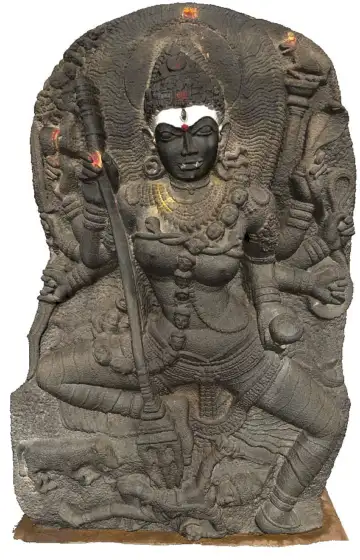 The eight-armed Chamundi idol at Marsur Madivala carved in strict Talamana proportions. 3D Scan by The Mythic Society
At Begur, the Durga idol faced a similar threat during recent lake renovation work, when it was pushed into the lake outlet; it was rescued and is now preserved at the Panchalingeshwara temple. The Marasur Madivala Chamundi, according to local oral tradition, was once submerged in a lake for years before being recovered and reinstalled by the community generations later. But not every idol has been so fortunate. A 10th-century Durga documented at Pattandur Lake is now untraceable.
The spirit of the commons
These idols belong to the same worldview as the 1340 CE Ramasamudra inscription, which records the construction of a lake as an act of punya - merit shared between the community and nature. In that world, water was not merely a resource. The goddess atop the buffalo's head was not just a religious figure; she was the visible sign of a community's responsibility to its water.
These eight idols carry that idea forward. As Bengaluru once again confronts water challenges, they remind us of a time when protecting a lake was both a community duty and a sacred obligation.
(The author is the Honorary Project Director, the Bengaluru Inscriptions 3D Digital Conservation project, The Mythic Society)