




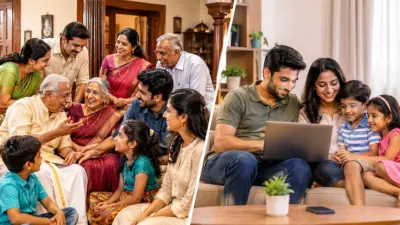

I was born into a joint family with more than 20 members. My grandfather managed the show. Besides my sister and my parents, I had aunts, uncles, and a host of other relatives, each with a specific name to address.
For instance, my father's elder brother was 'periappa' to me, while his younger brother was 'chittappa'.
Periappa's wife was 'periamma' to me and 'nathanaar' to my mother, and Chittappa's better half was 'chitti'. So, when I referred to my periappa's wife as 'periamma', my mother in the same conversation would address her as 'naathanaar'.
And then we had a host of other relationships like 'shaddahar' (co-brother), 'munnie' (elder brother's wife), 'machunan' (wife's brother), and so on. The list seemed endless and mind-boggling. It's strange that Oxford or Collins missed an opportunity to publish a Tamil dictionary of relationships.
The joy of a joint family: How growing up under one roof shapes a lifetime of solaceAt times in conversations, one relationship would be added to another, probably to identify a relative. It could be like 'naathanaar's' 'thambi' and so on. And with all this, communication was still really effective, considering how quickly conversations took place and relationships were rattled off. No one in the house made any mistake in addressing each other or referring to someone.
Today, it seems incredible that we had so many relationships and still knew and understood them without confusion. All this nomenclature seems dumbfounding in light of English vocabulary, where you have only a few words to name relatives, like, say, niece, nephew, aunt, or uncle.
To be more specific, you could add the prefix 'younger' or 'elder' to the relationship for better understanding and effective communication.
I have two daughters. Their world of relatives was restricted to just their parents and grandparents for quite some time. So, when, on the first occasion, I took them out to meet their kith and kin, they just looked at each other, bemused, and waited with bated breath to get out of the place and head straight home.
Introducing them to their cousins and all other elders in the house was a Herculean task for me. It seemed so tedious to remember the names of the relationships rather than the individuals concerned that my children preferred to categorise them as just our relatives.
With the disintegration of joint families due to changing times and economic, administrative, and personal reasons, bonding is the biggest hurdle. There is a strong undercurrent of sentiments that generally helps keep relatives and relationships intact.
With the shift from the joint family concept to the nuclear family, these relationships are gradually becoming redundant or fast fading into oblivion.
One obvious fallout of this change manifests itself at a family function, where the catering contractor's team at times outnumbers the family members organising the function. It's anybody's guess how the next generation would address their relatives and the issue of relationships.
(Disclaimer: The views expressed above are the author's own. They do not necessarily reflect the views of DH.)