
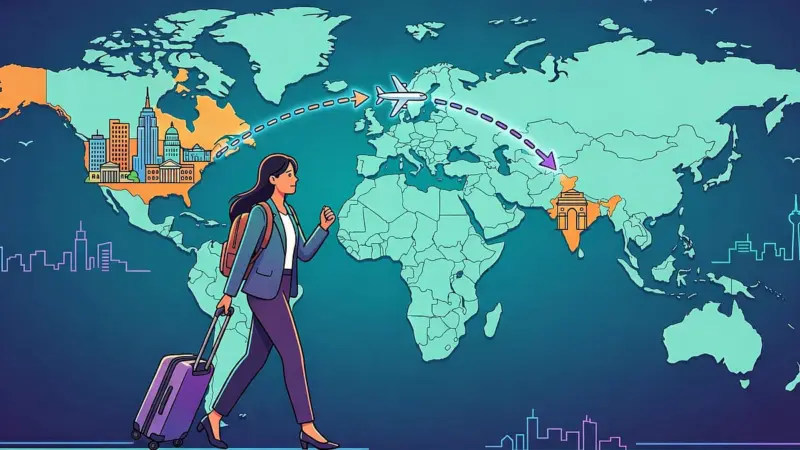

When Shreya (name changed) boarded her flight back to India, she wasn't just leaving behind a country, she was packing up five years of a life she had built alone in the United States.
"I had bought a car, I had a steady job, friends, and a stable life. It was hard to imagine that all of that could just be gone one day," she says.
For Shreya, moving to the US was never just about chasing the American dream, it was a deliberate choice. After pursuing Bachelors in Electronics for four years at a leading institute in Delhi, she found herself drawn to a niche field that wasn't easily accessible in India.
"I wanted to pursue nanomaterials… It's a mix of multiple disciplines, and it was offered in a much stronger capacity in the US than any other parts of the world. That's why I decided to move initially," she told DH.
After securing admission to the University of California San Diego, she moved in 2019, just before the pandemic reshaped the global academic and professional landscape. She graduated in 2021 and soon began working at a startup in the US, in a role closely aligned with her field.
But within a few years, that carefully built life began to unravel.
India, China bear brunt of Trump's tougher visa policies: ReportThis isn't the story of Shreya, but a growing number of Indian students and working professionals returning to India amid growing uncertainty over the US H-1B visa program, shrinking job opportunities for immigrants and shifting political landscape in the country.
Recent LinkedIn data shows a 40 per cent increase in tech workers changing their location to India in the third quarter of 2025.
Quick summary - click for full detailsConcise summary of key highlights
The long way home: Why Indians are abandoning the 'American Dream'
In one lineIndian professionals are returning home due to visa restrictions, job market challenges, and shifting US policies.Key points• Visa uncertaintyH-1B visa restrictions, lottery-based selection, and policy changes make it harder for Indians to stay in the US after graduation.• Job market challengesEmployers prioritize candidates with existing work authorization, and layoffs reduce opportunities for immigrants in the US tech sector.• Rising return trendsA 40% increase in tech workers relocating to India in Q3 2025 reflects growing migration back home due to these challenges.• Shift in education goalsIndian students now prioritize ROI and clearer immigration pathways, reducing blind optimism about studying abroad.Key statistics40%Increase in tech workers returning to India85,000H-1B visa applications allowed per year60 daysTime limit to find a new job after H-1B layoffProcessed with AI. Reviewed by DH Digital Team.
'I'm literally stuck in India', many H-1B visa holders share woes as US cancels visa interviewsA dream constrained by visas
"The first and biggest reason, about 70 to 80 per cent of it, was visa issues," Shreya explains.
Like thousands of international graduates, she entered the H-1B visa process, a rather uncertain path for aspiring job seekers. While the visa allows US employers to hire foreign workers in specialised roles, demand consistently exceeds the annual cap of 85,000, forcing applicants into a highly competitive selection system.
In recent years, that system has become even more difficult to navigate. For FY 2027, the process is no longer purely lottery-based; it now follows a weighted selection model based on prevailing wage levels, giving higher-paid roles a better chance. For early-career professionals, this significantly lowers the odds.
H-1B visa interviews postponed for thousands, social media profiles to be vettedDespite applying for an H-1B visa for three consecutive years, Shreya did not get it.
"That's basically the amount of time you're allowed to stay and work. After that, the only options are uncertain or less straightforward visa routes that are often difficult to navigate," she explained.
The situation is made worse by broader policy changes. Employers now face higher costs and stricter rules, and thus, many are more hesitant to sponsor international hires. At the same time, limited work options like Optional Practical Training (OPT) and short timelines, such as a 60-day window to find a new job after losing one, have made it even harder for immigrants to stay back.
Taken together, these changes have transformed what was once seen as a viable post-study route into a high-risk gamble, leaving many qualified candidates without a clear pathway to continue working in the United States.
Shrinking opportunities, rising uncertainty
Even beyond visas, Shreya noticed a shift in the job market. While the job opportunities are not shrinking in the US, they are becoming harder to achieve for immigrants and foreign candidates.
"If I'm applying to a job and they need me to have an H-1B and I don't have one, they would probably reject me before I even get to an interview," Shreya said.
Her observation aligns with a wider trend: employers in the US are increasingly prioritising candidates with existing work authorisation, especially amid layoffs in sectors like tech.
"Layoffs are another issue… If you lose your job on an H-1B, you have about two months to find another one," she says, adding, "I got my job in six months in my home country. So it's not at all easy to land another job within the span of two months.
This shrinking window of opportunity has begun to reshape migration patterns. According to industry experts, Indian students are becoming more cautious about investing in US education without clear post-study work pathways.
Steady decline in Indian students going abroad for higher education: Education Ministry tells Rajya SabhaPraneet Singh, Associate Vice President (University Partnerships) at upGrad Study Abroad, notes that this shift is driven by pragmatism rather than panic.
"Indian students and parents are no longer approaching international education with blind optimism… They are looking at global degrees not as a trophy anymore, but as a high-stakes investment where the primary metric is a clear, measurable Return on Investment (ROI)," he expressed.
This shift is already visible in the numbers of countries offering affordable education, clearer immigration policies, and longer post-study work options are gaining traction.
Germany, for instance, continues to attract Indian students due to its low or no tuition fees, while nations like France and Italy are expanding English-taught programmes.
Career counsellor Jitin Chawla points out that the shift is significant.
"If you asked me about three years ago… about 50 per cent of students pursued a future in the US. That number has… gone down by at least 30 per cent," he says, attributing it to visa uncertainties and growing parental concerns.
The emotional cost of leaving
For Shreya, however, the decision was not just logistical, it was deeply personal.
"For months, my mindset was chaotic… As the lottery approached, the uncertainty became overwhelming," she shared.
When the final rejection came, it marked a breaking point for her. "When I didn't get it, it felt like everything collapsed for a while," she added.
Back in India, the transition was anything but smooth.
"The first six months were very difficult. I was applying to jobs and getting constant rejections," she said.
One of the factors that pushed Shreya to return to her home country was the emerging industries in India.
"The emerging semiconductor industry here was a major factor. It gave me confidence that I could build something here. In fact, it felt like an upturn, because breaking into established industries in the US is much harder compared to entering a growing industry in India," she explained.
At present, she is working in a multinational company in Bengaluru.
A shifting dream
Shreya's experience has also reshaped how she views the "American dream."
"The current environment isn't very welcoming. On the ground, people are generally civil and accepting but at higher levels, the tone is different. When systems start encouraging exclusion, it becomes a difficult place to be, especially as an outsider," she says.
Beyond policies and the political landscape, there is also a quieter, more personal challenge.
"You're already dealing with loneliness, there are cultural differences… you don't know the culture, you don't have the accent, so it could be a lonely place," she said.
When asked if the US is still a viable option for students today, she had a cautious but hopeful opinion.
"In the short term, I would say no… It's currently difficult to be an immigrant in the US but in the long term, yes… The US economy depends heavily on immigrants, more than it admits. Adding to that, a life in the US is definitely worth experiencing. It taught me self-reliance," she said.
At its core, Shreya's story mirrors a larger transition among Indian students and professionals. For them, moving abroad is no longer just about aspiration, but about weighing risks and outcomes more carefully.
Even so, the interest in moving to the United States hasn't disappeared completely. It has simply become more cautious and calculated.