





There is something deeply intimate about devotional art. It is not just meant to be seen; it is meant to be felt, experienced, and returned to again and again.
At 'Dakhin Dilli-A Sacred Dialogue', presented by Raseel Gujral Art Legacy, that intimacy takes centre stage, bringing together traditions from south and north India.
Raseel Gujral Ansal, the curator, has presented it as a powerful conversation between regions, styles, and ways of seeing the divine. And it's not loud.
At its heart, the show is simple. "The theme is devotion. It had to speak to me at a visceral level. The bhava, the emotion, is very important. It's a very intangible selection process," says Gujral, a well-known interior designer. That emotion is visible the moment you enter.
While the exhibition explores a dialogue between Dakhin and Dilli, its starting point was more personal. "It was really about bringing the south to the north," Gujral explains.
She points out that while north Indian devotional art, particularly from Rajasthan, is more easily found and circulated, works from the south are not as readily available in Delhi. "You don't find authentic Dakhin handicrafts and devotional art as much in the north. So this was an attempt to bring them together in one place." That intent shapes the exhibition.
A meeting of styles
What makes the show compelling is the way different traditions sit alongside each other without competing.
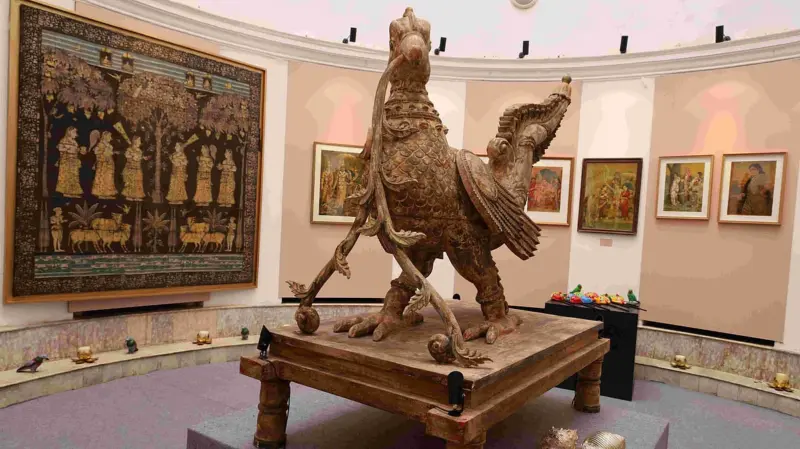
There are radiant Tanjore paintings, rich with gold leaf and intricate detailing, in which deities such as Raghunathan Swami, Panchmukhi Hanuman, Krishna, and Ashtalakshmi appear as though emerging from temple sanctums.
Mysuru reverse glass paintings are more delicate. Painted on the back of glass, works like Yashodha and Krishna, Venugopala, and Bala Krishna shimmer with colour and precision.
Then there are the iconic oleographs of Raja Ravi Varma - images of Lakshmi, Saraswati, Mohini, and Radha Rukmani - the kind of sacred imagery once found in almost every home. They evoke familiarity and nostalgia while also highlighting their role in making devotion accessible.
Bengaluru: Artist showcases tapestries and mixed media worksFrom the north, Pichwai paintings open up an entirely different world, filled with movement and narrative. Works like 'Shrinathji', 'Krishna under the Kadam Tree with Gopis', and 'Vintage Sharad' bring the pastoral landscapes of Vrindavan alive with music, celebration, and devotion.
When asked about the process of curating, Gujral responds, "Curation is a very personal and authentic process. It's not cerebral. It's about visually understanding which genres can come together to tell a story."
As the works come together, subtle connections begin to emerge. Gujral says she did notice overlaps, for instance, between Pichwai traditions and certain southern styles. But more than specific similarities, what stood out was how everything transformed when placed side by side. "When you put them together, they tell a very different story. It becomes a new visual expression," the curator remarks.
Unlike highly structured curatorial frameworks, Gujral's approach is guided by instinct. This instinctive approach also made it easier to bring together diverse forms. Having grown up around these traditions and worked closely with design, she was already familiar with their language. "I understand how to harmonise different elements without creating visual disharmony," she explains.
Among the many works on display, one holds special meaning for her. "The centrepiece of the show is the Annapakshi." It's a striking early 19th-century wooden sculpture. As the mythical vahana (vehicle) of Saraswati, it carries both symbolic and aesthetic weight. Placed within the exhibition, it becomes an anchor of sorts, connecting the spiritual with the material, the past and the present.
What also stands out is the presence of ritual objects, guardian figures, and sacred mounts. Reimagined here as artworks, they are part of lived practices, once used in temples, festivals, or homes. The pieces emphasise that devotion is not only visual. It is tactile, personal, and deeply embedded in everyday life.
The exhibition is on view till May 30 at Arzaani, Bikaner House, Pandara Road, New Delhi.