





In The Dark Knight Rises, Gotham is not conquered in a single dramatic stroke but softened with the cultivation of fear and the practice of control.
This allows for the appropriation of exceptional powers as the public has been conditioned to feel perpetually unsafe and hence extraordinary power begins to look like ordinary administration.
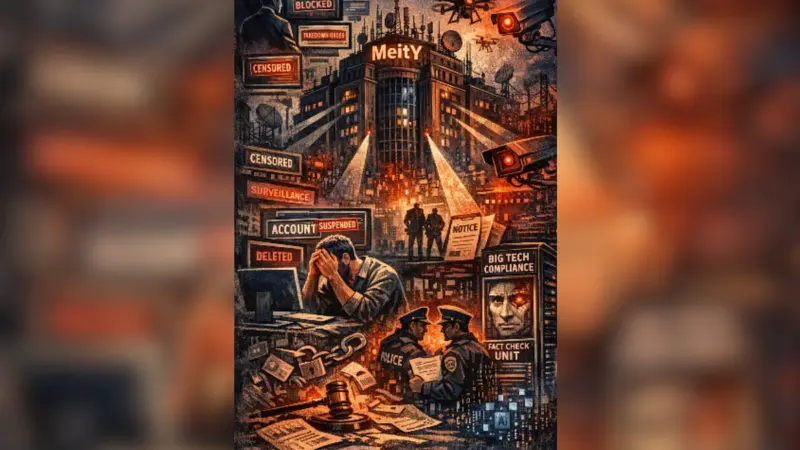
This provides a useful frame for understanding the digital censorship architecture assembled by the Ministry of Electronics and Information Technology (MeitY). Since February 2021, four expansions of the IT Rules have centralised executive power over what Indians may say, see, and share online, each presented as a minor technical adjustment, and wrapped up in the language of citizen safety.
The most recent draft, circulated on March 30, 2026, widens the net from news platforms to ordinary social media users who comment on news and current affairs, a move that plainly responds to the rise of independent commentators channelling citizen anger at public officials across the ideological spectrum. It also proposes to make informal communication such as advisories, clarifications, codes of practice to be legally binding on platforms.
Explained | Centre's draft IT rules: How are they going to affect social media creatorsThis not only exceeds the scope of the parent act but appears aimed at coercing platform compliance and redesign. For instance, if platforms are held liable for Community Notes and similar user-led fact-checking, they will remove the feature. While public pushback has been loud, the draft is only the newest layer in an 'India Censorship Stack' that already runs deep. The common principle of that stack is speed without scrutiny, prioritising pace of removal over due process. Hence, the user whose post, or even entire account, vanishes is rarely told why, or provided any real legal remedy to appeal.
Two provisions of the Information Technology Act, 2000 sit at the heart of this architecture: Section 69A, which governs blocking, and Section 79, which grants platforms safe harbour for user-generated content. Both were upheld in Shreya Singhal v Union of India but only because the Court read in safeguards that MeitY now flagrantly disregards.
Section 69A blocking orders are issued in secrecy, in volume, at velocity. Users who write to MeitY are denied copies of the orders against them. They are summoned to Delhi for meetings without being told what they are alleged to have done wrong. Section 79, meanwhile, has been twisted even further.
Consider the four amendments to the IT Rules, 2021 under Section 79 in sequence. The October 2022 amendment created a Grievance Appellate Committee, which is an executive body sitting in appeal over platform speech decisions and rewrote Rule 3 to require intermediaries to "ensure compliance" with their own terms and make "reasonable efforts" to keep prohibited speech content off their services. Takedown grievance windows shrank to 72 hours.
On the surface, the change was procedural. In substance, it was structural. It converted platforms from passive hosts into active enforcers, and positioned the Union government as the ultimate arbiter of permissible speech. The shift was unmistakable and required platforms to remove more, remove faster, do so under the shadow of government review.
In effect, our speech is being censored by the government via platforms that are meant to carry it.
The April 2023 amendment went further. Tucked alongside online-gaming provisions that were widely welcomed by industry was the fact-checking power under Rule 3(1)(b)(v). It required intermediaries to make "reasonable efforts" not to host speech that, "in respect of any business of the Central Government," was identified as fake, false or misleading by a fact-check unit designated by the Ministry itself.
In September 2024, the Bombay High Court struck down the amendment as unconstitutional. The Supreme Court issued notice in the Union's appeal in March 2026 but declined to stay the judgment. Therefore, the fact-check unit mechanism does not stand on secure legal footing.
The October 2025 amendment formalised the Sahyog portal, which is a one-stop online platform for police officers and bureaucrats across India to demand takedowns. Rule 3(1)(d) now provides that "actual knowledge" arises either from a court order or from a "reasoned intimation" issued by an officer of Joint Secretary rank or above (Deputy Inspector General in policing contexts), followed by monthly review by a Secretary-rank official. Removal is required within 36 hours.
Without safeguards
Presented as a safeguard, the change in practice does the opposite: it cements a centralised, portal-based censorship channel under Section 79, without the procedural architecture of Section 69A and the 2009 Blocking Rules. Hence, there is no public disclosure, notice or hearing for users or originators of content.
How many of the 29,118 takedown orders sent to X between January and June 2025 have been meaningfully reviewed by a Joint Secretary? The review process remains internal to the executive by the very body that passed the initial order. The Supreme Court in the landmark Shreya Singhal case tolerated Section 69A precisely because of recorded reasons, committee review, and the possibility of being heard. By contrast, these amendments treat constitutional rights as friction and reroute executive power into a parallel, lower-threshold censorship channel masquerading as a safe-harbour exception.
The February 2026 amendment built on this trajectory and intensified it further. The Rule 3(1)(d) takedown window collapsed from 36 hours to three. General grievance resolution timelines dropped from 15 days to seven. The window to take down intimate content fell from 24 hours to two, and other content, including speech, shrank from 72 hours to 36.
Alongside this, an entirely new regime was introduced for "synthetically generated information". Platforms offering tools that might create or disseminate such content are required to deploy "reasonable and appropriate technical measures," including automated systems, to prevent unlawful synthetic content. Lawful synthetic content must be prominently labelled and embedded with permanent provenance markers.
Further, significant social media intermediaries must require user declarations, verify them technically, and label confirmed synthetic content before publication. Failure to comply is treated as a breach of due diligence, which were originally largely about issuing terms and conditions.
This is the threshold being crossed. The amendment moves from reactive takedown toward pre-censorship and continuous platform surveillance. The definition of synthetic content is broad and subjective, hinging on whether material appears authentic to a "reasonable person." Platforms, facing legal risk, will deploy error-prone automated systems, label widely, remove quickly, and prefer false positives to liability. Compressed timelines make human review effectively impossible, and as ever, users receive no notice of the order that erased them.
Read together, the four amendments form a single trajectory. The distinction between lawful assessment and platform-side compliance management has been merged. Power thus shifts from courts and the structured safeguards of Section 69A towards executive discretion and the platform's own profit incentives to maintain access to the Indian market.
It is an infrastructure that has been assembled in public, one rule at a time, while attention is often focussed on individual instances of censorship, cases that trigger responses shaped by personal and political beliefs, and are sometimes even defended in the name of safety.
In The Dark Knight, Bruce Wayne hands Lucius Fox a machine that turns every phone in Gotham into a sonar receiver, mapping the city in real time. The purpose is urgent and the threat is real but Fox understands the deeper danger. The problem is not merely who uses the device but the very existence of it legitimises extraordinary power. As history has shown, unaccountable power built for exceptional use does not remain exceptional for long.
That is the frame for MeitY's censorship architecture. Each amendment is justified as necessary, targeted and reasonable, or perhaps even procedural. Each one is framed as a response to some urgent harm ranging from misinformation to deepfake crises. But the deeper constitutional injury lies in the system being built: a state equipped to secure removals at speed, in secrecy, and at scale, with only weak obligations to explain itself to those whose rights it burdens.
There is, unfortunately, no Lucius Fox at Electronics Niketan but only a permanent Digital Public Infrastructure for censorship.
(Apar Gupta is the Founding Director of the Internet Freedom Foundation and Nikhil Pahwa is the Founder of Medianama)