




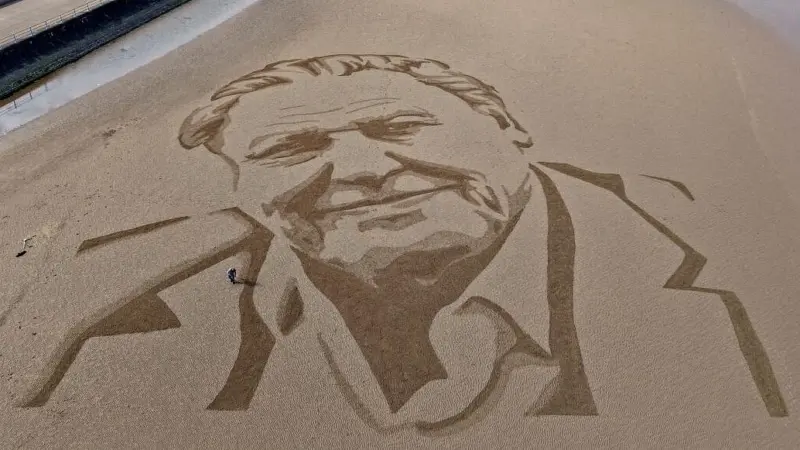

If you look up "national treasure" in the dictionary, I'd half expect to find a picture of Sir David Attenborough. As he turns 100 on Friday, his remarkable career speaks to both our changing planet, and a shifting media industry.
Over his eight decades working in television, the broadcaster and natural historian has accumulated a diverse list of credits. He commissioned the seminal sketch series Monty Python's Flying Circus, launching the careers of Michael Palin and John Cleese. As BBC Two controller in the 1960s, he realized white tennis balls were difficult to follow on the new wave of color TVs, and lobbied the International Tennis Federation to switch to colored balls; a few years later, fluorescent yellow became the industry standard.
But he will, of course, be most remembered for his service to and passion for the natural world. As the face and voice of groundbreaking documentaries including Life on Earth (1979), a thirteen-part series that begins with an entire hour on algae, The Blue Planet (2001) and the Planet Earth series (2006, 2016, 2023), Attenborough has inspired multiple generations of wildlife lovers, researchers and conservationists.
Don't mistake UAE's OPEC exit for an Indian winTestament to his influence on fellow naturalists is the sheer amount of flora and fauna named after him, from Attenborosaurus, a genus of plesiosaurs (that's an extinct group of marine reptiles from the age of the dinosaurs), to Zaglossus attenboroughi, a critically endangered species of echidna residing in New Guinea. He added another to the collection recently - albeit this time in the form of a single creature: In a short video tribute by UK conservation charity Whitley Fund for Nature (WFN), ecologist Rodrigo Medellin - aka "Bat Man of Mexico" - holds a disgruntled woolly false vampire bat to the camera and names him David.
Attenborough's approval level with the general population is extraordinary, particularly in an age where experts and establishment figures are viewed with distrust. According to YouGov's popularity tracker, he is by far the most beloved celebrity, with 91% of respondents holding a favorable view of him as of the latest update in April. There are surely a few skeptics out there - in my research, I came across exactly one - but his ratings speak for themselves. His documentaries still draw in millions of viewers: The first episode of his 2023 series Planet Earth III, for example, attracted 10.6 million UK viewers in its first 28 days, becoming one of Britain's highest-rated programs of the year ( beaten only by the King's coronation, Eurovision and drama series Happy Valley).
They're also highly influential. Wild Isles, a 2023 series focusing on British wildlife, highlighted the problems commercial fishing causes for sandeels, a major source of food for seabirds such as puffins and kittiwakes. Thérèse Coffey, the then-environment secretary, says knowing that the series was coming helped on timing and securing the cross-Whitehall agreement required to ban sandeel fishing. The Royal Society for the Protection of Birds, a conservation charity, had been lobbying for the closure of industrial sandeel fisheries for more than two decades.
How has one man become so universally respected and trusted? His longevity counts for something. Born just weeks after the late Queen Elizabeth II, another overwhelmingly popular public figure, he's been a constant presence for many, especially in the UK. Attenborough's first TV productions were in black and white, and he started filming at an opportune time - commercial air travel wasn't yet widely accessible and the natural world was in much better shape than today. He became our window to a wild and pristine planet.
It's hard to imagine now, but when Pablo, a three-year-old gorilla, was broadcast crawling on Attenborough in Life on Earth in one of television's most iconic sequences, most viewers had never seen footage of mountain gorillas in their natural habitat. With King Kong then pop culture's dominant gorilla, Attenborough not only offered the public this first glimpse of the great ape, but the first portrayal of them as friendly, playful creatures not that different from ourselves. The scene - and Pablo's descendants - are revisited in Netflix's new A Gorilla Story. Greater awareness of these gentle giants has paid off. Today, there are at least 600 mountain gorillas in the Virunga Mountains - more than twice as many as when Attenborough visited in the 1970s.
In 1994, the director general of the BBC tasked Alastair Fothergill, producer of A Gorilla Story and other Attenborough documentaries, with finding the new David Attenborough. Fothergill knew then, as we all should know now, that it was an impossible task. In the second season of An Idiot Abroad, a TV show produced by comedians Ricky Gervais and Stephen Merchant, the show's presenter, Karl Pilkington, hints at why that is. Asked whether there's a gap in the market for him to be the new Attenborough, Pilkington says: "I'd like to do it…but everyone knows too much these days."
There's a lot of truth in that - it's never been easier to travel to the Galapagos Islands to see marine iguanas and giant tortoises or to Kenya to see rhinos. It's also never been easier to produce video. As we face a future without Sir David, we're living in a time with more Attenborough-wannabes than ever before. But the way the media industry now operates all but ensures his success won't be repeated. To make it big as a influencer or personality, content creators - whether on TV or social media - have to build up a personal brand, selling either themselves or products to have a chance of making a living. In contrast, Attenborough never made himself the story, but merely acted as an ambassador and storyteller for the real stars: the animals themselves.
When Attenborough started, wildlife was also mostly not a political topic. That's no longer the case. As Fothergill tells me: "David has seen more of the natural world than anybody who's ever lived on our planet, but also significantly, he's seen more change than anybody else on our planet, because of the timing of his life." That's clear in the content of his documentaries. Once criticized for presenting wildlife through rose-tinted glasses, his later works haven't turned away from the damaging impact our own species has wrought upon the natural world. But he was right in his instinct that each new generation has to know nature in order to be given a chance to love it.
After all, we want to protect what we love: Medellin, along with a whole host of other WFN-supported conservationists, say Attenborough inspired their life's work. In the video, Medellin instructs the bat to smile for the camera before releasing him back into a Mayan temple to rejoin his colony. His name, and his home, can be credited to the one and only Sir David Attenborough.
Disclaimer: The views expressed above are the author's own. They do not necessarily reflect the views of DH.
By Lara Williams