





Sometimes, my nightly ritual of doomscrolling and laughing a little too hard at questionable reels unexpectedly yields sharp insights.
One evening, exhausted after a long day at work, I opened Instagram and was midway through sending reels to "my three favourite people" when a particular post gave me pause.
It was a carousel on Indian handloom motifs and their significance. I patiently swiped through the 15-odd slides, reading about each one. When I reached the end, it struck me: there was nothing from South India. I'm no expert, but even I could name a few off the top of my head - gopuram, vanki, yazhi, and mallige motu, for instance.
It may sound trivial, but there I was, once again feeling alienated in my own country. It's a familiar feeling for many South Indians, I'm sure. Why must we fight for representation in every little thing, I wondered - our languages, our cultures, even the simple fact that we are five distinct states, a concept easy enough for a snotty six-year-old to grasp? But I digress.
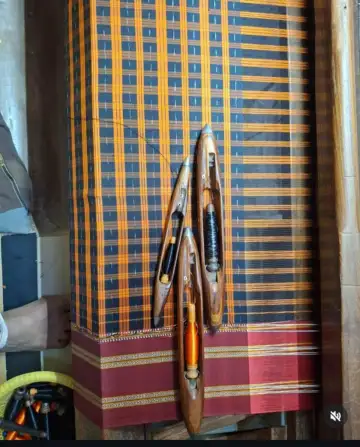
A sari woven in Bagalkot from handloom enthusiast Uma Rao's collection that was recreated for the 2025 Hampi exhibition, 'Pampa: Textiles of Karnataka'.
That Instagram post, and my resulting indignation, got me thinking. It eventually led me to an extremely rare handloom tradition from Karnataka: the use of ikat techniques in Ilkal weaving.So rare is this feature that several textile experts and connoisseurs I spoke to were completely unaware of its existence.
I was not deterred, though. I continued my search and found an answer of sorts in the collection of an acquaintance, Uma Rao, who lives in my neighbourhood. Uma, who has been in the business for over 50 years, runs an antique store in Benson Town in Bengaluru and has an extensive personal collection of handloom saris.
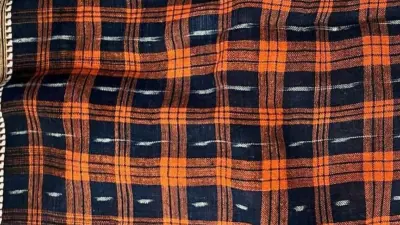
She has been collecting saris since her twenties. When I asked if she knew Karnataka had an ikat weaving tradition, she replied, "Yes, I do," and sent me a photograph of one of her saris: a black Ilkal from Bagalkot, with orange checks, a gomi border, and contrasting white ikat motifs. It was a very old piece, with a design that is practically non-existent in the market today.
In fact, the sari was recreated by textile expert Lavina Baldota for her exhibition 'Pampa: Textiles of Karnataka', held in Hampi last year. "Ikat was woven in three regions of Karnataka - Shorapur, Gulbarga and Molakalmuru," said Lavina, and added that she is attempting to revive these forgotten textiles through exhibitions like 'Pampa'.
Indian Handlooms showcase contemporary global designsI was sure I would gain more insight from Pavithra Muddaya, best described as a second-generation textile revivalist. As co-founder of Vimor Saris and The Vimor Museum of Living Textiles, she has worked closely with weavers across South India for over half a century. Sure enough, she offered some valuable insights. "The way I see it, it was probably the result of weaver migration from Andhra Pradesh to Karnataka, or Karnataka weavers replicating what they saw on their travels in the neighbouring state," she explained, adding that there was little else to say about the tradition.
It fascinated me nonetheless. That Karnataka had its own version of ikat, though fleeting and minimal, says much about the richness of its weaving traditions. "It was quite common at one point, but not anymore. I have not seen these motifs for over a decade," she said. The chikki, a single-ikat motif, was once common in puja saris, she noted.
Geeta Patil, who has worked with weaving clusters in north Karnataka since 2019, expressed regret at the loss of these techniques. "I think Shorapur in Yadgir district was known for its own version of ikat at some point, but all that is lost now," she said, lamenting the lack of documentation of north Karnataka's weaves.
She also introduced me to another Karnataka ikat motif, bekkina hejje, which she is currently recreating for a line of saris under her clothing label. As its name suggests, the pattern resembles a cat's paws.
The single-ikat weave she is replicating has a pure cotton body and a silk pallu. "Our weavers in Ilkal just finished the dyeing process and will be putting the yarns on the loom once we find a skilled ikat weaver," she revealed. Bekkina kannu, meanwhile, is another motif resembling cats' eyes.
There is so much that goes into reviving a sari. We instinctively think of the loom, but "there are so many factors that must feed into it," Geeta said. "You see a 100-year-old sari and think, 'It would be nice to recreate this.' I would love to do that too. But we must think about the dyeing facility, find the right yarn, find a knowledgeable weaver and so on. I sometimes find myself struggling with all the additional requirements," she admitted.
In early 2026, I was invited to 'Ikat. Itihaas. Kahaani', an exhibition and film screening by Aadyam Handwoven, centred on Indian ikat and Shyam Benegal's Susman. "Ikat is sheer geometry and precision at play. Threads tied, dyed and arranged to make motifs emerge on the loom are beyond fascinating.
The irregularities truly define its character - the haze and the blur add to its uniqueness," said Manish Saksena, a textile enthusiast and business lead at Aadyam. Released in 1987 and starring Shabana Azmi, Neena Gupta and Om Puri, Susman highlights the struggles of ikat weavers in Pochampally. Nearly annihilated by powerlooms and industrialisation, they must resist shortcuts and temptation to remain true to their craft. It dawned on me that this fight for survival, even for a sari as sought-after as Pochampally ikat, has gone on for over four decades. It left me wondering: where do Karnataka's lesser-known weaves stand?
The writer has been a fashion journalist for a decade and hopes to unravel textile tales one elegant weave at a time.
Loom Chronicles is a new monthly column on handlooms, their signature elements, diversity and the history hidden within their folds.