






Few artists have shaped the trajectory of modern Indian art as profoundly as Tyeb Mehta. Yet, despite his towering stature in the art world, surprisingly little comprehensive scholarship has been devoted to his practice.
That gap is now addressed with 'Tyeb Mehta', the first major volume devoted to the artist's oeuvre in over two decades and among the most exhaustive studies of his work ever assembled.
Published by the Kiran Nadar Museum of Art (KNMA) in collaboration with the Tyeb Mehta Foundation and Saffronart, the book emerges from the landmark centennial retrospective Tyeb Mehta: Bearing Weight (With the Lightness of Being), curated by Roobina Karode. More than an exhibition catalogue, it is a critical reassessment of an artist who transformed personal trauma and collective upheaval into one of the most distinctive visual vocabularies in post-Independence India.
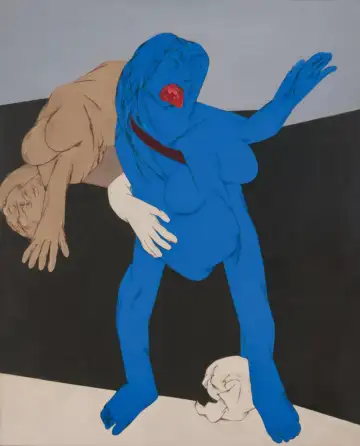
One of Tyeb Mehta's works.
The significance of the publication lies not merely in its scale but in its ambition. For the first time, Mehta's entire artistic journey is examined across every medium he explored - painting, drawing, sculpture and even cinema through Koodal, his rarely seen 1970 experimental film. Richly illustrated and supported by essays from leading scholars, the volume traces the evolution of recurring motifs that became synonymous with his practice: the falling figure, the trussed bull, the falling bird, the diagonal slash and his powerful reinterpretations of Kali and Mahishasura.
Existential tension on canvas
Born in 1925 in Kapadvanj, Gujarat, Mehta came of age during one of the most turbulent periods in South Asian history. The trauma of Partition left an indelible imprint on his imagination. He famously witnessed a mob killing in Mumbai during the communal violence of the 1940s, an experience that found expression in the fractured bodies and existential tension in his canvases.
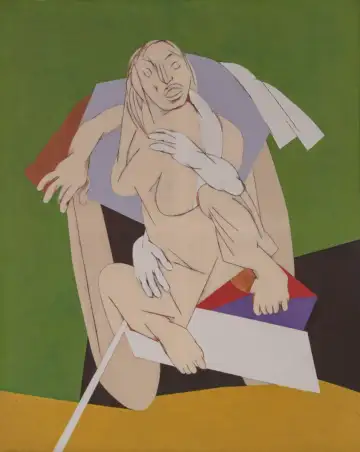
One of Tyeb Mehta's works.
Unlike many of his contemporaries, Mehta resisted narrative excess. His genius lay in minimalism. Over a career spanning more than five decades, and through extraordinary economy, he distilled violence, displacement and psychological conflict into forms of startling clarity.
This achievement places him among the most important artists of India's first postcolonial generation. Alongside members of the Progressive Artists' Group, with whom he shared friendships and intellectual affinities, Mehta helped forge a modern visual language for a newly independent nation.
Saffron, white, saffron again: The colour war at Kolkata's 90-year-old Academy of Fine ArtsThe new publication pays particular attention to his evolution as an artist. While his early works reveal thick brushwork and restless energy, later paintings display the geometric precision that became his hallmark. Despite his brilliance, Mehta often spoke about the difficulty of painting. "The process of painting is not easy for me," he once remarked. "I struggle at every step. I destroy many paintings before one finally emerges."
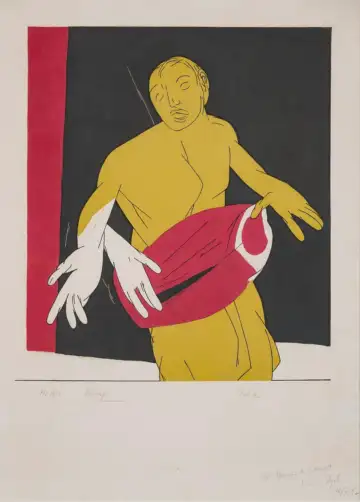
One of Tyeb Mehta's works.
That relentless self-editing is evident throughout the book. Each canvas appears as the result of intense negotiation rather than spontaneous inspiration. The famous Diagonal Series, for instance, demonstrates how a single formal device could generate immense emotional force.
Similarly, works depicting Mahishasura and Kali reveal how Mehta transformed mythological subjects into meditations on conflict, duality and human vulnerability.
Burdens of memory
The book's essays move beyond market narratives and auction records to explore the philosophical concerns underlying the work. They reveal an artist grappling with the burdens of memory while searching for visual order amid chaos.
For younger audiences encountering Mehta primarily through headlines about record-breaking auction prices, the publication reminds them that his significance extends far beyond the marketplace. His contribution lies in demonstrating how modern Indian art could engage universal human questions without dishonesty.
In that sense, the book arrives at an important moment. As museums, scholars and collectors increasingly revisit Indian modernism, it provides an authoritative resource on one of its most inclusive practitioners, documenting a remarkable body of work while making a compelling case for its enduring relevance.
More than a tribute, this volume reaffirms why Tyeb Mehta remains indispensable to any understanding of modern Indian art. Few artists carried the weight of history so heavily. Fewer still transformed that burden into images of such lasting power.