
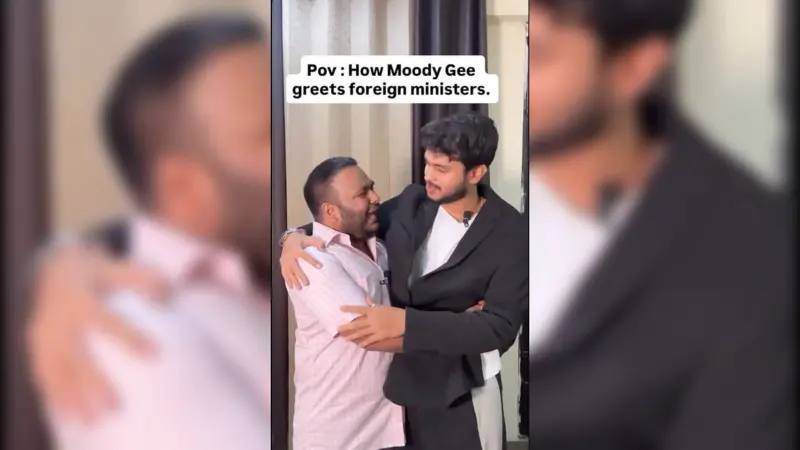

A wildly viral comedy sketch mimicking Prime Minister Narendra Modi has triggered a debate about the limits of humour and whether satire, a legitimate form of criticism in a democracy, is being curbed.
The sketch, acted out by two unnamed actors and shared by political commentator-activist Dhruv Rathee, was taken down last week, reportedly under Section 79(3)(b) of the Information Technology Act, 2000.
The video reposted by Rathee garnered over 15 lakh views on X, and the government's action has reignited conversations about censorship and creative freedom.
Stand-up comedian Ashwin Srinivas says all "satire is rooted in reality", and taking down a satirical video is unjustified. Such restrictions are becoming common, he says. "The lines around what is acceptable are increasingly vague," he says. Comedian Dr Anil Abraham, who posts sketches on contemporary life, argues that in a democracy, restricting freedom of expression is "not the answer".
Cartoonist Satish Acharya calls humour "a legitimate form of criticism in a democracy," adding that banning such videos is undemocratic. "Humour is a powerful tool to question and ridicule those in power. The real target here is to curb criticism," he says.
However, comedian Shrirupa Sengupta disagrees. "The issue here is not criticism but its nature. This video isn't about governance. Targeting someone's personality or background crosses a line," she says.
Anxious times
India enjoys a long tradition of political satire, explored by magazines such as 'Shankar's Weekly' and Cho Ramaswamy's 'Thuglaq', Abraham says, observing that the current climate is making humourists cautious.
He observes that comedians often preface their jokes with disclaimers, and audiences respond hesitantly to politically sensitive material.
While defending creative freedom, Acharya adds that most comedians, cartoonists and journalists are responsible when they question or criticise the government. "They work within boundaries and are careful not to spread hatred. More than restricting topics, intent and impact matter," he says.
What is off limits?
Quoting comedian Ricky Gervais, Abraham says humour can interrogate ideas without causing personal harm. He draws the line at disability and what he calls "blatant misogyny". He is uncomfortable with "excessive profanity," but admits such limits are subjective.
Srinivas believes any topic can be explored through humour, with nothing strictly off-limits in principle. "Intent and context matter," he says. With the stand-up scene rapidly expanding, "there are more comedians, audiences and platforms than ever before," he says, adding that exposure to international acts is "broadening audience perspectives".
Graphic novelist-comedian Falah Faisal says the line should be drawn at targeting "those more vulnerable than you". He avoids sketches on topics like sexual violence and queer sexuality.
Shrirupa emphasises responsibility. "If we're laughing at someone's background, something is wrong. Context matters - when people know it's not hatred but hilarity, the response changes," she says.
Humour is contextual, and you can't do every kind of humour everywhere, she argues. Her advice: "You must know your audience."
Cost of virality
Srinivas notes that viral content often attracts more negative comments than positive ones. Having spent years putting content online, he largely ignores personal attacks. "You realise not everything will work for everyone, and that's okay," he says.
Abraham's experience has largely been positive, aided by his "sugar-coated satire". However, "when content spills onto more vocal platforms, trolling and veiled threats become more common".
Ironically, negativity boosts traction, he says, as he recalls occasionally responding to some comments to counter misinformation. Shrirupa has faced online trolling and even a walkout during a show on menstrual health. "If something feels threatening, I step back till I feel safe. I reflect and learn from it," she says.
Often, a backlash is created by anonymous accounts. The same happened with a recent post on Umar Khalid. Faisal says, "A lot of the comments are from fake accounts. I just block them and move on. There's no conversation there."