




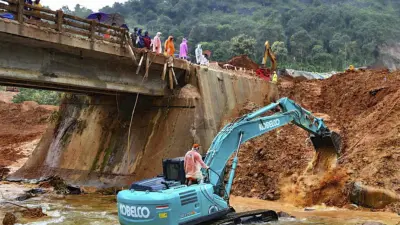

There is a tragic familiarity to the images from Kalladi, in Wayanad: torrential monsoon rain, collapsing slopes, rescue teams battling unstable terrain, and grieving families have once again become part of Kerala's annual vocabulary.
The landslide at the Anakkampoyil-Kalladi-Meppadi twin-tube tunnel construction site, which claimed lives and left several workers missing, is not merely another natural disaster, but an indictment of our recurring failure to distinguish nature's fury from human folly.
While climate change has undeniably intensified extreme rainfall along the Western Ghats, rainfall alone cannot explain why some slopes collapse while neighbouring hillsides remain stable. The difference often lies in disturbed geology, altered drainage, indiscriminate excavation, unstable debris disposal, and engineering decisions that underestimate the ecological fragility of mountain landscapes.
Wayanad mudslide | Pinarayi Vijayan defends twin-tunnel project clearances as death toll rises to 6The Kalladi disaster reflects the convergence of natural hazard and governance failure. The Kerala government has ordered two investigations, suspended construction, and initiated scrutiny into compliance with environmental and forest clearance conditions, while senior ministers have described the tragedy as a 'man-made disaster', citing unscientific dumping of excavated earth that may have destabilised the slope during intense rainfall.
If confirmed, Kalladi will represent a preventable failure of planning, supervision, and accountability rather than an unavoidable act of nature. The 8.7-km tunnel was conceived to ease chronic congestion, accidents, and monsoon disruptions on the Thamarassery Ghat Road, improving connectivity between Kozhikode and Wayanad. Kerala needs such infrastructure, but not at the cost of undermining the ecologically fragile landscapes on which its long-term sustainability depends.
Environmental experts, geologists, and civil society had long warned that construction through the biodiversity-rich Western Ghats required safeguards far beyond conventional highway engineering, given the region's critical role in regulating rainfall, recharging rivers, and sustaining millions downstream. Kerala has repeatedly learnt this at enormous human cost - from the 2018 floods to successive landslides across Idukki, Kottayam, and Wayanad, culminating in the devastating Wayanad disaster of 2024 - all demonstrating how extreme rainfall combined with altered land use triggers catastrophe. Expert committees have consistently argued that disaster mitigation must begin with scientific land-use planning, cumulative environmental assessments, and continuous geological monitoring before, during, and after construction. Yet Kerala's disaster memory often proves shorter than its monsoon.
Governments inherit projects from their predecessors, but they also inherit the responsibility. The state Cabinet's decision to halt construction pending investigation was a necessary first step. The chief minister's visit to Kalladi, after he declared a comprehensive technical and legal inquiry into the disaster and compliance with environmental safeguards, now places the onus on the government to ensure that these assurances translate into institutional reform. It becomes a turning point when the findings are made public, responsibility is held to account without political calculation, and engineering practices are fundamentally reformed.
Kerala's larger challenge is institutional. Environmental Impact Assessments are too often treated as procedural formalities, while compliance with debris management, drainage, slope stabilisation, and groundwater monitoring frequently weakens after construction begins. Independent oversight, community participation, transparent audits, and continuous scientific supervision remain inadequate, particularly in the ecologically fragile Western Ghats, where excavation-induced instability may manifest years later during intense monsoons. While extreme rainfall may trigger disasters, vulnerability is created over time.
Kerala must reject the false choice between development and conservation by pursuing infrastructure through rigorous geological assessments, adaptive engineering, scientific excavation, and strict environmental compliance. If negligence is established in Kalladi, accountability must extend beyond contractors to every level of supervision, with inquiry findings made public and safeguards strengthened through independent scientific review.
As climate change intensifies rainfall and development expands into fragile terrain, Kerala must place geological intelligence at the heart of policymaking through cumulative impact assessments, real-time geotechnical monitoring, rainfall-triggered safety protocols, independent oversight, and rigorous enforcement. The dead of Kalladi deserve more than condolences; they deserve a State willing to learn.
The Western Ghats will continue to receive torrential rain. Whether that rain sustains Kerala or buries its people depends not only on the clouds but on the wisdom with which we shape the land beneath. Ecological prudence is not an obstacle to development, but its first condition - because nature keeps score.
Amal Chandra is an Indian author and policy analyst, serving as a core member of the policy department, Kerala PCC. X:@ens_socialis.
Disclaimer: The views expressed above are the author's own. They do not necessarily reflect the views of DH.