

How many of you have lost your voting rights?" Mamata Banerjee asked, pacing down the podium in her trademark style. Over 60% of the crowd, mostly women, raised their hands.
"Eh!" the chief minister paused in disbelief and exclaimed, "Who will vote then?"
The Trinamool Congress rally at Enayetpur in Malda offered one of the many snapshots of the Special Intensive Revision (SIR) of the electoral rolls in West Bengal and its impact on people.
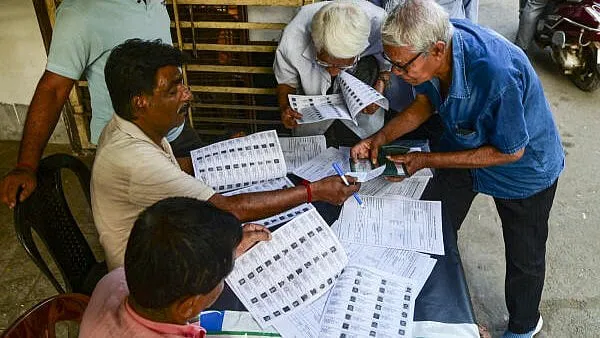
Move to Rampurhat in Birbhum district. Hundreds of voters struck off the rolls stood in a long queue in front of the Sub-Divisional Officer's office to file appeals before the tribunals. Word suddenly spread that the documents for the tribunals would be accepted at a college nearly a kilometre away. A mad rush followed, as women and men, desperate to get back on the rolls, ran to queue up outside the college.
The scene was even more harrowing in Suri, nearly 50 km from Rampurhat. "I have already submitted all the documents they asked for, not once, but thrice, since the revision started, but they still deleted me from the rolls," said Meera Dolui, who left her home in Husnabad early in the morning to come to Suri and waited for hours in a queue to submit her documents for the fourth time. "If the tribunal rejects my appeal, I don't know where I will go".
When process overrides the Right to VoteTanuja Bibi, who came from Dubrajpur to Suri, fainted just after submitting her documents to challenge her disenfranchisement. "My wife fell sick while we were waiting in the queue," said her husband, Mukim Sheikh, who was also struck off the list. "But we could not have left the queue after waiting for so long, else we would have had to come back another day."
Jiban Krishna Biswas left his home in Garapota, Nadia district early in the morning with his daughter Champa. The father-daughter duo - both deleted from the voter lists - walked, rode an autorickshaw, and then took a train to reach Ranaghat. They had set out to file appeals before the tribunal and seek restoration of their voting rights.
But, before they could do so, Jiban suffered a cardiac arrest. He was taken to a hospital, where he was declared dead. The 68-year-old, who worked as a cook at a construction site to support his family, had voted in many elections in his life, but died without that right.
He was not alone. Anarul Sheikh, 32, died by suicide at his home in Nalhati in Birbhum, allegedly after discovering that his name was deleted from the electoral roll last week. So did Kabil Sheikh, 37, at Sahapur in Malda.
Four more deaths linked to the deletion of names from electoral rolls have been reported in the state over the past two weeks.
Mamata alleged that the roll revision exercise had claimed about 220 lives across West Bengal. The Election Commission did not endorse the claim.
The Bharatiya Janata Party (BJP) accused her of exaggeration and of using natural deaths to discredit what it said was an essential process to clean up the electoral rolls.
The Election Commission (EC) commenced the SIR of electoral rolls in West Bengal on November 4, 2025, about six months before the assembly elections. The electorate shrank from 7.66 crore before the start of the revision to 7.08 crore after the first phase ended on December 16, with about 58 lakh names struck off as ASDDs - the absent, shifted, dead and duplicate voters.
Massive voter purge controversy deepens
In the second phase, which began on December 27, 2025, 1.67 crore voters under scrutiny were summoned for hearings, including 1.36 crore flagged for "logical discrepancies" and 31 lakh others whose details did not match or link with records from the 2002 electoral roll.
The commission published another roll at the end of the process on February 28, with around 63.66 lakh voters, nearly 8.3% of the electorate, being deleted in total. In addition, over 60.06 lakh others were placed in the "under adjudication" category, with their eligibility subjected to scrutiny by judicial officers monitored by the Calcutta High Court, as directed by the Supreme Court.
The EC data released on April 6 and 7 showed that over 27 lakh people placed in the "under adjudication" category had been struck off the rolls, sending them back into queues across the state to appeal before the 19 appellate tribunals constituted for the purpose, in line with Supreme Court orders.
However, with the electoral rolls for all 294 Assembly constituencies in West Bengal now 'frozen', with the deadlines for filing nominations being over, the 91 lakh disenfranchised people will not be able to cast their votes, even if the tribunals restore their rights before the state goes to polls on April 23 and 29, unless the Supreme Court intervenes. The electorate in the state has been shrunk to about 6.77 crore.
At loggerheads
The EC and the TMC have been at loggerheads since the roll revision began in West Bengal. The party has accused the poll panel of conducting the exercise at the behest of the BJP to give the saffron party an edge in the Assembly elections.
The chief minister alleged that the removal of several senior bureaucrats and police officers after the poll schedule was announced has contributed to the situation in which seven judicial officers were held hostage by mobs protesting disenfranchisement in Kaliachak, Malda.
The latest flashpoint came on April 8, when the TMC parliamentarians alleged that the chief election commissioner had asked them to "get lost" during a meeting at the Nirvachan Sadan. The EC later posted on X its "straight talks" to the TMC - that elections in West Bengal "this time" would be "violence-free", "intimidation-free", and "inducement-free", as well as "without any chhappa (large-scale fake voting), booth jamming and source-Jamming". The unprecedented post on social media appeared to echo the BJP's allegations about the methods the TMC had used to win elections in the past.
The TMC won 213 of the 294 seats in the 2021 Assembly polls, securing 3.28 crore votes (47.9%), while the BJP secured 2.63 crore votes (38.1%) and 77 seats. The 91-lakh deletion from the electoral rolls exceeds the 65-lakh vote difference between the TMC and the BJP.
A study by the Sabar Institute in Kolkata found that Muslims account for nearly 25% of residents in Nandigram but constituted around 95% of voters deleted during scrutiny by the judicial officers. The study also revealed that over 40% of voters removed after adjudication in Bhabanipur were Muslims, although the community accounted for around 20% of the population. Suvendu had defeated Mamata in Nandigram by a narrow margin in 2021.
The North and South 24 Parganas have recorded the highest voter deletions since the SIR began in November 2025, with 12.6 lakh names struck off from 83 lakh voters and 10.91 lakh from 85.94 lakh, respectively. In 2021, the TMC had won 28 of 33 seats in North 24 Parganas and 30 of 31 in South 24 Parganas, while the BJP secured five and none, respectively. The Muslim-majority Murshidabad (66%) and Malda (51%) districts saw the sharpest deletions from among "under adjudication" voters - 4.55 lakh and 2.39 lakh, respectively.
What may also give the BJP an edge is that around 57 lakh of the deleted voters are women - a constituency the TMC has carefully consolidated as one of its most dependable support bases, second only to the minority community, through welfare schemes such as Kanyashree and Lakshmir Bhandar.
Not without costs
However, for the BJP, the gains from the roll revision are not without costs. The deleted voters include a large number of Hindu Matuas, who migrated from Bangladesh to India, and have since grown into a significant electoral force that could influence outcomes in around 45 constituencies in West Bengal.
"The BJP leaders said that the revision of the rolls was aimed at detecting and deporting illegal Muslim migrants. But why are they now targeting Hindu Matuas, who came here as refugees?" said Navin Biswas, a leader of the community, who had hosted Home Minister Amit Shah at his modest home in New Town, Rajarhat, for lunch a few years ago. "We are disappointed with the BJP leaders of the state and the Centre."
The TMC insiders pointed out that a majority - around 57 lakh - of the 91 lakh deleted voters were Hindus, while around 31 lakh were Muslims. "The BJP claimed that the roll revision was necessary to protect Hindus. But the exercise has hurt Hindus the most in West Bengal," said a senior leader of the ruling party.
Prakash Chik Baraik, a Rajya Sabha member, has been camping in Alipurduar to oversee the TMC's poll preparations. "We have provided legal help and aid to people struck off the electoral rolls. The SIR will ultimately hurt the BJP as it has put people in great trouble," he said.
Three subdivisions in Cooch Behar - Dinhata, Mathabhanga and Mekhliganj - are most affected by the SIR. Some of these areas share borders with Bangladesh. The roll revision has become a huge issue with the people, who were promised Indian citizenship following the exchange of 162 enclaves under the 2015 agreement between India and Bangladesh. The dwellers have been demanding that their names be included based on the 2015 electoral rolls and not the 2002 documents.
A Supreme Court bench led by Chief Justice of India Surya Kant clarified that the court was not suggesting that every tribunal decision delivered on the final day must automatically be incorporated. However, where rulings extend beyond the cut-off, inclusion in the supplementary list may not be feasible.
The court then emphasised that such rights cannot be permanently extinguished, warning that denying them altogether voting rights would create an "extremely oppressive situation." The court permitted appellate tribunals to consider fresh documents in electoral roll disputes, but only after verifying their authenticity.
(With inputs from Ashish Tripathi in New Delhi and Sumit Pande in Darjeeling)