
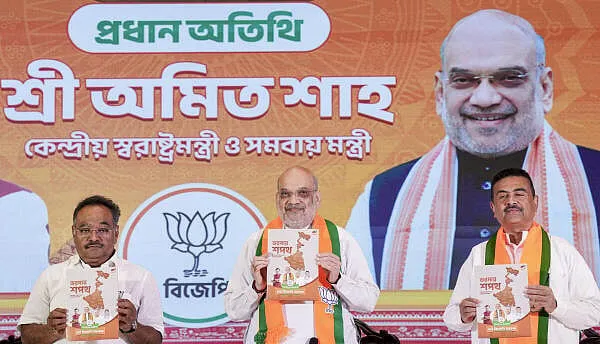

Kolkata: Ahead of the West BengalAssembly elections, the BJP on Friday changed its messaging, combining Bengali culture with its Hindutva pitch to counter the Trinamool Congress's "anti-Bengali" charge.
The party's manifesto, unveiled by Union Home Minister Amit Shah, placed unusual emphasis on Bengal's cultural legacy, invoking figures such as Rabindranath Tagore, Chaitanya Mahaprabhu and Rajbongshi icon Thakur Panchanan Barma, alongside promises centred on heritage and regional pride.
"To promote Bengal's culture, we will build a Vande Mataram Museum. Through this museum, Bengal's culture, already admired across the world, will gain fresh recognition and revival," Shah said.
In a departure from its earlier campaigns that foregrounded issues like infiltration and nationalism, the BJP repeatedly stressed themes such as "Bangla's glory", "Bengal's civilisation" and "Bengali Hindu cultural identity", suggesting an attempt to localise its ideological pitch.
The manifesto outlined a series of cultural and institutional initiatives, including a Chaitanya Mahaprabhu spiritual circuit, Tagore-inspired cultural centres, a modern theatre institute and an increase in annual grants for theatre groups to Rs 1 lakh.
It also proposed scholarships for young artists and initiatives to preserve and promote Tagore's work at both national and global levels.
Tapping into regional aspirations, the BJP promised to include Kurmali and Rajbongshi languages in the Eighth Schedule of the Constitution and recognise regional figures such as Thakur Panchanan Barma.
West Bengal Assembly Elections 2026 | 'Fighter Didi' teaser casts Mamata as lone shield, signals TMC's battle pitch for pollsUnder a "One District One Product" plan, the party said it would promote local industries and crafts, Murshidabad silk, Nadia taant, Uttar Dinajpur's shola craft, on larger platforms.
The manifesto further promised to elevate major cultural events such as Gangasagar Mela, Mahesher Rath Yatra, Baruni Mela and Bandna festival to international status, while pursuing UNESCO intangible cultural heritage recognition for them.
It also proposed a Shaktipeeth circuit linking key religious sites across the state, blending pilgrimage with cultural outreach.
Addressing concerns raised by the ruling TMC, Shah rejected "rumours" that a BJP government would interfere with Bengal's food habits, including fish consumption.
The document also included a promise to enact a law ensuring "freedom of religious faith and worship", stating that individuals would have the right to practise religion without restrictions.
The recalibrated messaging comes against the backdrop of the BJP's mixed electoral record in the state. After a strong performance in the 2019 Lok Sabha elections, winning 18 of 42 seats with around 41 per cent vote share, the party failed to translate that momentum into victory in the 2021 Assembly polls, where the TMC secured 213 seats against the BJP's 77.
Chief Minister Mamata Banerjee had framed that contest as one between Bengalis and "outsiders", backed by the slogan "Bangla Nijer Meyekei Chai", consolidating regional identity as a decisive political factor.
Since then, the BJP has struggled to shake off the perception of being culturally disconnected from Bengal.
Will win Bengal polls, then 'capture Delhi': Mamata at state election rallyThe latest manifesto indicates an effort to reposition the party as rooted in the state's own cultural and civilisational traditions, combining religious symbolism with language, literature and regional pride.
BJP leaders have increasingly invoked not just "Jai Shri Ram" but also "Jai Ma Kali", "Jai Ma Durga" and references to Tagore in their messaging.
Shah linked the party's vision to the period between Poila Baisakh on April 15 and Tagore's birth anniversary on May 9, calling it the beginning of efforts to restore Bengal's "lost glory".
Observers say the BJP's approach underscores a recognition that in Bengal, electoral battles are fought as much over culture and identity as over governance and ideology.
Polling for the 294-member West Bengal Assembly will be held in two phases on April 23 and April 29.