





By Akhilesh Sinha
India's defence industry is entering a new phase. A sector once dominated by state-owned enterprises is increasingly making space for private manufacturers and technology companies developing drones, sensors, surveillance systems, electronics and other technologies that are becoming central to modern warfare.
The transformation is closely tied to India's larger push for self-reliance, especially in this crucial sector. Indigenous technology, domestic manufacturing and strategic autonomy have become central to defence policy. But as Indian defence companies grow, raise capital and begin approaching public markets, an uncomfortable question is likely to become harder to avoid: what exactly qualifies as indigenous defence technology?
A modern military system can be designed by Indian engineers, assembled in an Indian factory and supplied to an Indian defence customer while still relying on specialised sensors, optics, semiconductors and electronic components manufactured overseas.
The question is not whether every component in an Indian defence product must immediately be made in India. That is neither realistic nor necessarily possible. The more important question is how much visibility policymakers, customers and now public-market investors have into the supply chains behind products marketed as part of India's defence-indigenisation story.
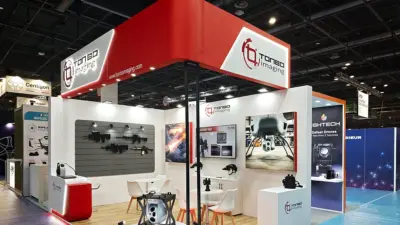
The upcoming IPO of Bengaluru-based Tonbo Imaging offers a window into that larger debate.
Tonbo describes itself as an original equipment manufacturer developing electro-optical, thermal-imaging, targeting, surveillance and guidance systems for military applications.
It is precisely the kind of high-technology private company that India's expanding defence ecosystem hopes to produce more of.
But its regulatory filings and publicly available trade records also illustrate how complicated the idea of an indigenous defence company can become in a globalised supply chain.
At the centre of Tonbo's corporate structure is CEAQ Technologies Pte Ltd., a Singapore company formerly known as Tonbo Imaging Pte Ltd.
Tonbo's IPOdocumentation identifies CEAQ Singapore as an enterprise having substantial interest in the company.
According to the Draft Red Herring Prospectus, CEAQ Technologies Pte Ltd holds 26.77% of Tonbo Imaging India, while CEAQ Technologies Private Limited, the Indian group entity formerly known as Tonbo Imaging Private Limited, holds another 17.74%. Together, the two entities account for more than 44% of the company before the offer.
The Singapore entity is also part of Tonbo's commercial ecosystem. The company's filings disclose related-party transactions involving purchases of project material and equipment from CEAQ Singapore.
There is nothing inherently unusual or improper about a company sourcing material from a related entity, particularly in a multinational technology business. But in the defence sector, such relationships raise an additional question: how much visibility is available into what is being procured, where it was manufactured and how it entered the Indian company's supply chain?
That question becomes more significant in the context of Tonbo's import records.
Trade-data platform Volza records more than 11,500 import shipments associated with Tonbo Imaging India from 226 suppliers. Around 2,262 of those recorded shipments, or nearly one in five by shipment count, are attributed to China, while Singapore accounts for around 1,157 shipments.
These figures should be read carefully. Shipment counts are not the same as import values and do not mean that nearly 20% of Tonbo's procurement expenditure comes from China. Nor does sourcing from Chinese companies, by itself, establish any wrongdoing.
But in a company whose business is built around electro-optics, thermal imaging and sophisticated sensing systems, the origin of specialised components is a material question.
The trade data identifies Chinese optics companies, including Changchun Jstar Optics Co Ltd and Changchun Sunday Optoelectronics Co Ltd among Tonbo India's recorded trading relationships. What matters is not simply the nationality of a supplier but the nature of the components supplied and their role in the final systems.
This is where Tonbo's story connects with a much larger challenge facing India's defence-tech ambitions.
India does not yet manufacture every advanced sensor, semiconductor, specialised optical component or electronic subsystem required for modern defence technology.
Even companies with substantial Indian engineering and intellectual property may therefore depend on global supply chains. The policy challenge is to distinguish between an Indian company that designs and
builds sophisticated systems while importing some specialised components and one whose domestic value addition is limited primarily to assembly and integration. The answer may differ from company to company, and from product to product.
It may also matter where those imports originate.
Defence dependence is different from ordinary industrial dependence. A foreign-made component in a consumer product may largely be a commercial issue. In defence systems, supply-chain dependence can raise questions about continuity of supply, geopolitical risk and the security of strategically sensitive technologies.
The rise of defence companies in the public markets adds another dimension. Until recently, questions about the origin of critical components were primarily matters for procurement agencies and the Ministry of Defence. As private defence companies raise public capital, investors too will increasingly want to understand how dependent a company's business is on overseas suppliers and related-party procurement arrangements.
Tonbo has denied allegations disclosed in connection with its revised IPO documentation concerning procurement and certain contracts. The company should also have the opportunity to explain the role of its Singapore-linked entities, the nature of its overseas sourcing and the extent of domestic value addition in its products.
Ultimately, Tonbo may provide satisfactory answers to these questions. But the larger issue will remain.
India's defence ambitions are moving rapidly beyond government laboratories and public-sector factories into private companies and technology startups. Many of them will operate through international supply chains because India is still building capabilities across critical technologies.
The challenge is not to demand that every Indian defence company immediately eliminate all foreign dependence. It is to be more precise about what India means when it speaks of indigenisation.
Tonbo Imaging's IPO is one company's journey to the public markets. But the questions surrounding its supply chain point to a larger issue for India's defence industry: as the country builds its next generation of defence companies, transparency about where critical technology and components come from may become just as important as where the final product is assembled.
The author is a Delhi-based senior journalist and political analyst
(Disclaimer: The views expressed above are the author's own. They do not necessarily reflect the views of DH)