




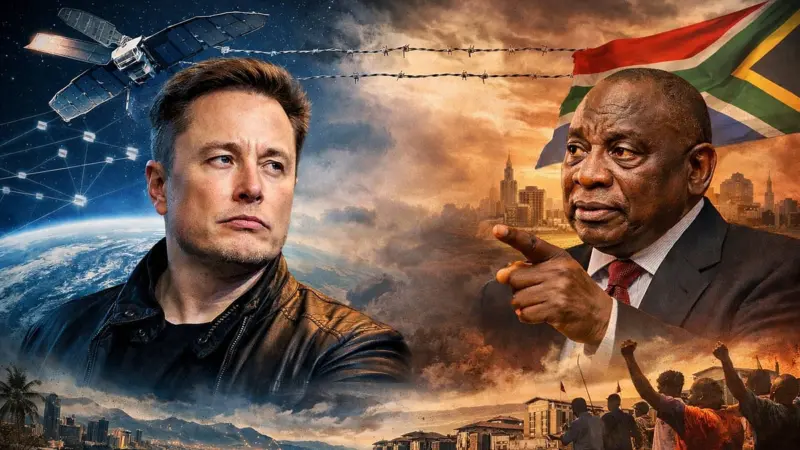

The clash between the world's richest man, Elon Musk, and South Africa over Starlink is not just a corporate licensing dispute. It won't be far from reality to say that it is a juxtaposition of history, race, and who gets to define fairness in a post-apartheid society of South Africa.
Elon Musk alleges that South Africa's Broad-Based Black Economic Empowerment (B-BBEE) laws are openly 'racist'.
Elon Musk's Starlink not working on 'smartphone', but may bring direct-to-device internet globallyThe laws state that 30 per cent ownership of companies, especially in regulated sectors like telecommunications, should be with historically disadvantaged groups. Failing to do so, companies will not be able to acquire licenses or gain a favourable procurement status. The law defines African, Coloured, and Indian citizens as beneficiaries who were disadvantaged before 1994.
It is in this backdrop that Musk alleged, 'Racist laws in South Africa are evil, and the politicians that push these are shameful, disgusting people.'
What Musk sees as discrimination, the state views as restitution. South Africa's stand is based on the country's colonial past, which is far older and more complex. It is a known fact that Black South Africans have faced systematic exclusion from economic participation for decades under apartheid.
In the last three decades, people in the southernmost nation of the African continent have spoken of different sorts of realities. The current debate around the BBEE, which has been started by Musk, is something similar. In literature, too, we find some such references.
No work of art comes closer to highlighting this societal tension than Nobel laureate J M Coetzee's novel 'Disgrace'. It was published in 1999, almost five years after the end of the immoral apartheid era, and when the country was under the rule of the nation's biggest hero, Nelson Mandela.
Coetzee's protagonist's name is David Lurie, and he is a white academic at a prestigious university in one of the three capital cities of the country, Cape Town. Lurie finds himself irrelevant in a country reshaped by new moral and political realities of the post-apartheid era. His personal fall in the new set-up, established after decades of suppression and oppression faced by a larger chunk of the population, mirrors a broader societal shift. It is a society that does not factor in the loss of unexamined privilege.
There is a parallel between Lurie and Musk. They both find themselves as just, and they both are facing a system that no longer prioritises them.
Musk wants South Africa, where he was born, to be 'shunned until it stops its extreme anti-White and anti-Asian racism, and there should be severe 'sanctions' against the country.'
The undertone of the argument made by both Musk and Lurie is about believing that everyone should be treated the same today, without accepting that past injustices may require different treatment to correct them.
Coetzee tried to show how South Africa failed to offer clean moral resolutions in the post-apartheid era of the 1990s. Lurie's daughter, under the new social order, chose survival over resistance and preferred compromise and even submission. This choice certainly unsettles readers, much like B-BBEE unsettles global investors accustomed to neutral, market-driven frameworks.
Musk alleges that Starlink is 'not allowed to operate in South Africa', as he is not Black.
Colonial history has taught us how power, imposed in the name of order, can dismantle existing indigenous systems. South Africa's empowerment laws, brought in post-90s, in a sense, attempt to invert the colonial impact and reconstruct a system. Meanwhile, there have been instances of states justifying harsh measures in the name of justice or security, blurring the line between moral necessity and overreach.
The Starlink impasse is exactly at this intersection of these narratives. Musk, on one hand, represents a borderless, technology-driven worldview that prioritises efficiency and scale, and on the other, South Africa represents a nation still negotiating the scars of a very specific past.
When these two collide, the result is not merely regulatory friction; it is a philosophical conflict.