
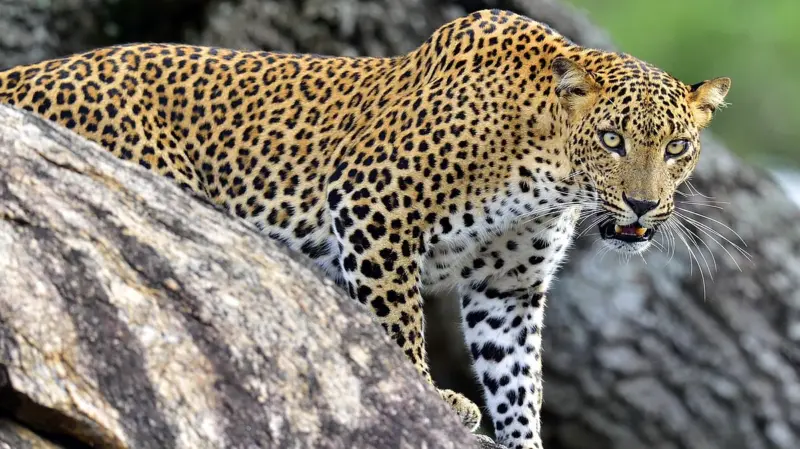

A black leopard drinks alongside a normally coloured leopard in the backwaters of the Bhadra Reservoir, within the Lakkavalli Range of Bhadra Tiger Reserve.
The video, shared widely, delighted safari enthusiasts and the wildlife photography community. Around the same time, an AI-generated video of a black leopard circulated on a YouTube "news" channel, warning residents of alleged attacks in the Malavalli taluk of Mandya district.
One sighting celebrated the wild; the other, though fabricated, fuelled fear. Together, they capture the stark spectrum of public responses to wildlife in India, especially to species associated with human conflict.
India's engagement with wildlife is increasingly split into two divergent realities. On one side are those who experience wildlife through tourism and recreation; on the other are communities that bear the costs - loss of livestock, livelihoods, and occasionally, human life. Unsurprisingly, these losses breed resentment.
The leopard, one of India's most adaptable large carnivores, often finds itself at the centre of this hostility. Its ability to survive in human-dominated landscapes, coupled with relatively modest prey requirements, brings it into frequent contact with people. As a result, conflict is rising across the country.
A key driver of this escalation is the unscientific translocation of leopards. Rather than resolving conflict, translocation often displaces it - sometimes intensifying it in previously unaffected areas.
The landscape encompassing the Cauvery, MM Hills, and BRT wildlife sanctuaries illustrates this trend. Between 2019 and 2022, around 300 human-leopard conflict incidents were recorded here, with ex gratia payments totalling Rs 25.4 lakh. Between 2022 and 2025, incidents surged to approximately 1,300, with compensation rising nearly fivefold to over Rs 1.21 crore.
What explains this dramatic increase? Earlier, under pressure from affected communities, the Forest Department frequently translocated leopards to larger reserves such as Bandipur and Nagarahole tiger reserves. In the last three years, however, many leopards have been moved into the Cauvery-MM Hills-BRT landscape, often from distant parts of Karnataka.
Research and field experience show that translocated leopards rarely remain at release sites. Unfamiliar with the new terrain and prey base, they attempt to return to their home ranges, moving through human-dominated areas. This increases encounters with people, often leading to livestock depredation and, in some cases, human casualties. Being territorial, they may also be displaced by resident leopards, compounding instability. The result is predictable: higher conflict.
Translocation, therefore, is not a solution. Forest personnel acknowledge this in private discussions, especially during capacity-building workshops. Yet they point to the intense pressure they face from affected communities demanding immediate action. For many officials, capture and relocation become the only politically and socially viable response, despite their known limitations.
Reactive to preventive
Communities express frustration over compensation. Payments are often delayed and fall well below market value. This erodes tolerance for wildlife, particularly large carnivores like leopards.
Compounding the problem is the role of social media and sections of the mainstream media. CCTV clips of leopard sightings, often stripped of context, circulate rapidly, heightening anxiety. Sensational headlines, dramatic visuals, and misleading narratives amplify fear rather than inform.
In this cycle of blame, the Forest Department points to public pressure, communities highlight inadequate compensation, and systemic constraints limit government response. The result is a pattern of knee-jerk measures - capturing and relocating leopards - that merely shift conflict elsewhere. As incidents rise, communities lose patience, frontline staff bear the brunt of public anger, and the leopards - voiceless in this debate - pay the ultimate price.
Breaking this cycle requires a shift from reactive to preventive strategies. Governments must ensure compensation that reflects market realities and is delivered within a fixed, short timeframe: ideally within a month. Investment in better livestock protection - such as reinforced corrals and improved guarding practices - is essential. Equally important is sustained outreach and education to build awareness and reduce fear.
Unless these long-term measures are prioritised and implemented in both letter and spirit, both people and leopards will continue to suffer. Translocation, elite-sounding task forces, water-harvesting initiatives, and prey augmentation within leopard habitats may appear proactive and politically expedient, but they remain largely reactive. Such measures may offer temporary reassurance, but they fall short of delivering durable solutions.
If India is to truly reconcile conservation with coexistence, it must move beyond optics and commit to interventions that address the root causes of conflict. Anything less will only deepen the divide between those who celebrate leopards and those who live with their consequences - a divide the country can ill-afford as it seeks to safeguard its natural heritage.
(The writer is the author of Leopard Diaries: The Rosette in India)