
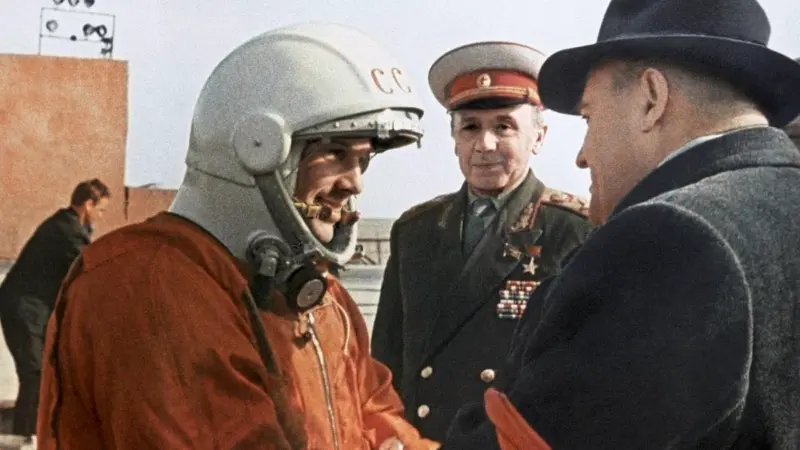

Exactly 65 years ago today, a Soviet citizen changed the course of history when he flew to space for the first time. Air Force Major Yuri Gagarin, took to the skies on April 12, 1961, faster and higher than any human ever - marking a monumental victory for the Soviet Union that was fighting a fierce cold war with the United States.
It was at 9:07 am (local time) when the journey began, with the 287-tonne rocket lifting off from the Baikonur Cosmodrome.
"Poyekhali!" (Let's go!) Gagarin radioed from the Vostok-1 spacecraft, which entered Earth's orbit at 9:12 am at 28,260 kilometres per hour, making the Soviet citizen the fastest man alive.
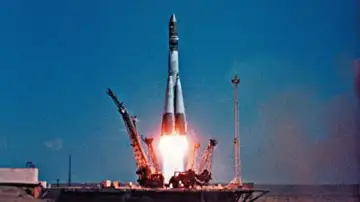
Vostok-1 blasts off from Baikonur Cosmodrome.
Gagarin spent about 90 minutes in space during which he recorded his observations and transmitted what he saw - the curvature of Earth, the fragile and luminous blue atmosphere, coastlines and vast landmasses all balled up into this blue world against the immense darkness of space.
Then began his descent, but it wasn't exactly a smooth-sailing. The descent module initially failed to separate from the equipment module but the heat generated due to friction during reentry burned the connecting cables between the two sections, allowing for the unhindered dive.
About seven kilometres above surface, Gagarin, wearing a bright orange suit, ejected from his spacecraft and parachuted in a field near the city of Engels, about four kilometres from the historic Volga river - the longest in Europe. The entire flight lasted 108 minutes.
This daring feat earned Gagarin a much-deserved recognition. On April 14, he was awarded the title Hero of the Soviet Union, together with the Order of Lenin and the Gold Star medal. According to Russia's Ministry of Foreign Affairs, Gagarin was honoured as a true hero in more than 30 countries which he visited over the next two years as part of the 'Mission of Peace' tour.
Thanks to that flight, April 12 is also celebrated as the International Day of Human Space Flight to commemorate the event.
Gagarin's mission allowed the Soviet Union to one-up the US, whose biggest achievement in space until 1961 was launching the Explorer 1 satellite - it's first - in January 1958. America was defeated here as well since the Soviets launched the world's first satellite Sputnik in October 1957.
In a way, the Vostok mission by Gagarin inspired the US to push harder, as just a month later in May, 1961, NASA (formed in 1958 after Explorer 1) sent the first American to space - Alan Shepard. Unfortunately, Gagarin's flight was the final glorious moment for the Soviet's in the space race as NASA put the first man on the Moon in 1969, and the Soviet space program took severe hits after serious accidents including death of their cosmonauts during flights.