





On Labour Day this year, something unusual happened and it had nothing to do with labour. The price of electricity on the Indian Energy Exchange (IEX) plunged to near zero.
As temperatures eased that day, electricity demand (trade on the exchange) dropped, even as supply surged, driven largely by solar power generation. Explaining the sharp fall in prices, IEX said, "Cooler weather, record solar generation (~57.5 GW), and inflexible thermal supply are leading to ample sell-side availability on the Exchange. Today, up to 5 PM, the average price recorded stood at Rs 1.22/kWh, with near-zero prices observed across multiple time blocks."
There is a good reason why IEX singled out solar power as a key factor behind the near-zero electricity prices on May 1. Over the past 12 years, since the Modi government came to power at the Centre, investment in India's renewable energy sector has skyrocketed. Investment in solar energy, in particular, has grown manifold, making it one of the largest contributors to the country's installed electricity generation capacity today.
According to government data, India's installed solar power capacity has risen to around 154 GW today, from less than 3 GW in 2014.
India's energy demand hit new high in April but grid not ready to absorb full RE: StudyThe push for massive investment in the solar power sector is aimed at addressing two major challenges. First, the country's economic growth has fuelled a steady increase in electricity demand, with new sources of consumption emerging from power-hungry data centres and the expanding market for air conditioners. Second, the government's intention to lower the dependence on environmentally unsustainable thermal power, much of which is generated using fossil fuels such as coal.
Yet, thermal power continues to dominate India's energy mix. According to the Central Electricity Authority's (CEA) Renewable Generation Report for April 2026, around 73% of the electricity generated during the month came from thermal sources.
Renewable energy accounted for less than 25%, with solar contributing only around 13%.
According to NITI Aayog, fossil fuels - coal, oil and gas - account for about 47% of India's total installed power generation capacity of 537 GW. Solar power, the largest source among renewables, accounts for 29%.
So why isn't solar power contributing more to actual generation? The answer lies in a combination of factors, including gaps in transmission infrastructure, inadequate energy storage capacity and anomalies in electricity markets.
Electricity generated at power plants is first fed into the transmission network, the high-voltage lines carried by the large pylons seen across the country, before reaching consumers through local distribution systems. However, the transmission network, which takes far longer to build than solar power projects, has struggled to keep pace with the rapid expansion of generation capacity and, by extension, demand.
According to Charith Konda, energy specialist at the Institute for Energy Economics and Financial Analysis (IEEFA), transmission lines can take up to five years to build, while solar farms are today being set up at a breakneck speed of 18-24 months.
The consequences of this mismatch are already becoming evident. According to Ember, a London-based global energy think tank, India had to curtail 300 gigawatt-hours (GWh) of renewable energy during the first quarter (January-March) of 2026 due to transmission constraints. This accounted for nearly two-thirds of the total curtailment across the national grid.
In a report published last month, Ember warned: "This growing mismatch between fast-moving solar projects and slower-moving transmission infrastructure is now the most critical operational risk to the country's 2030 target of 500 gigawatts (GW) of non-fossil electricity."
It is generally quicker and more economical to curtail solar power generation than to scale down thermal power plants.
The transmission bottlenecks are now being addressed by the Central Electricity Regulatory Commission (CERC) through regulatory measures. One such initiative is the General Network Access (GNA) framework, which seeks to strengthen the vision of "One Nation, One Grid" by expanding transmission infrastructure for all sources of electricity, including renewable energy.
Storage challenges
Battery energy storage systems (BESS) have emerged as a viable option for optimising electricity generation and consumption, particularly by storing solar power generated during the day and supplying it during periods of peak evening demand. However, India continues to lag in developing large-scale energy storage capacity.
According to industry estimates, India's demand for advanced chemistry cell (ACC) batteries stood at 28 GWh in 2025, with battery electric vehicles (BEVs) accounting for roughly 60% and stationary or grid-scale storage making up the remaining 40%.
In contrast, the country's domestic cell manufacturing capacity is currently only about 4 GWh. According to projections by IEEFA and JMK Research, India will need to expand this capacity at a compound annual growth rate of 36.5% to reach around 272 GWh by FY2030.
Demand is expected to rise even further, crossing 700 GWh by the mid-2040s, when India aims to achieve developed-country status. However, domestic manufacturing capacity continues to lag behind demand, leaving the country heavily reliant on imports, particularly from China.
India crosses 150 GW solar milestone; next phase of growth hinges on self-reliance, market diversificationCharith Konda said while India has rightly embarked on plans to build huge renewable energy capacity to reduce dependence on imported fuels like crude and coal, we have simply replaced them with imports of expensive battery cells. He added that the country is also not investing enough in research and development in critical areas like ACC.
Rooftop solar
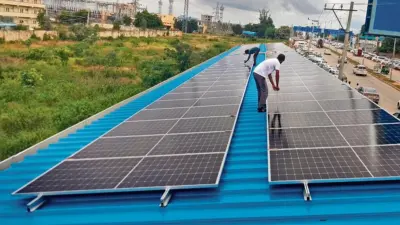
Over the past decade, rooftop solar installations across residential and commercial segments have also recorded impressive growth. From less than 3 GW around 10 years ago, India's rooftop solar capacity had expanded to 23.5 GW by March this year, aided in no small measure by centrally funded programmes like the PM Surya Ghar Yojana.
Experts, however, say that the sector's growth potential is far greater than current levels suggest. They point to two key constraints: the uneven implementation of net metering, which allows households and businesses to sell surplus electricity back to the grid, and the availability of heavily subsidised or free electricity provided by various state governments.
Today, India is the world's third-largest renewable energy market, behind China and the United States, in terms of installed capacity. Yet nearly 70% of its electricity generation still comes from fossil fuel-fired power plants, highlighting the gap between capacity creation and actual energy transition.
Unless India addresses constraints such as inadequate transmission infrastructure, limited energy storage capacity, continued dependence on imported battery cells and the uneven implementation of net metering, its remarkable expansion in renewable energy capacity will not realise its full potential.
(Kalyan Subramani is a Bengaluru-based writer)