
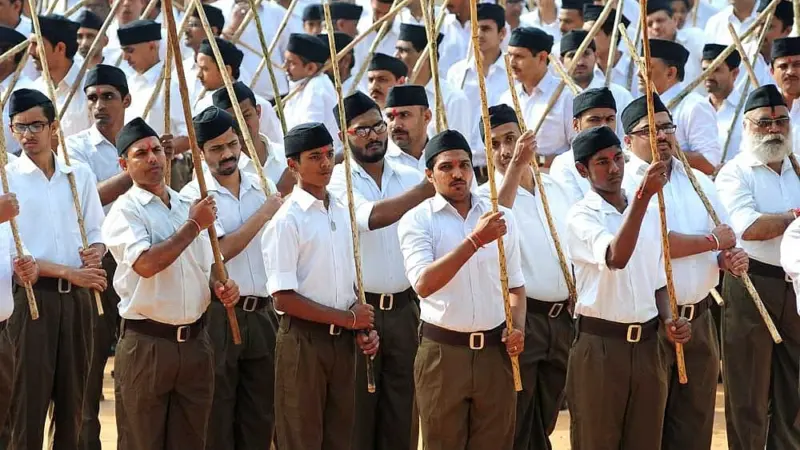

The Rashtriya Swayamsevak Sangh (RSS) - despite recurring squabbles since early 2024 with Sangh Parivar constituents, particularly the Bharatiya Janata Party (BJP) - remains the undisputed ideological hegemon across large parts of India.
Yet, as domestic support for Hindutva has surged, the RSS continues to grapple with the long-existing gap between its self-projected image as a 'service-oriented cultural organisation' and its global perception, as a sectarian, politically influential force. Outside India, it is seen almost universally as steeped in Hindu majoritarianism, bearing traces of European fascism, and contemporary Zionism.
For decades, the RSS' global outreach focused largely on diaspora mobilisation and financial support for various programmes and agitations such as the epochal Ram Janmabhoomi Andolan. This strategy, as Australian academic Felix Pal documents, produced well over 250 affiliated organisations in almost 40 countries.
However, recent events in the United States and Germany suggest a shift - the RSS is now directly addressing what it calls 'critical knowledge gaps' and misperceptions about itself and India's current trajectory.
At high-profile interactions last month with Stanford University and the US think-tank Hudson Institute, RSS General Secretary Dattatreya Hosabale highlighted the organisation's role in social capital, disaster relief, character-building, and civilisational perspectives.
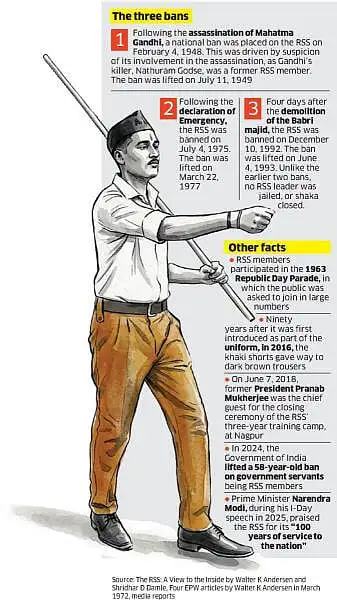
These structured dialogues went beyond monologues, allowing questions on India's global ambitions, economic restructuring, and even on bilateral tensions and strategic defence co-operation with the US.
A day-long 'New India Conference' in Washington DC, aimed at addressing what the Hudson Institute stated as 'critical knowledge gaps in Washington regarding India's current trajectory', featured Hosabale, alongside noted Indians: Vinay Kwatra, Ambassador of India to the US, BJP foreign affairs chief Vijay Chauthaiwale, RSS leader Ram Madhav, and Ashok Malik, Chair of the New Delhi-based subsidiary of the Washington-headquartered The Asia Group. The session also featured addresses by prominent US scholars and former officials, some of whom have worked in India in various capacities. The highlight was Hosabale's fireside chat with Walter Russell Mead, Distinguished Fellow in Strategy and Statesmanship, at the Hudson Institute.

Hosabale used the platform to assert that the RSS is not an Indian version of the Ku Klux Klan, the US white supremacist group. He insisted that neither the organisation nor the Hindu community espouses chauvinism. He claimed that the US' misconceptions about the RSS mirror outdated stereotypes of India as a "land of snakes, slums, and swamis". He blamed Indian political adversaries, Western media, and sections of the intelligentsia for projecting the RSS as anti-minority, anti-development, and anti-modernisation. He also lamented that the positive facets of the RSS are never mentioned, while the emphasis is ceaselessly on the false perceptions.
Yet, Hosabale's articulation about Hindu philosophy and culture - that the whole world is one family and rejects supremacy - is highly problematic. The Sangh Parivar neither recognises diversity within Hinduism nor offers space within the Hindu nation state - whose formal creation is an RSS objective - to 'non-Indic' religions whose 'punya bhoomi' (holy land) lies outside India. This underscores its supremacist orientation. Hosabale's claim that the saffron fraternity sees 'oneness in everything, living and non-living' paradoxically undermines India's cherished principle of unity in diversity.
The views and factual assertions that Hosabale showcased were steeped in irony. When claiming that the RSS was a "people's voluntary movement inspired by cultural ethos and civilisation values of the ancient society of India, which is generally known as Hindu culture", he excluded the heritage of the medieval era. The Right-wing ecosystem has for decades argued for the physical and conceptual erasure of this period by depicting it, alternatively, as foreign, invasive, and obliterative of the 'Hindu period'. Hosabale also portrayed India's civilisational strength as vital in times of global conflicts - though New Delhi has conspicuously avoided mediatory roles in recent years.
The RSS' international outreach clearly enjoys tacit government support. Since RSS Sarsanghchalak, Mohan Bhagwat's 2018 lectures in New Delhi, the organisation has sought to shed its shadowy image. Yet, its exclusivist character ensures women cannot formally be a part of the RSS, but only associate through the Rashtra Sevika Samiti. Also, its critics at home and abroad continue to challenge its claims. Despite the assertions of the variety that Hosabale made, it remains under scrutiny.
The US Commission on International Religious Freedom recently recommended targeted sanctions on the RSS, citing "severe violations of religious freedom". India's Ministry of External Affairs almost immediately dismissed the report as "distorted and motivated", accusing international bodies of relying on ideological narratives over objective facts about the RSS' social work.
Quite clearly, the RSS would be aided in efforts like that of Hosabale, in promoting a 'positive' image of the organisation across the globe. This foray in the US may be followed elsewhere, bolstering the Modi government's legitimacy as the leader of the world's largest democracy. Knowing that the RSS could face opposition in the US during the Hudson Institute's event, it was open to a restricted audience. The real test will be when the RSS' efforts at altering its global image are thrown open to unrestricted audiences. In such a foreseeable future, critics within the diaspora as well as the international community may unite to contest the RSS narrative - one that seeks to veil its real beliefs beneath civilisational rhetoric.
(The writer is a journalist and author of 'The RSS: Icons of the Indian Right'. X: @NilanjanUdwin)