
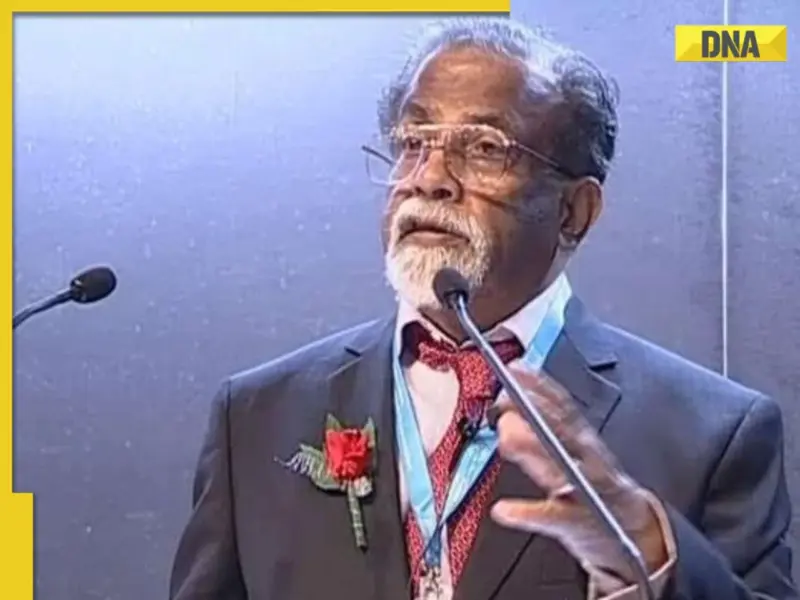

Ennackal Chandy George Sudarshan, popularly known as ECG Sudarshan, was an Indian American theoretical physicist and a professor at the University of Texas.
Born in 1931 in Pallom, Kottayam, Travancore, British India, the scientist earned a name for himself in the field of theoretical physics. Interestingly, ECG Sudarshan was raised in a Syrian Christian family, but later in life, he converted to Hinduism after marrying Lalita Rau in 1954. The marriage sadly ended in divorce in 1990, after which ECG Sudarshan married Bhamathi Gopalakrishnan in Texas, US.
ECG Sudarshan had an intriguing personal life, but his professional achievements throughout his life surpassed those. He was an Indian genius with one of the brightest minds, who completed his studies at CMS College, Kottayam. ECG Sudarshan then graduated from the Madras Christian College, after which he went on to work at the Tata Institute of Fundamental Research (TIFR) with Dr Homi Bhabha.
ECG Sudarshan then received his Ph.D. at the University of Rochester in New York and moved to Harvard University as a postdoctoral fellow.
ECG Sudarshan was also nominated for a Nobel Prize 9 times, but he never won it. The story goes that in 1960, when ECG Sudarshan started working on quantum optics at the University of Rochester, his use of classical electromagnetic theory in explaining optical fields, two years into his work, was rebuked by Glauber.
On the impact of this incident, a physicist wrote, "Glauber criticized Sudarshan's representation, but his own was unable to generate any of the typical quantum optics phenomena, hence he introduces what he calls a P-representation, which was Sudarshan's representation by another name. This representation, which had at first been scorned by Glauber, later became known as the Glauber-Sudarshan representation."
ECG Sudarshan was passed over for the Physics Nobel Prize many times.
In 2005, a major controversy broke out when several physicists wrote to the Swedish Academy, demanding that ECG Sudarshan deserves acknowledgment for his stake in the Sudarshan diagonal representation (also known as Glauber-Sudarshan representation) in quantum optics, for which Roy J Glauber won his share of the prize.
Speaking about being passed over for the Nobel Prize, ECG Sudarshan said in 2007, "The 2005 Nobel Prize for Physics was awarded for my work, but I wasn't the one to get it. Each one of the discoveries for which this Nobel was given was for work based on my research," Hindustan Times quoted him as saying.
On not being selected for the 1979 Nobel, ECG Sudarshan said, "Steven Weinberg, Sheldon Glashow, and Abdus Salam built on work I had done as a 26-year-old student. If you give a prize for a building, shouldn't the fellow who built the first floor be given the prize before those who built the second floor?"
At the age of 86, ECG Sudarshan died in 2018 in Austin, US.