
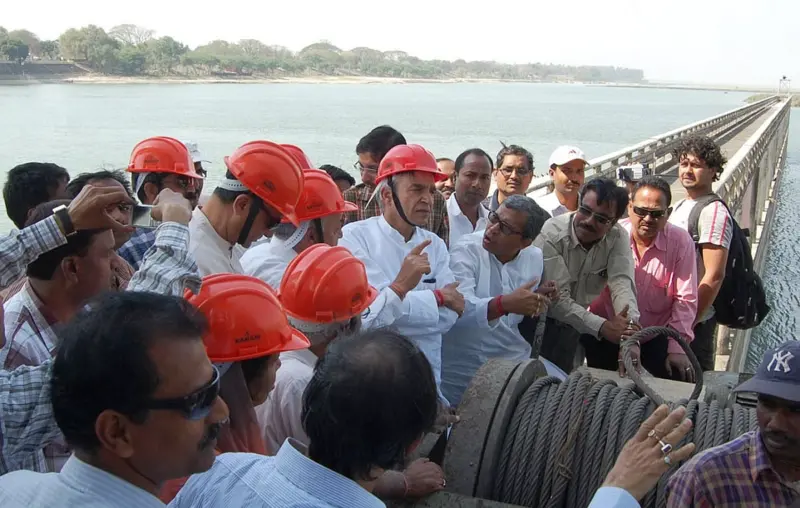

South Asia stands at a critical inflection point in water diplomacy as the Ganga Water treaty (GWT) is set to expire in December 2026. Signed on December 12, 1996, by then Indian Prime Minister H D Deve Gowda and Bangladesh Prime Minister Sheikh Hasina, the framework established a dry-season water sharing mechanism based on flow measurements at the Farakka Barrage - a strategic control structure located in West Bengal, barely 18 kilometres from the Bangladesh border.
For decades, this agreement has been treated primarily as a geo-political bargain over allocation. But today, the larger challenge is no longer simply "who gets how much water" - it is whether the Ganga can remain sustainable at all.
For its time, the 1996 treaty was widely seen as a stabilising breakthrough. It came after years of friction that escalated sharply following India's commissioning of the Farakka Barrage in 1975, which Dhaka argued worsened downstream scarcity during lean months. Earlier interim arrangements in the late 1970s and 1980s failed to offer durable solutions. Yet, the 1996 treaty has never fully escaped political and public tensions. The civil society and policy voices of Bangladesh have frequently stressed that the country has not consistently received its "fair-share" during most of the critical lean-season periods - pointing to structural weaknesses in the treaty's water-sharing formula that does not always guarantee promised volumes.
On the Indian side, growing upstream demand for irrigation, hydropower, drinking water supply and industrial use has strengthened the domestic development imperative to retain more water. But for a lower riparian country like Bangladesh, excessive upstream withdrawals reduce the volume of water reaching Farakka, shrinking overall downstream water availability and accelerating salinity intrusion in the delta - damaging fisheries, agriculture, and riverine livelihoods.
As the treaty nears its deadline, both sides have indicated a willingness to revisit the agreement's terms. But framing the debate only through the lens of fairness and allocation misses the deeper crisis now unfolding - a rapidly shifting hydrological regime driven by climate change. The Ganga basin, especially the lower and the delta region is among the worst-hit river systems and scientific assessments suggest that the basin is increasingly experiencing climate extremes - intensified lean-season scarcity in some years and sudden high-flow episodes in others, driven by changing rainfall patterns and accelerating Himalayan glacier retreat.
Erratic monsoon behaviour is overwhelming embankments, reshaping river channels, and triggering intensified flooding, bank erosion, and causing significant land loss in the lower delta. Higher temperatures and altered precipitation patterns are producing significant hydrological imbalances, making water management far more unpredictable. Looking ahead, studies warn that by the 2050s the basin could witness substantial changes in river flow patterns.
Pollution further compounds this crisis, particularly along the Indian stretch of the river, where rapid industrialisation and urbanisation have significantly increased the pollutant load. During lean seasons, reduced flow lowers dissolved oxygen and weakens the river's self-purification capacity. Industrial discharge introduces heavy metals such as lead, cadmium, and chromium, while agricultural runoff adds nitrates and chemical residues, raising concentrations of zinc and copper that bioaccumulate and disrupt microbial processes essential for river health - altering sediment transport. Adding to this toxic burden is the growing threat of microplastic pollution - discharging approximately 0.12 million tons annually and reportedly the key contributor in undermining the region's blue-carbon capacity by weakening the mangrove ecosystem's ability to sequester CO2 - thereby deepening climate vulnerability in the delta.
This is precisely why the treaty's approaching deadline cannot be treated as a routine renewal exercise. It must be a reset. The Ganga can no longer be approached as a mere resource pipeline - it's crucial to treat it as a living ecological entity. One meaningful approach would be to adopt principles aligned with the Helsinki Rules on the Uses of the Waters of International Rivers - later shaped the foundation of the UN Water Convention - which emphasise not only equitable and reasonable utilisation, but also cooperative governance, information sharing, and integrated river basin management. Such an approach is also consistent with Sustainable Development Goals 6.5 which calls for implementing sustainable management of shared water resources, while indirectly advancing wider goals related to food security, energy, climate resilience, and peace institutions.
India is not a party to the convention and has historically been reluctant to commit to broader multilateral water conventions, arguing that they could externalise bilateral water disputes and constrain negotiating flexibility. Yet, this position deserves reconsideration. Climate-driven hydrological uncertainty makes purely bilateral negotiation-based control less effective and long-term stability more dependent on institutional cooperation.
Equally urgent is the need to update the treaty's hydrological baseline. The existing framework relies on the flow data from 1948 to 1988 for working out total water availability - a dataset that no longer reflects present-day realities. Any renewed agreement must incorporate updated flow records up to the present and integrate climate projections. It must also include clear contingency provisions such as drought protocols, flood coordination mechanisms, and joint basin-level cooperation on sedimentation and embankment planning.
Additionally, the renewed treaty must expand beyond its narrow surface-water focus. Groundwater aquifers must be incorporated into joint assessments. Pollution control requires coordinated monitoring, enforceable water-quality standards, shared telemetry stations, and investment in river restoration. The impact of Farakka itself also requires serious reassessment, as studies suggest that nearly 65 per cent of crops have been directly affected due to shifts in regional agricultural patterns linked to the barrage. It has also contributed to downstream ecological stress and also accelerated land loss through intensified riverbank erosion in Malda and Murshidabad districts of West Bengal - issues that become even more severe as climate change amplifies hydrological volatility.
Finally, the renewed framework should institutionalise a mandatory periodic river clause - for example every five years - to recalibrate allocations and governance mechanisms based on updated field data and statistical analysis on future water flow, along with river's ecological stress indicators. It should also create space to assess technological interventions for long-term river conservation, enabling both countries to respond more dynamically to changing river conditions.
The strategic choice before India and Bangladesh is clear. Water must be treated as a shared security challenge rather than only a zero-sum national resource. While equitable and fair sharing remains crucial, it must be pursued alongside balancing equitable distribution with ecological resilience, because the greatest threat today is not simply unequal sharing - it is accelerating ecological collapse. Saving a transboundary river necessitates a transboundary response and it must be governed not as contested property, but as shared climate infrastructure demanding cooperative stewardship.
Mahesh Ganguly, Teaching Assistant and Research Fellow, based at IIT Bombay, focusing on energy transition, public health, water governance and South Asian policy issues.
Views expressed are the author's own and don't necessarily reflect those of Down To Earth