
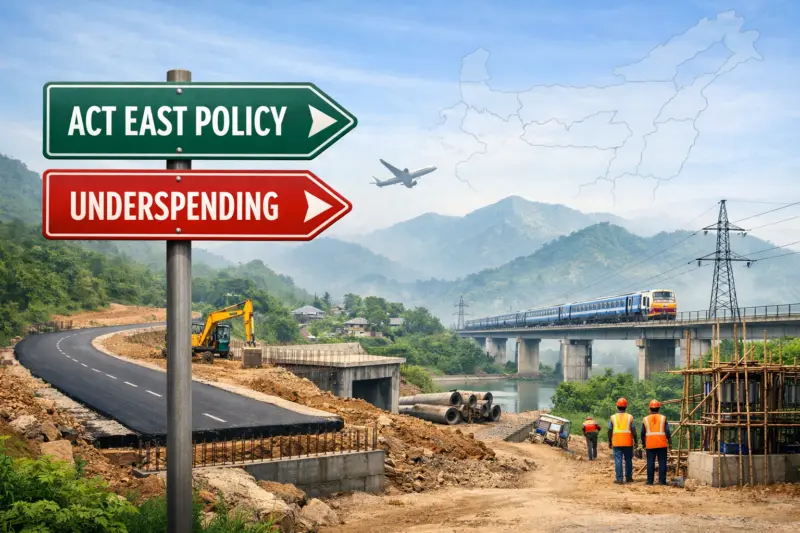

The Union government's decision to raise the allocation for the Ministry of Development of North Eastern Region (DoNER) to ₹6,812.30 crore (about $820 million) for 2026-27 signals yet another assertive push to accelerate development in India's strategically vital eastern flank.
Yet, beneath this expansion lies a persistent and uncomfortable reality-the system continues to struggle to spend what it allocates, leaving a widening gap between fiscal intent and on-ground outcomes.
The increase, which represents a 52% jump over the previous year's revised estimates, appears substantial at first glance, though it moderates to around 15% when compared with the original budget estimates of 2025-26, pointing to a pattern of fluctuating projections that the Parliamentary Standing Committee, in a report tabled on Tuesday, has flagged as symptomatic of weak financial planning.
More telling than the allocation itself, however, is the trajectory of utilisation. In 2024-25, the Ministry spent ₹3,447.71 crore-about 86% of its revised allocation-while in 2025-26, utilisation had already slipped to roughly 77% by the end of December, suggesting that a significant portion of funds may again remain unspent by the close of the fiscal year.
This divergence between allocation and expenditure is not merely an accounting issue; it goes to the heart of India's development strategy for the northeast, a region that spans nearly 8% of the country's landmass, houses around 45 million people, and is central to the country's Act East policy.
The policy envisions the region as a gateway to South-East Asia, with seamless connectivity enabling trade, investment, and strategic integration. Yet, the slow pace of project execution suggests that this vision continues to outstrip administrative capacity.
The composition of the latest allocation underscores the government's priorities. Nearly 67% of the outlay for 2026-27 is directed towards capital expenditure, reflecting a clear emphasis on infrastructure creation-roads, connectivity, and long-term assets intended to transform the region's economic landscape.
However, capital-heavy spending also brings with it execution challenges, particularly in a region marked by difficult terrain, logistical constraints, and layered governance structures.
Under the North East Special Infrastructure Development Scheme (NESIDS), for instance, road projects worth over ₹5,300 crore have been sanctioned, yet only about half have been completed so far, illustrating the lag between project approval and delivery.
Such delays carry broader implications, not just for local connectivity but for India's larger ambition of linking the northeast with regional markets in South-East Asia.
The expansion of flagship schemes further complicates the picture. Combined allocations under NESIDS, the Prime Minister's Development Initiative for North East Region (PM-DevINE), and Special Development Packages have risen sharply, contributing to an overall 69.5% increase in outlay compared with the previous year's revised estimates.
Within this, Special Development Packages have seen a dramatic 718% surge, largely aimed at tribal and vulnerable populations in states such as Assam and Tripura-a move that reflects both political prioritisation and social targeting, but also raises questions about the system's ability to absorb such rapid increases without compromising efficiency.
PM-DevINE, conceived as a catalytic intervention to bridge critical infrastructure gaps, offers another example of the disconnect between planning and provisioning.
While the projected requirement for 2026-27 stands at ₹859.29 crore, the actual budget allocation is just ₹260.45 crore, leaving a significant shortfall that is expected to be addressed later through revised estimates-a practice that underscores the iterative, and at times uncertain, nature of budget execution.
At an institutional level, the challenge is compounded by the Ministry's role as a coordinating body rather than a direct implementing agency.
DoNER must work through state governments, central ministries, and a broader framework that mandates 10% of Gross Budgetary Support across Union ministries for the North East.
While this structure is designed to ensure comprehensive coverage, it often results in diffused accountability, where delays in execution can be attributed to multiple agencies.
The Parliamentary Committee's assessment, though measured in tone, points to a deeper structural issue: the expansion of financial outlays has not been matched by a corresponding strengthening of implementation capacity.
Delays in project approvals, slow utilisation of funds, and administrative bottlenecks at the state level continue to impede progress, even as allocations rise.
In effect, the northeast's development is increasingly defined not by how much is being spent, but by how much remains unspent.
The government's intent-to transform the region into a dynamic economic corridor and a bridge to South-East Asia-is clearly visible in the numbers. What remains uncertain is whether the machinery of governance can keep pace with that ambition.
Until then, the latest increase in allocation, while significant, risks becoming part of a familiar cycle-announced with urgency, expanded with intent, but only partially realised on the ground.
Why the Mizo language's constitutional recognition is sparking debate