
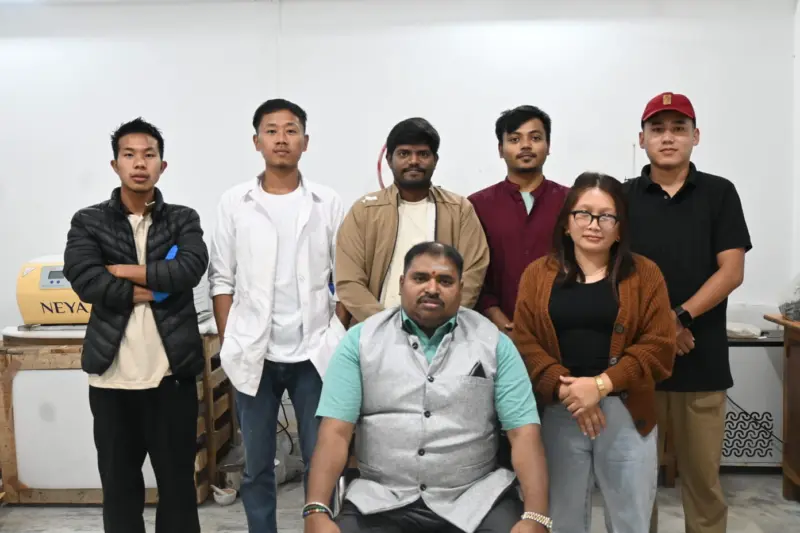

Guwahati: In a significant breakthrough linking indigenous knowledge with modern science, researchers from Nagaland University and partner institutions have identified anti-cancer potential in a traditional herbal formulation used by the Konyak tribe of Nagaland.
The study, conducted in collaboration with Berhampur University and Saveetha Medical College, is among the first to scientifically analyse how a specific tribal remedy works at the molecular level.
Published in the Microchemical Journal, the research examined a five-plant formulation comprising Persicaria maculosa, Acorus calamus, Erythrina variegata, Stereospermum chelonoides, and Oroxylum indicum.
Using GC-MS analysis, the team identified several bioactive compounds, including sterols and triterpenoids. One compound, 9,19-Cyclolanost-24-en-3-ol, showed strong binding affinity to VEGFR2-a key protein involved in tumour blood vessel growth-comparable to the anti-cancer drug Axitinib.
Further molecular simulations confirmed stable interactions, while pharmacokinetic analysis indicated low toxicity and favourable safety profiles, making these compounds promising candidates for drug development.
Emphasising the uniqueness of the work, G. Bupesh said, "This is the first time a specific five-plant formulation used by Konyak tribal healers has been scientifically analysed and validated using advanced computational methods. Using GC-MS analysis and molecular simulations, we identified compounds with strong anti-cancer potential, showing performance comparable to existing drugs while indicating lower toxicity."
Applauding the research, Vice Chancellor Jagadish K. Patnaik said the study reflects the university's commitment to "integrating indigenous knowledge with advanced molecular science to identify safer and more effective therapeutic options."
Researchers say the findings help bridge a long-standing gap in understanding traditional medicine systems, which are widely used but rarely validated using modern scientific tools.
The study also found that the compounds selectively target VEGFR2 over similar proteins, which could reduce side effects in future therapies.
While the findings are based on computational analysis, scientists stressed the need for further laboratory and clinical validation, particularly in relation to colon cancer.
The research not only validates indigenous knowledge systems but also opens new pathways for cost-effective, nature-based drug discovery-highlighting the untapped scientific potential of traditional medicine in Northeast India.
Manipur: Three years on, why has peace remained elusive despite new CM?