

Recently, on March 10, 2026, the longest flyover in Northeast India was inaugurated by Chief Minister Himanta Biswa Sarma. Named after Maharaja Prithu, who is remembered as one of the powerful rulers of ancient Kamrupa, this flyover is more than 5 km long and promises to ease vehicular mobility.
Today, while Guwahatians have begun to lose count of flyovers constructed during the last decade, there are a few more projects already announced for the next few years.
However, despite the projection of flyovers as an immediate remedy for traffic congestion, they are more of a response to the idea of the construction of a 'world-class city' whereby infrastructures are funded that privilege the elite groups of society.
The Chief Minister
Flyovers and their experience have always been a 'relief' for some, and 'ugly' and 'messy' for others. As such, flyovers need to be analysed separately from the accounts of politicians, engineers, builders and road users on one hand and flyovers as a structure themselves.
According to French Sociologist Bruno Latour, to understand the power division, one needs to weave human relations with non-human objects. For Latour, infrastructures and material objects play a significant role in shaping human lives, thus acquiring an agency of their own that facilitates decision-making power.
Having said this, it is important to note that the last inaugurated flyover was one of the most controversial flyovers as it led to public attention and protests. In 2025, a section of concerned citizens, along with students, actively opposed the ongoing flyover construction as the extension of the flyover would destroy the heritage and disturb the ecology of the region.
For many, this space not only reflects environmental value but also stands as a nostalgia of the old and 'almost lost' Guwahati charm. Even the late singer Zubeen Garg, a few months before his death, stood against the cutting down of trees during this ongoing construction.
Despite this, the government uprooted a huge section of trees to make a passage for the flyover. Similarly, in 2023, during the construction of the four-lane Maligaon flyover, various commercial properties were bulldozed without any prior notice. Many of these establishments were not just businesses; instead, they were family legacies of 80-90 years. To this day, a significant number still awaits compensation.
Thus, while a flyover connects people from different corners of the city, it can simultaneously disconnect them from culture, heritage, and livelihood. Nevertheless, social media was flooded with photos and reels of hundreds of people gathered together during the inauguration of each flyover in Guwahati.
People celebrate a new infrastructure while praising the government for such 'progress'. The Chief Minister amplified this sentiment by opening the flyovers for pedestrians exclusively for either the first week or the first three days. However, once the vehicular movement begins, pedestrian access will be restricted.
This brief moment of shared public space, where people from different social backgrounds gather, may appear as 'inclusivity of urban space' but does not reflect a resolved issue. Rather, it is an indication of unequal production of social hierarchies within social classes.
Flyovers have shifted how cities are lived and experienced. While flyovers and highways are assumed to be part of a well-planned city, the construction of this infrastructure reflects the shortcomings and low value of human life belonging to the economically lower class.
Behind the wide highway lanes and flyovers are the silent stories of lives lost and forgotten labour. Innumerable news reports of construction workers' accidental deaths in construction sites were heard during the last few years.
From a recent case of a construction worker who succumbed to the injuries incurred through electrocution on February 1st 2026, in Kalapahar, an ongoing flyover construction site, to two other electrical mishaps that injured workers during the last flyover construction, there are images of negligence, lack of safety for labourers, and strict action against the supervising authority.
To add on, besides this negligence on workers' safety, citizens find these construction sites troublesome in their daily lives.
Untangled wires, open drains, broken pavements, and a lack of barricades on construction sites have resulted in various accidents. Some accidents bring mass protests; however, while cases linger on in the courts, the blame game goes on, and finally, construction workers continue with their work.
There are even reports on how construction sites with heavy machinery and continuous dust forced commuters to experience dangerous hazards every day. Citizens living near these flyovers have continuously raised concerns about increasing dust pollution and deteriorating health conditions.
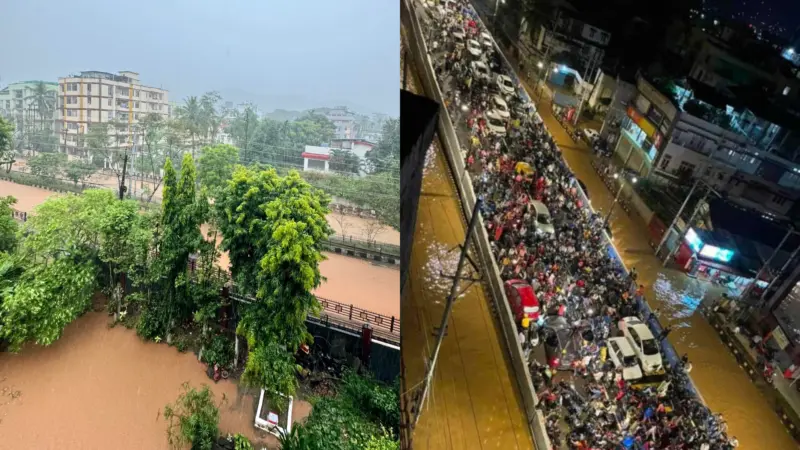
Moreover, despite such infrastructural advancements, urban floods still remain one of the major issues in Guwahati. With the introduction of a new flyover, floods underneath are commonly seen.
From the Rukmini Gaon Downtown stretch flyover to the Ganeshguri or Zoo Road flyover, urban floods have become an annual reality. Monsoon, which was once a much-awaited season after scorching summer, now brings with it a sense of anxiety and fear of mobility.
In fact, various sections of the National Highway that connect Khanapara to Jalukbari witnessed waterlogging. Places like Lokhora and Boragaon, which were once considered relatively free from flooding, remain underwater following the construction of flyovers along the National Highway. Nevertheless, in the midst of this fragile relationship, flyovers are celebrated.
Roads and highways are not just technical objects but operate on the level of fantasy and desire. These desires and fantasies are transmitted and emotionally made real by the vehicles and vehicle owners.
For vehicle owners, these flyovers are a way of avoiding traffic lights, beggars, rickshaw pullers or roadside vendors that provide a comfortable movement. They are considered wider, cleaner, faster with a skyline view unlike congestion underneath. Ganeshguri flyover, also known as Bishnu Rabha Flyover, inaugurated in 2020 which is situated in one of the busiest markets, narrates the story of water clogging, dirt, street vendors, beggars, homeless people, and public urination (especially men).
While working at Cotton University, my daily commute across Ulubari flyover revealed the underlying reality of infrastructural growth. Groups of beggars and homeless children made their homes beneath the flyover. From infants to young children to the elderly occupied these spaces which were never intended for habitation.
These scenes reflect the contrasting picture above and underneath a flyover where bigger roads provide speedy mobility, while vulnerability lies beneath it. Interestingly, these are the same section of people who will be removed whenever a VIP visits the city. Beggars, street vendors will be evicted temporarily and shifted to an area where the dignitaries will not visit.
Urban sociologist Amita Baviskar in her book "Uncivil City: Ecology, Equity and the Commons in Delhi" (2020) argues how the elite can decide the 'aesthetic' of a city. This portrayal of aesthetic by the elite somehow seems to represent the city's whole population.
While rickshaw pullers and small cart vendors are considered the actual problem that clogs roads, the cars as per elite environmental vision remains unquestioned. Baviskar calls it Bourgeoise Environmentalism.
She clearly notes that this is not confined only to the elite class, rather the middle class also adopts this view of 'world class city' where a marginalised section remains neglected.
The question remains whose development are we celebrating? Are flyovers a solution to the bigger problems of floods and traffic congestion?
Recently, a local digital and print media channel, Guwahati Plus, published an article where the author mentioned how flyovers and highways in cities like Los Angeles, Bangkok, and Jakarta failed to keep pace with growing private vehicle ownership.
This seems absolutely true with Guwahati itself in the near future. Flyovers cannot be a futuristic solution to the existing problems of the city. Neither can they stand as an architectural success to become a global city. Moreover, in Guwahati, cars and automobiles are not just used; they are a symbol of status.
Each year, the number of registrations for luxury cars increases, which ultimately contributes to increasing traffic congestion. Without any policy on the limitation on the number of cars a household can own, this problem is likely to persist. Whether the existing flyovers will be able to solve the growing vehicle traffic in the city remains an open question for the future.
Having spent the last year in Europe, I have noticed a different approach. Although Germans have an affinity for automobiles, they are clear about their commitment towards environmental sustainability. A significant point lies in their shift from prioritising private vehicles to public transport.
Trains, trams, metros, and public city buses are not only widely available and efficient but are also valued by residents, unlike in India. While the government policies in Europe deeply encourage the usage of more public transport for a sustainable environment, this approach is highly welcomed even by citizens.
A notable example is Germany, which set in the year 2022 when the government brought a 9 euro (approximately Rs 750 as per the 2022 rate) monthly scheme for 3 months (June, July. Through this monthly ticket, passengers can travel anywhere across cities in Germany using any public transport.
While this scheme was later criticised due to an increase in train delays and overcrowding, the scheme brought a shift of commuters from private vehicles to public transport usage. In 2020, Luxembourg became the first country in the world to offer free public transport across its buses and trains.
Although such models may not be financially viable for a state like Assam, the government must explore practical alternatives rather than only focusing on flyover construction to create an inclusive urban experience.
With elections approaching, it will be interesting to see whether the construction of flyovers translates into political gains for the current government.
Will these visible symbols of development be enough to secure public support, or will the citizens of Guwahati recall the pertinent issues like urban floods, lack of proper roads, sanitation, drainage system, etc.? The answer will ultimately reflect what and whose development gains weight in shaping public opinion.
Views expressed are that of the author and do not reflect EastMojo's stance on this or any other issue. Based in Germany, the author is currently associated as a Teaching Assistant at Institut für Soziologie, Friedrich Alexander Universität, Germany. She has previously worked as an Assistant Professor in the Department of Sociology, Cotton University, Assam.