




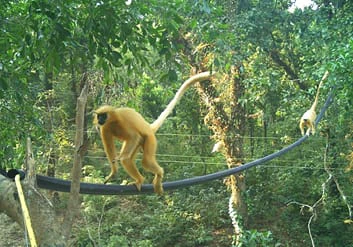

Guwahati: Artificial canopy bridges installed over a busy Assam highway have reduced road accidents involving the endangered golden langur by nearly 75%, offering a promising model for wildlife-friendly infrastructure in fragmented forest landscapes, a new study has found.
The findings emerge from research led by primatologist Jihosuo Biswas and wildlife biologist Joydeep Shil, along with Kanmaina Ray, Mehtab Uddin Ahmed, Dharma Kanta Ray, Amulya Boro, Puja Muchahary, Benjamin P. Dorsey and Honnavalli N. Kumara. The study has been published in the Journal of Wildlife Science (December 2025 issue).
The golden langur (Trachypithecus geei) is an obligate canopy-dwelling primate endemic to the Indo-Bhutan border region, occurring in four districts of western Assam and six districts of south-central Bhutan.
It is among the most range-restricted primate species in South Asia. More than half of its natural habitat has been lost in recent decades due to deforestation and land-use change.
The decline has been particularly severe in Assam's southern range, including parts of Kokrajhar district and Bongaigaon, where forests have been fragmented into isolated patches by agriculture, human settlements and infrastructure expansion. Recent estimates suggest that these fragmented forests support nearly 25% of India's total golden langur population.
Linear infrastructure such as highways and power transmission lines has created artificial gaps in forest canopies, forcing these arboreal primates to descend to the ground. This exposes them to high risks of vehicle collisions, electrocution and other anthropogenic threats.
Conducted along a 5.2-kilometre stretch of State Highway-14 in Kokrajhar district, the study documents how overhead canopy bridges enabled golden langurs to cross roads safely without descending to ground level.
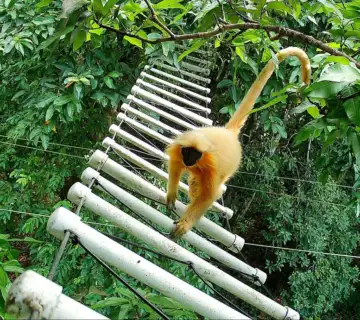
Between January 2023 and December 2024, researchers recorded 18 vehicle collisions involving golden langurs along this stretch, resulting in seven deaths and multiple serious injuries. To mitigate the risk, the team installed 15 artificial canopy bridges of different designs-pipe bridges, ladder bridges, rope bridges and hybrid structures-at identified animal crossing points.
Monitoring revealed rapid behavioural adaptation by the animals. Of 112 documented crossings during the study period, 74% occurred via the canopy bridges, with pipe bridges emerging as the most frequently used and effective structure. Following installation, ground-level crossings declined sharply, leading to a significant reduction in the risk of fatal road accidents.
The study notes that Kokrajhar district alone supports around 15% of India's golden langur population, making targeted conservation interventions in the region particularly critical for the species' long-term survival.
While the canopy bridges significantly reduced roadkill, the authors caution that such structures must be integrated with complementary measures including power-line insulation, vehicle speed regulation and habitat restoration to address other major threats, such as electrocution and genetic isolation.
The researchers also underscore the importance of local community participation in monitoring bridge use, maintaining awareness signage and restoring forest corridors. The study adds to growing global evidence that low-cost, species-specific canopy bridges can play a crucial role in conserving arboreal wildlife in rapidly developing, biodiversity-rich landscapes such as Northeast India.