
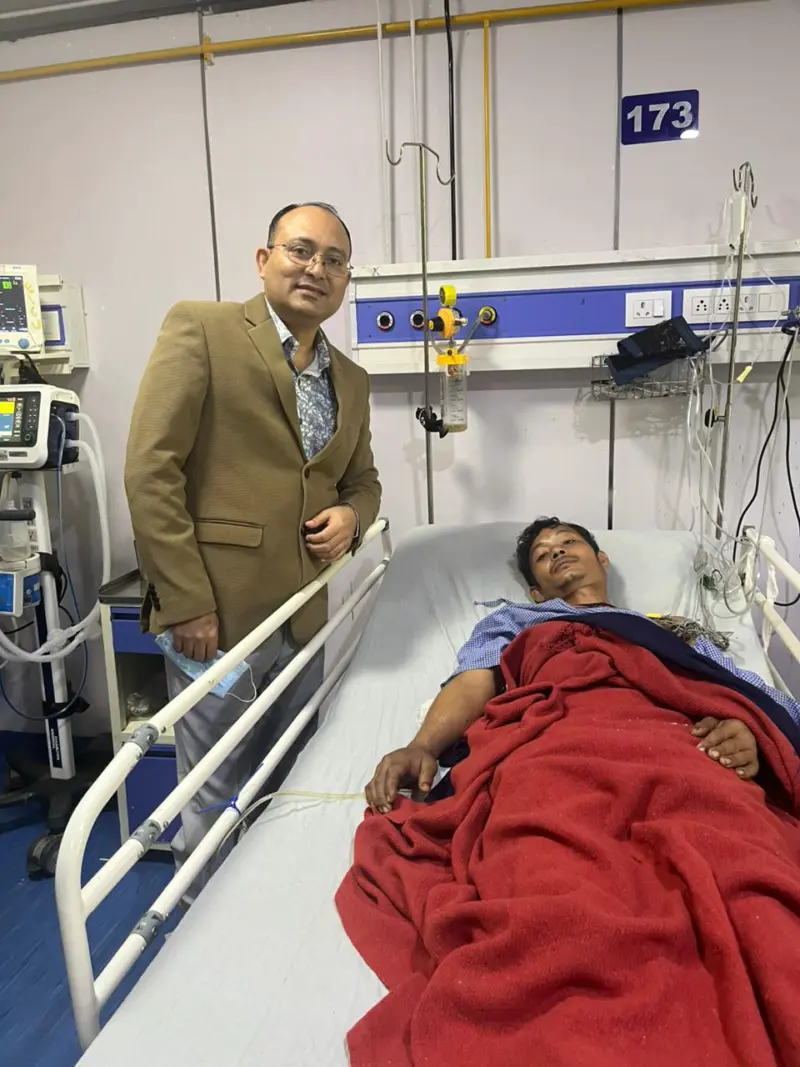

In a rare and remarkable medical outcome, Assam has recorded its first confirmed survival following a King Cobra (Ophiophagus hannah) bite, underscoring the life-saving impact of rapid response and coordinated healthcare systems.
The incident occurred on December 16 in Kamrup Rural district, when a male individual was bitten on the right palm while working in bushes. Unaware that he had grasped the head of a King Cobra, the man initially experienced only mild swelling and delayed reporting the incident. As pain and swelling progressed, the case was flagged through a local communication and surveillance network.
In an unusual turn of events, the victim reportedly captured the snake and secured it in a bag, enabling later photographic identification by trained snake rescuers.
The patient was swiftly transported by the Local Venom Response Team to Bamunigaon Model Hospital, a government-run community health centre, reaching the facility around 1:00 pm. Doctors administered 20 vials of polyvalent anti-snake venom (ASV) in response to suspected cobra envenomation. At the time, no neurotoxic or systemic symptoms were observed.
By 2:00 pm, snake rescuers confirmed the species as a King Cobra, one of the world's most venomous snakes and a species for which no specific antivenom exists. Given the high-risk nature of the bite, doctors immediately referred the patient to Gauhati Medical College and Hospital (GMCH) for advanced monitoring and intensive care. The transfer, covering a distance of about 1.5 hours, was carried out with seamless inter-facility coordination.
More than 24 hours after the bite, the patient remains clinically stable, exhibiting only local pain and swelling, with no neurotoxic or systemic complications-a highly unusual outcome in King Cobra envenomation cases.
Medical significance
Experts note that the survival may be attributed to factors such as low venom inoculation or a partial or dry bite, resulting in predominantly local effects rather than severe neurotoxicity. Documented King Cobra bites in India are extremely rare, and available literature suggests that most reported cases have been fatal.
"This case demonstrates that even in the absence of species-specific antivenom, timely medical intervention, early referral and coordinated teamwork can save lives," said a senior physician involved in the case.
Medical and response teams
The patient was initially treated at Bamunigaon Model Hospital by Dr Francis Rahang and Dr Vineet, and later managed at GMCH under Prof. Dr Raj Pratim Das and the Emergency ICU team.
Snake identification and support were provided by rescuers Bikash Boro, Rubul Rajbanshi and Mantu Rabha from Boko, Kamrup Rural. Overall coordination and oversight were led by Dr Surajit Giri, who personally interacted with the patient while attending a state-level snakebite management training programme for over 500 doctors in Assam during the same period.
A larger message
Health experts say the case sets an important precedent for Assam and the Northeast, highlighting how structured snakebite response systems, trained rescue networks and strong referral linkages can dramatically improve outcomes-even in rare and high-risk envenomations such as that of the King Cobra.
"This survival is not just a medical rarity-it is proof that organised preparedness saves lives," doctors said.
Kaladan project threatens indigenous culture in Mizoram, say experts