
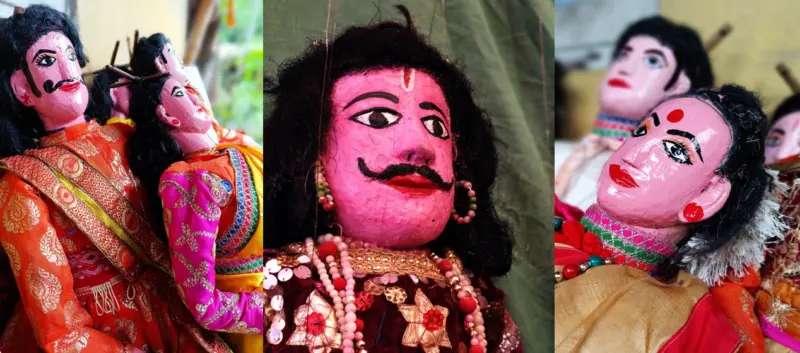

In Assam's Nalbari district, the number of artistes who perform the traditional Putola Naas is shrinking.
For most of the year, their puppets, which, on stage, become Krishna, a king, or characters from Devi Manasa, Raja Harishchandra, Shakuntala, Joymoti and Tezimola, are stored in trunks in their homes.
Performances are limited, often to festival seasons, a few times a year.
For generations, Putola Naas has been one of the ways communities in Assam have told stories through puppets, music and narration, bringing together mythology, folklore and social themes.
Rooted in the Vaishnavite cultural traditions shaped by Srimanta Sankardeva, the form has long been part of local festivals, devotional practices and community gatherings.
Today, it is sustained by small, close-knit troupes, typically made up of five to twelve members, many of whom have been performing since the 1990s.
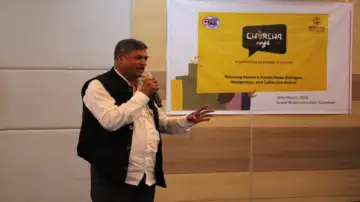 Pranab Sharma, Basudev Puppet Theatre, Nalbari.
 A recent study by the NAAT (New Age Actors' Theatre) Foundation, based on fieldwork across Kamrup and Nalbari, documents nine traditional puppetry troupes along with five contemporary groups working with the form in different ways.
It notes that the core skills of the craft, from making puppets and writing scripts to performing them, remain concentrated among a small group of experienced practitioners, with few structured pathways for younger people to enter the field.
"Not everyone involved in the show is a puppeteer. We put up a naat. There are singers involved, musicians involved," says Dhiren Thakuria, founder of Pallavi Puppet Theatre in Makhibaha, Nalbari, who has been engaged with the craft since 1987.
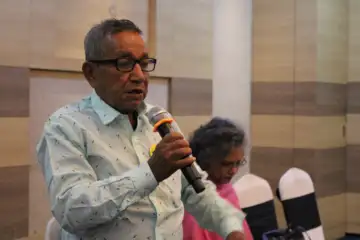 Lankeshwar Barman, Asomi Puppet Theatre, Nalbari.
"A simple puppet can cost around ₹5,000 to make, from sourcing the materials to stitching the costume," says Haradhan Chakraborty, co-founder of the Ma Manasa Puppet Theatre in Gandhiya, Nalbari. He has been involved in puppetry since 2004, though the troupe was formally registered only in 2018.
"In a mythological naat, we may need 20 to 25 characters. Just imagine the cost of the puppets alone."
Chakraborty now also works with government outreach programmes such as the Bharat Janabigyan Jatra, using puppetry to communicate social messages. For him, the expectations around the form have changed.
"There is no comparison between today's Putola Naas and what it used to be earlier," he says. "Young audiences today are different. They want to see something different."
Adapting, however, is not straightforward. "We have to change ourselves as the world around us changes. But we can only do that if we are financially strong enough to invest in those changes."
Music, which is central to the performance, reflects a similar shift. Traditionally, live accompaniment included instruments such as the harmonium, khol and taal, with musicians seated to one side of the stage, working in sync with the puppeteers and narrator.
"Earlier, we used to play harmonium. But now people demand an electric guitar, a Casio. But bringing in those changes is not straightforward. If we bring in a Casio player, we might have to give them ₹10,000 per show," says Thakuria.
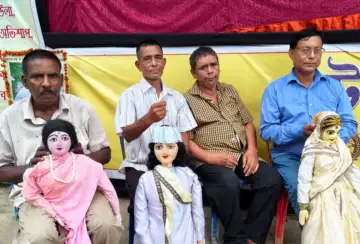 Nataraj Puppet Theatre, Nalbari. Image credit: NAAT Foundation
The changes are not limited to music. "We also get demands to reduce a two-hour naat into 30 minutes. We do agree to those demands," he says.
The financial strain becomes clearer when set against what a performance earns.
"On average, a show earns around ₹25,000. Almost ₹20,000 goes into costs like transport, puppet maintenance, payments to musicians, and basic sound and lighting," says Manoranjan Roy, founder of the Sagarika Putola Theatre in Khetri, Kamrup (Metro), established in 1998.
A typical troupe has around eight to ten members, and what remains is divided among them.
For most, that is not enough to rely on. Puppetry is rarely the only occupation for these artistes. Many take up other work, such as farming, daily wage labour or small businesses, returning to performances during festival seasons.
Roy estimates that only around 12 to 13 Putola Naas troupes remain active across Assam. Economics has also shaped who continues in the field.
"Why will our children or any youth come forward to do it if there is no financial stability?" says Thakuria. "No one wants to be a puppet artiste anymore."
The shift is visible within families. Ashok Barman grew up watching his father, Lankeshwar Barman, run the Asomi Puppet Theatre in Nalbari, established in 1987. Today, he works as a makeup artist in the film industry, returning to puppetry when he can.
"As a kid, I used to stitch clothes for the puppets and do their makeup. That's how I got interested," he says. "But we don't have regular shows now. Mostly, we get work during Raas or Durga Puja. Unless ticketed shows become regular again, there is no sustainable model to survive this." He still helps when he can, but like many others of his generation, he does not depend on it.
Beyond individual struggles, there are also structural gaps. According to practitioners and the NAAT study, only a small number of troupes-around two to three-are formally registered, limiting their access to government schemes and institutional support.
Access to welfare schemes remains uneven. While provisions such as the Shilpi Pension are meant to support senior artistes, only a few puppeteers have been able to receive it. Several others, despite decades of work, say they are still waiting.
"I am almost 70, but I have not received any pension yet," says Thakuria.
At the same time, the study points to a parallel shift towards contemporary puppetry practices.
One such group is Antaranga, a Guwahati-based collective founded in 2012 by puppetry artist Antara GG Choudhury.
Its work focuses on theatre-in-education, engaging young audiences through performances and workshops. Productions such as Minmin & Gungun, Bhim Charit and The Yellow Butterfly are designed to introduce storytelling through puppetry to children and students, often in collaboration with cultural institutions.
A different approach is seen in PuppetPeople Assam, founded in 2013, which works at the intersection of puppetry and social change. The collective uses forms such as string puppets, rod puppets and masks to address issues such as gender violence, health awareness and access to education.
Through productions such as Ou Kunwori and Panesoi, and performances in multiple local languages, the group engages with communities across Assam, often in partnership with NGOs and government programmes.
While these groups operate through institutional collaborations and project-based work, traditional troupes continue to navigate a system that remains difficult to access.
The NAAT Foundation study points to cultural bodies such as the Directorate of Cultural Affairs in Assam, the North East Zone Cultural Centre, and the Centre for Cultural Resources and Training as key institutions that support puppetry through performances, grants and training opportunities.
However, for many traditional troupes, this support remains inconsistent or out of reach, largely due to gaps in registration, documentation and awareness.
The study suggests that strengthening Putola Naas will require simplifying registration processes, creating artist collectives, expanding regular performance opportunities, and introducing training initiatives for younger practitioners.
Some of these concerns were also discussed at Charcha Café 2026, a convening held in Guwahati on March 30 that brought together puppetry artistes from across Assam.
The event, themed "Reviving Assam's Putola Naas - Dialogue, Recognition, and Collective Action," was organised by Roots to Branches Foundation in collaboration with the NAAT Foundation. Around two dozen artistes from multiple puppetry groups participated in discussions on the future of the art form.
Artists highlighted concerns around rising costs, irregular work, and limited access to institutional support, while also calling for stronger collectives, better access to schemes, and efforts to expand audiences beyond seasonal performances.
"If we get this kind of help, maybe it will bring some smiles to the puppeteers," says Thakuria.
For now, the performances continue. "On stage, a puppet playing a king is treated like one," says Deben Talukdar of the Srimanta Sankardev Putola Naas Dol in Nalbari. "But once the show ends, it goes back into a trunk. In many ways, our lives are no different."
Explained: Why SC pulled up the Centre on Northeast citizens' safety