
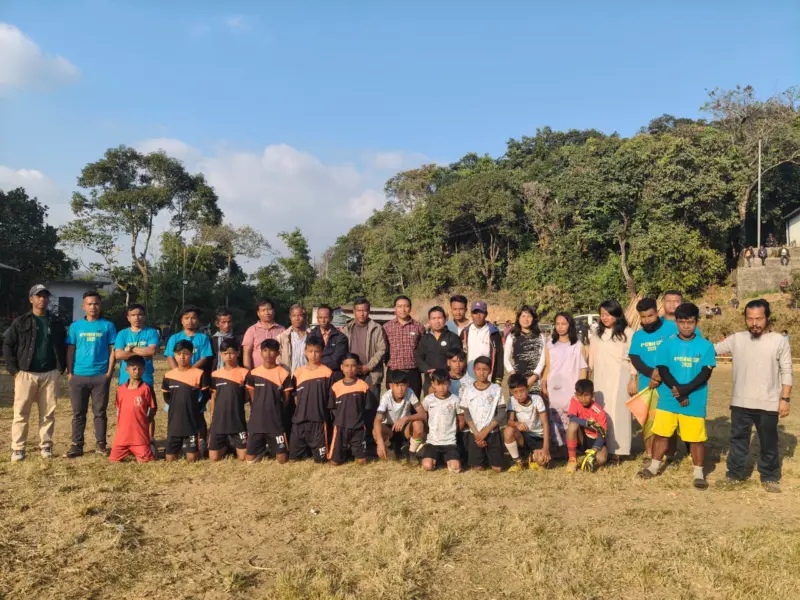

A few weeks ago, I was invited to be a guest of honour for the 4th Riwar Cup, organised in Tangmang village on 20 December 2025 by Pryshang Da Lade, a socio-economic organisation aimed at creating an alternative space for indigenous tribal communities, and the Tangmang Sports Association, in Meghalaya.
To reach the village, I had to cross Pynursla and negotiate the tricky stretches after Laitylyngkot until Lyngkyrdem, which are under construction for the Shillong-Dawki highway. In the last couple of years, the area has become infamous for massive landslides leading to loss of lives. The reason becomes clear as one travels through it.
Loose pebbles are scattered across the road, and piles of sand create a serious risk of skidding. Huge boulders are lying on the side of the newly dug road, with quite a few overhanging on the rock face, looking like they could fall on passersby at any time. In fact, around Rngain village, we saw a crane crushed under huge piles of boulders, a reminder of the danger faced by every commuter.
As someone who does not believe in the existence of an uncaring and jealous supernatural being, I wondered if my safety depended on discovering faith and then renouncing it later when I could get back home safely. But in the end, superstition never saved anyone, and I reached Pynursla safely, still faithless and spared from having to give in to delusion.
To reach Tangmang village, one had to take a detour from the Pynursla junction. Instead of taking the road that leads to Dawki, we took the road on the right to Nongjri, also located along the Indo-Bangladesh border. After travelling a few kilometres, we took another diversion to the left and continued for around 15 kilometres until we reached the village, passing a waterfall and some breathtaking views along the way.
I had been to the village more than ten years ago when I came with my team to collect data for a project on medium and small enterprises. We stayed only for a couple of days and slept in a classroom by joining benches together and covering them with blankets. This time, I had come just for a day.
Riwar Cup is a football tournament that brings together War Khasi villages to compete for the trophy. I am not sure, but I do not think War-Amlarem villages are currently taking part. Hopefully, in the future, all War Khasi villages-from Khasi Hills to Jaintia Hills-can compete in the tournament.
Maybe Jirang, which is also a War Khasi village in Ri Bhoi, can someday send a team. In this year's edition, there were eight teams each for boys and girls. All the players and their coaches stayed in the village during the three days of the competition, with accommodation arranged at Tangmang Secondary School.
During lunch, which was also served at the school, we saw sleeping bags spread across the floor, while a few tents had been put up on the compound. Everyone stayed together to foster a sense of unity and camaraderie among the participants.
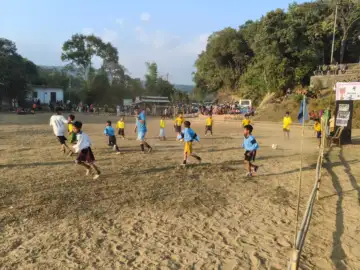
The matches themselves were quite competitive, and although I could attend only the final day, what I saw was truly impressive, especially the finals. In the boys' category, Nongthymmai and Pynter reached the final.
The first half was evenly matched until Nongthymmai eventually scored, after which the floodgates opened, with Pynter conceding a few more goals in the second half. What stood out about Nongthymmai was not just their skill but the organisation and tactical awareness with which they played.
It was classic "pass and move" football. An extra player was always available to relieve pressure, and the goals were examples of perfect teamwork: overlapping runs, cutting the ball inside, and passing to a player making a late run into the box to tap it home-simple yet highly effective.
Game management was also impressive, something that was missing in the Meghalaya versus Sikkim Santosh Trophy match, where Meghalaya allowed Sikkim to come back and win. It was clear that the players were well coached, and they executed their plans perfectly. Pynter gave their best, but the quality of the opposition proved too much.
The girls' final, between Nongmadan and Umsyiem, was far more evenly matched. Both teams fought hard, but neither could break through the other's defence. When loose balls broke inside the box, goalkeepers from both sides put their bodies on the line.
On one occasion, the young Nongmadan goalkeeper took a boot to her head while lying on the ground grappling to hold the ball. Tempers flared at times, with players quarrelling, but the Umsyiem coaching team did a commendable job in restoring calm and reinforcing respect for the spirit of the game.
It was evident that Umsyiem had received structured coaching. Their jerseys featured an attractive dark green patterned design, in contrast to Nongmadan's simple yellow-and-black stripes.
The players looked more athletic, and the coaching staff constantly instructed them on positioning and made frequent substitutions to keep them fresh.
Even before kickoff, while Nongmadan players practised shooting, Umsyiem's players were huddled around their coach, listening intently. Yet, once the game began, preparation alone did not decide the outcome, and both teams remained evenly matched until the final whistle.
I was particularly impressed by the Nongmadan goalkeeper-very young, light on her feet, with excellent ball-handling skills. When the match went to the tie-breaker, I felt Nongmadan had the edge because of her presence.
She made a superb point-blank save and almost stopped the final shot that eventually handed Umsyiem the trophy. Still, her reading of the game, quick footwork, and sheer bravery left a strong impression. Players from Umsyiem, if not already, will-and should-look to feature in the SSA women's league. I hope players from Nongmadan will also push themselves to see how far they can go.
Compared to the men, women footballers from Meghalaya are making rapid strides at the national level. Garhwal United FC won the Indian Women's League 2, the second-tier professional women's football league, earning promotion to the top division next season.
They did so with seven players from Meghalaya in their squad: Sanfida Nongrum, Fragrancy Riwan, Ribansi Jamu, Bonifilia Shullai, Banrisha Wahlang, Ribahunshisha Kharshiing, and Iaraplang Nongrum. If the team performs well next year and the players continue to progress, the state could soon see more representation at the national level. At present, Fragrancy Riwan and Ribansi Jamu are already part of the national team set-up.
One unique aspect of the trophy ceremony was the decision to invite elders of the community to present the trophies. This was suggested by Rothell Khongsit, Chairperson of the Meghalaya Rural Tourism Cooperative Federation, the chief guest.
What was disappointing, however, was that the runners-up trophies for both boys and girls were presented by women, while the winners' trophies were presented by men. What began as a mix-up was justified by someone shouting that the boys' trophy was the biggest and therefore should be presented by men.
Hopefully, such sexist remarks will not be encouraged in the future. Despite this isolated incident, the programme went smoothly and lasted late into the evening, after which I returned to Shillong.
Football is the most popular sport in the state, yet our achievements do not match our passion. We came close to winning the Santosh Trophy a few years ago but have failed to reach the final since, particularly in the men's category.
The rise of women's football, however, offers hope. It is tournaments like the Riwar Cup, and many others played across the state, that carry the promise that one day we might truly become champions.
(The views expressed in this article are those of the author and do not reflect, in any way, his affiliation to any organisation or institution.)
Bangladesh's strategic shift puts India's northeast in a geopolitical bind