

Two years after Manipur was consumed by the flames of May 3, 2023, a date now etched in the people's memory and the very architecture of everyday mistrust, the embers still burn, even if the world has looked away.
BJP Rajya Sabha MP Maharaja Leishemba Sanajaoba has declared that a "popular government" will rise in Manipur within two months, which is a hopeful declaration. It is also risky because it presumes that the prerequisites for democratic legitimacy will still be met, not because governance is undesirable. No, they don't.
The idea of a popular government presumes the existence of a demos, a political people who, despite disagreement, inhabit a shared moral universe. But what if that very idea of "the people" has fragmented beyond recognition? What if Manipur's political community has atomized into mutually exclusive sovereignties, Meitei, Kuki-Zomi, and Naga, not just territorially but epistemologically? Can a state govern when the governed no longer recognize each other?
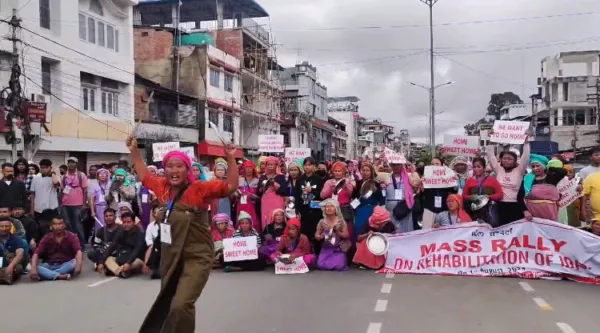
Perhaps one should ask that question in light of recent developments: the conclusion of the Shirui Lily Festival in Ukhrul, which, despite its cultural significance, unfolded amid underlying tensions, and the mass rally in Tamenglong, where thousands of indigenous residents led by the Joint Action Committee comprising Naga tribal councils demanded the protection of their ancestral lands, against state-imposed wildlife sanctuaries, reserve forests, and seismic surveys.
The protesters' slogans, "Our Land, Our Lives, Our Right" and "We Are Guardians, Not Encroachers," echoed a profound sense of dispossession. In Manipur today, governance often proceeds without genuine consent. It imposes decrees that marginalize indigenous voices.
What does it mean to govern a land where roads, rituals, and rights have all become contested terrain? In Manipur today, the question is not whether a popular government can be formed; the question is whether a popular government can be formed. It is whether there is still a people to whom it can be accountable.
The spectacle of a 'Popular Government'
To call for a "popular government" in Manipur today is to cling to the hollow shell of constitutional form long after its moral and political content has evaporated. The phrase presumes that demos, a collective political people capable of being represented, remain. But Manipur, two years after its collapse into open ethnic violence, no longer hosts such people. What remains is not polity but partition, mutually exclusive sovereignties inhabiting the same terrain but not the same political reality.
The recent plea by 21 MLAS, including from the BJP, NPP, and NPF, urging the Centre to restore elected rule is a gesture of political exhaustion rather than moral resolve. It reflects less a will to govern than a desperation to escape the ignominy of the President's Rule. These legislators, many of whom silently presided over the slow rot of democratic norms, now find themselves begging for restoration not because the crisis has subsided but because it has deepened beyond their reach.
Can a popular government be formed? Certainly in the narrowest, most technical sense. One can cobble together a ministry, administer oaths, and pass budgets. But can it be sustained? That is a different, more difficult question. Sustainability demands more than numerical strength in the Assembly. It requires a minimal consensus on coexistence. That consensus is absent.
Even if such a government were to be cobbled together, what would it govern? And for whom? Would it be a genuine political compact or merely an attempt to confer democratic legitimacy on the very apparatus that enabled state-sponsored polarisation?
The historical record leaves little doubt. Since 2017, under Chief Minister N. Biren Singh, the state apparatus has been weaponised for domination, not for integration. Arrests, intimidation, and narrative manipulation became routine instruments of control. Dissent, whether from the majority or the minority, was met with detention, police violence, or death. The state responded not as a neutral arbiter but as an ethnic actor, embedding a majoritarian logic into its administrative core.
What followed was not governance but choreography: a careful orchestration of fear and mistrust. Kuki-Zomi protesters who had opposed forest surveys and wildlife sanctuary declarations in Tamenglong before May 2023 were branded outsiders, accused of encroachment, and their demands for land rights dismissed as threats to state integrity. Now, in a bitter twist, it is the Naga communities of Tamenglong Zeme, Liangmai, Rongmei, and Inpui Naga Union who march in protest against the same state machinery, demanding the protection of their ancestral lands from the same forest declarations and seismic surveys they believe threaten their existence. The slogans carried in Tamenglong, "Our Land, Our Lives, Our Right" and "We Are Guardians, Not Encroachers", mirror those once raised by the Kuki-Zomi. But in a state fractured into exclusive sovereignties, solidarity dissolves. The roads may cross, but the struggles do not speak to each other.
The state did not collapse. It took sides. It is within this context that any proposal for a new popular government must be scrutinised. What will change when the same political actors return to power under a different constitutional cloak? If power continues to be exercised through the same ecosystem of vigilante groups, narrative repression, and majoritarian mobilisation, how is this government "popular" in anything but name?
What, then, would a popular government govern? Certainly not a united state. The Valley is governed by Meitei civil vigilantes who operate with impunity. The Hills remain under armed tribal control and the watch of central forces.
Trust cannot be legislated. Buffer zones cannot be passed into bridges by majority vote. Yet the BJP may reinstall a Chief Minister. They may conjure a cabinet from the ruins of consensus. However, the democratic legitimacy of such a government will be as fragile as the security convoys that now escort even MLAs to their constituencies. The same wine, in a bottle, is now more cracked than ever.
Sanajaoba Leishemba's claim that a new administration will "find a solution to the ethnic crisis" is either naivety or theatre. It ignores the fundamental truth that governance cannot produce justice when built atop impunity. No credible political solution can emerge from a government whose very authority rests on the fracture of the social contract. Unless the foundational injustices, the violation of land rights, the demonisation of minorities, and the erasure of dissent are reckoned with, governance will be reduced to a performance staged before an absent audience.
The tragedy of Manipur today is not simply that it lacks a government. The very architecture of state power has become inseparable from the production of division. Without confronting this architecture, the call for a "popular government" is not a promise of democracy but a prescription for déjà vu.
What Must Be Said
Manipur is not failing because it lacks a government. It is failing because it no longer shares a common political imagination. No festival can disguise that. No election can resolve it. No policy document, however well-crafted, can impose unity where the social contract has already fractured.
A popular government, if it is to mean anything, requires more than votes. It requires a compact between citizens: a belief that they belong to each other before they belong to a party, a tribe, or a nation. That compact is broken. The state exists, but the sense of shared belonging that animates a democracy does not. The roads are patrolled, the borders are redrawn, and festivals are organised. But the people remain estranged. Fear has replaced familiarity. Silence has replaced speech.
Today, Manipur is a state where people fear the road more than they fear the storm. Peace is not the absence of violence but the absence of voice. A festival is not a celebration but a fault line. And a government, no matter how "popular" in procedure, is met with averted eyes and locked doors.
If Manipur is to heal, it must begin not with speeches but with truth brutal, unvarnished truth. It must begin with an honest reckoning of what the state has become and what it has allowed to fester. Healing demands more than reconciliation between communities. It demands accountability from those who fractured the possibility of community in the first place.
A lot can be said. Policies can be drafted. Festivities can be held. A government can be formed. But none of these, on their own, will touch the ground. None will restore the neighbour who is now a stranger. None will undo the violence etched into the everyday.
The question is not whether a government will be formed in Manipur. It will be. The question is: will it matter? Because the real crisis is not that there is no state. It is that there is no longer a people to whom the state is answerable. And unless that truth is faced, what comes next will not be restoration; it will be repetition.
Views expressed are that of the author and do not reflect EastMojo's position on this or any other issue.
From boulders to biscuits: Dawki's trade holds steady amid import curbs