
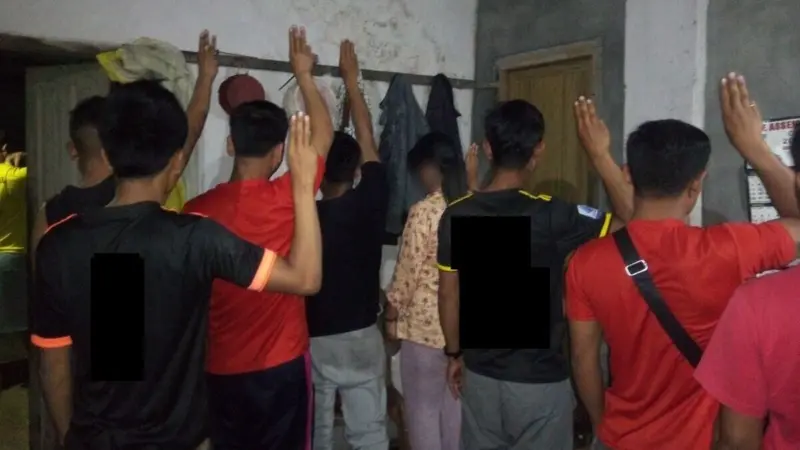

The Mizoram government has reported progress in biometric registration of displaced refugees, with Myanmar nationals' enrolment standing at 97.25 per cent and Bangladesh refugees at 21.23 per cent, according to state Home Department officials cited by Times of India.
However, questions remain over the reliability of these figures, as refugee population data in the state is inconsistent.
The report stated that 27,574 Myanmar refugees and 501 Bangladeshi refugees had been biometrically enrolled. According to a trusted source, the percentage of biometric data collected from Bangladeshi refugees remains low because officials in Lawngtlai district, where they form the majority, initially focused on Myanmar refugees. Authorities plan to collect biometric data from Bangladeshi refugees at a later stage.
The biometric exercise, launched on July 31, 2025, is the first official initiative to collect biometric data from refugees from Myanmar and Bangladesh.
Official estimates suggest that Mizoram is currently hosting around 28,355 refugees from Myanmar and 2,360 from Bangladesh's Chittagong Hill Tracts, totalling 30,715 displaced persons, which aligns with figures cited by officials when discussing biometric enrolment.
An official who requested anonymity stated, "Maintaining precise data is challenging because people are continually coming and going, so the numbers may not reflect the full picture."
RTI Reveals Gaps in Data Collection
An RTI filed by EastMojo in May 2025 exposed inconsistencies in how refugee counts are maintained and verified across Mizoram's districts.
Responses from seven districts show that data collection largely depends on village-level monitoring, with sporadic updates, non-uniform practices, and no centralised digital system.
In Saitual District, data was collected by the Deputy Commissioner's Office based on reports from Village Councils, with the last updates in January 2025.
In Aizawl District, data collection in relief camps was more structured, but outside the camps, Local Councils, Village Councils, and NGOs maintain separate records, leading to fragmented information.
Frequent relocation of refugees in Khawzawl, Serchhip, and Siaha districts further complicates accurate reporting. Some Village Council representatives remain inactive, and in Siaha, data is still collected through informal phone conversations.
Border districts such as Lawngtlai face challenges due to porous borders and ongoing Indo-Myanmar trade, complicating the monitoring of refugee movement. Hnahthial District cited lack of funding, irregular border crossings, and low awareness among refugees as obstacles to consistent data collection.
Officials noted that without a centralised, verifiable registration system, accurate refugee tracking is nearly impossible.
Myanmar Now Report Highlights Refugee Experiences
Areportby Myanmar Now offered ground-level insights from camps in Champhai district. The report said displaced persons were unaware of the purpose of the biometric enrolment, often referred to as a "refugee ID," and feared refusal could result in questioning or detention. Camp leaders maintained that registration was voluntary, but many felt compelled to comply.
The data collected includes photographs, fingerprints, and personal details, often the first such experience for refugees, who expressed concern about possible misuse.
As per the report, many people who spoke to Myanmar Now said the exercise might have been more effective if it had offered tangible benefits for refugees, such as access to further education.
As it stands, biometric registration offers no direct benefits to refugees. It does not allow them to travel or move freely, nor does it function as a valid form of identification in schools or in other places where official ID is required.
State-Centre Correspondence on Enrolment
In response to questions sent to the Chief Minister's Office regarding Mizoram's initial opposition and subsequent agreement to the Centre's proposal for biometric data collection of refugees, the Home Department provided a detailed explanation.
Communications between the Mizoram government and the Ministry of Home Affairs (MHA) show that the biometric exercise was contentious from the start. The state initially opposed it due to shared ethnic and cultural ties with the displaced Chin-Zo communities, and the Chief Minister sent a letter to the Union Home Minister in January 2024 highlighting concerns that the forms provided were designed for deportation, which could compromise the safety and dignity of the refugees.
After multiple rounds of discussion, the MHA redesigned the Foreigners Identification Portal to specifically address these concerns and training sessions for Deputy Commissioners and Superintendents of Police were conducted in Aizawl with the National Informatics Centre to ensure proper handling of the data.
Mizoram's refugee biometric enrolment is progressing, but questions over data accuracy and centralisation continue to spark debate among officials and civil society. An official of the Mizo Zirlai Pawl told EastMojo, "The biometric data should be centralised and digitised, and used at all border points to effectively track and manage the displaced population."
Beyond religion: Rethinking tribal rights and constitutional safeguards